 Back
BackChapter 7: Periodic Properties of the Elements – Study Notes
Study Guide - Smart Notes
 Tailored notes based on your materials, expanded with key definitions, examples, and context.
Chapter 7: Periodic Properties of the Elements
7.1 Development of the Periodic Table
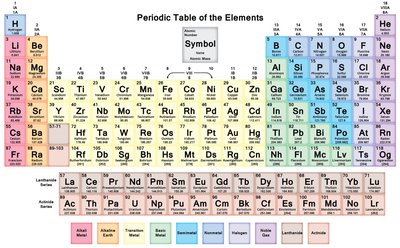
The periodic table is a systematic arrangement of the chemical elements, reflecting recurring trends in their chemical and physical properties. Its development was a major milestone in chemistry, allowing scientists to predict the properties of elements yet to be discovered.
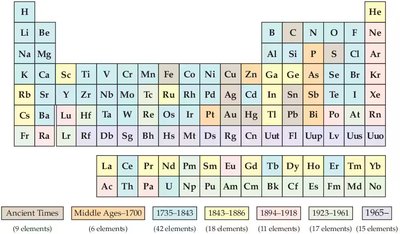
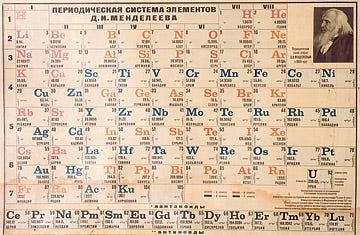
Historical Development: Early attempts by Mendeleev and Meyer arranged elements by increasing atomic weight, but some elements did not fit well.
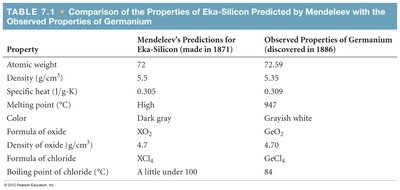
Mendeleev's Predictions: Mendeleev left gaps for undiscovered elements and predicted their properties with remarkable accuracy, such as "eka-silicon" (germanium).
Modern Table: The modern periodic table arranges elements by increasing atomic number, which resolved previous inconsistencies.
Property | Mendeleev's Prediction (Eka-Silicon) | Observed (Germanium) |
|---|---|---|
Atomic weight | 72 | 72.59 |
Density (g/cm³) | 5.5 | 5.35 |
Specific heat (J/g·K) | 0.305 | 0.309 |
Melting point (°C) | High | 947 |
Color | Dark gray | Grayish white |
Formula of oxide | XO2 | GeO2 |
Density of oxide (g/cm³) | 4.7 | 4.70 |
Formula of chloride | XCl4 | GeCl4 |
Boiling point of chloride (°C) | A little under 100 | 84 |
7.2 Effective Nuclear Charge
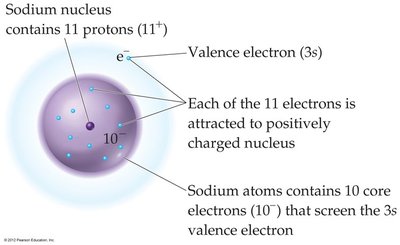
In multi-electron atoms, electrons experience both attraction to the nucleus and repulsion from other electrons. The effective nuclear charge (Zeff) is the net positive charge experienced by an electron, accounting for both effects.
Formula: where is the atomic number and is the screening constant (approximate number of inner electrons).
Shielding Effect: Inner electrons shield outer electrons from the full nuclear charge, reducing Zeff.
Trends: As the number of screening electrons increases, Zeff decreases. Zeff also decreases with increasing distance from the nucleus.
7.3 Sizes of Atoms and Ions
Atomic Radii
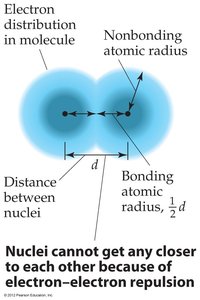
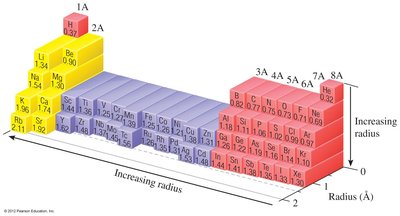
The bonding atomic radius is defined as half the distance between the nuclei of two covalently bonded atoms. Atomic size is influenced by effective nuclear charge and principal quantum number.
Trends: Atomic radius decreases from left to right across a period (due to increasing Zeff) and increases from top to bottom within a group (due to increasing principal quantum number, n).
Ionic Radii
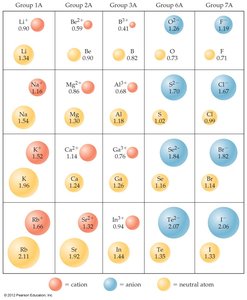
Ionic size depends on nuclear charge, number of electrons, and the orbitals occupied by electrons.
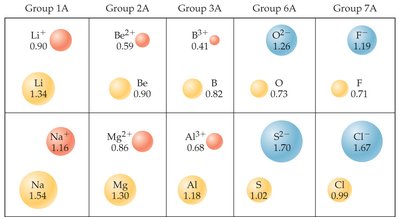
Cations are smaller than their parent atoms (loss of electrons reduces electron-electron repulsion).
Anions are larger than their parent atoms (gain of electrons increases repulsion).
Trends: Ionic size increases down a group. In an isoelectronic series (ions with the same number of electrons), size decreases with increasing nuclear charge.
7.4 Ionization Energy
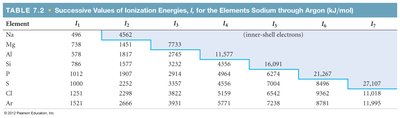
Ionization energy (IE) is the energy required to remove an electron from a gaseous atom or ion. The first ionization energy (I1) removes the first electron; the second (I2) removes the second, and so on.
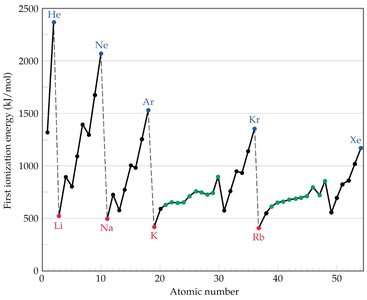
Trends: IE decreases down a group and generally increases across a period (due to increasing Zeff).
Successive Ionization Energies: Each successive electron requires more energy to remove, with a sharp increase after all valence electrons are removed.
Exceptions: Discontinuities occur between Groups IIA/IIIA and VA/VIA due to electron configuration effects.

7.5 Electron Affinities
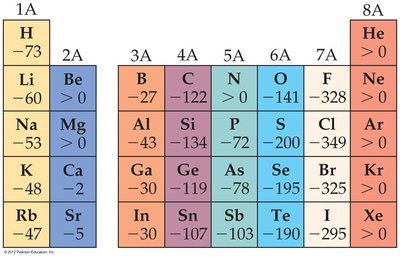
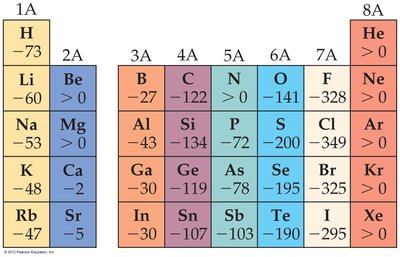
Electron affinity (EA) is the energy change when an electron is added to a gaseous atom. A negative value indicates energy is released (exothermic), while a positive value means energy is required (endothermic).
Trends: EA generally becomes more exothermic across a period, with exceptions between Groups IA/IIA and IVA/VA due to electron configuration and repulsion effects.
Noble Gases: Have positive electron affinities; they do not form stable anions.
7.6 Metals, Nonmetals, and Metalloids
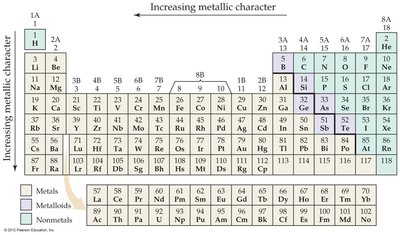
Elements are classified as metals, nonmetals, or metalloids based on their physical and chemical properties.
Metals: Shiny, malleable, good conductors, tend to form cations, and have basic oxides.
Nonmetals: Dull, brittle, poor conductors, tend to form anions, and have acidic oxides.
Metalloids: Exhibit properties intermediate between metals and nonmetals (e.g., silicon).
Trends: Metallic character increases down a group and decreases across a period.
Metals | Nonmetals |
|---|---|
Shiny, various colors Good conductors Malleable, ductile Form basic oxides Form cations in solution | No luster, various colors Poor conductors Brittle (some hard, some soft) Form acidic oxides Form anions in solution |
7.7 Trends for Group 1A and Group 2A Metals
Group 1A: Alkali Metals
Soft, metallic solids with low densities and melting points.
Highly reactive, especially with water, forming hydroxides and hydrogen gas.
Reactivity increases down the group.
Form M+ ions and are found only in compounds in nature.
Group 2A: Alkaline Earth Metals
Harder, denser, and higher melting points than alkali metals.
Less reactive than alkali metals, but reactivity increases down the group.
Form M2+ ions; some react with water (except Be and Mg under normal conditions).
7.8 Trends for Selected Nonmetals
Hydrogen
Exists as H2 gas; can form H+ (proton) or H- (hydride) ions.
Unique chemistry, not fitting neatly into any group.
Group 6A: The Oxygen Group
Oxygen exists as O2 (dioxygen) and O3 (ozone).
Metallic character increases down the group (O2 is a gas, Te is a metalloid, Po is a metal).
Sulfur forms S8 rings and S2- ions; is a weaker oxidizer than oxygen.
Group 7A: The Halogens
Highly reactive nonmetals, exist as diatomic molecules (X2).
Large, negative electron affinities; strong oxidizers.
React with metals to form salts (halides).
Group 8A: The Noble Gases
Very high ionization energies and positive electron affinities.
Monatomic, colorless, and chemically inert under standard conditions.
Some compounds of Xe and Kr have been synthesized.
