 Back
Chapter 7: Periodic Properties of the Elements – Structured Study Notes
Study Guide - Smart Notes
 Tailored notes based on your materials, expanded with key definitions, examples, and context.
Periodic Properties of the Elements
Development of the Periodic Table
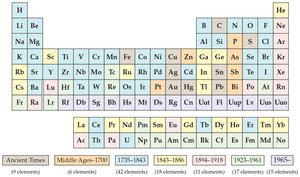
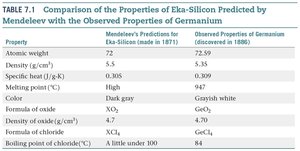
The periodic table is a fundamental tool in chemistry, organizing elements according to their properties and atomic structure. Dmitri Mendeleev and Lothar Meyer independently proposed grouping elements based on similarities in their properties. Mendeleev is credited for using chemical properties and predicting the existence and properties of undiscovered elements, such as germanium.
Atomic Number and Periodicity
Mendeleev's table was originally based on atomic masses, but the discovery of the nuclear atom by Rutherford and the concept of atomic number by Moseley established the number of protons as the basis for periodic properties. Periodicity refers to the recurring pattern of element properties as a function of atomic number. Key periodic properties include atomic and ionic sizes, ionization energy, electron affinity, and group chemical trends.
Effective Nuclear Charge (Zeff)
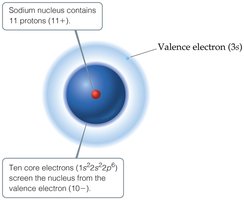
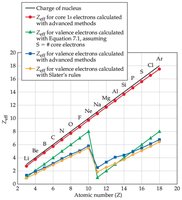
The effective nuclear charge is the net positive charge experienced by valence electrons, accounting for both attraction to the nucleus and repulsion by inner electrons. It is calculated as:
Formula: where Z is the atomic number and S is the screening constant (approximate number of inner electrons).
Trend: Zeff increases across a period and slightly increases down a group.
Atomic and Ionic Sizes
Atomic Radius
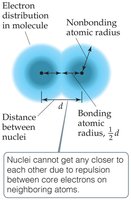
The atomic radius can be defined in two ways:
Nonbonding atomic radius (van der Waals radius): Half the shortest distance between nuclei during atomic collisions.
Bonding atomic radius (covalent radius): Half the distance between nuclei in a bond.
Trends in Atomic Size
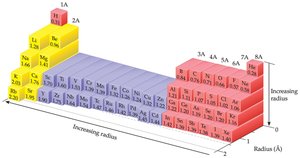
Atomic size varies systematically across the periodic table:
Decreases from left to right across a period (due to increasing Zeff).
Increases from top to bottom within a group (due to increasing principal quantum number n).
Sizes of Ions
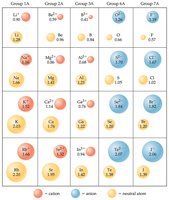
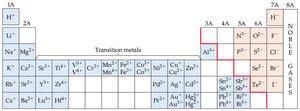
Ionic size is determined by interatomic distances in ionic compounds and depends on nuclear charge, number of electrons, and electron orbital occupancy.
Cations are smaller than their parent atoms (loss of electrons reduces repulsion).
Anions are larger than their parent atoms (gain of electrons increases repulsion).
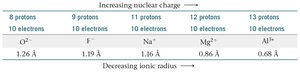
Isoelectronic Series
An isoelectronic series consists of ions with the same number of electrons. Within such a series, ionic size decreases as nuclear charge increases.
Ionization Energy
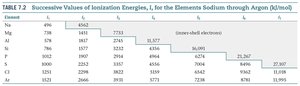
Definition and Successive Ionization Energies
Ionization energy (I) is the minimum energy required to remove an electron from a gaseous atom or ion. The first ionization energy (I1) removes the first electron; subsequent ionization energies remove additional electrons. Each successive electron requires more energy, especially after all valence electrons are removed.
Periodic Trends in Ionization Energy
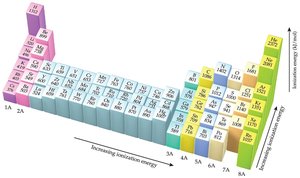
I1 generally increases across a period.
I1 generally decreases down a group.
s- and p-block elements show larger ranges; d- and f-block elements vary less.
Factors Influencing Ionization Energy
Smaller atoms have higher ionization energies.
Depends on effective nuclear charge and average electron-nucleus distance.
Irregularities in Ionization Energy Trends
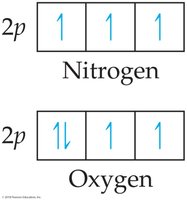
Irregularities occur when the added valence electron enters a new sublevel or is the first to pair in an orbital, causing electron repulsions and lowering energy.
Electron Configurations and Electron Affinity
Electron Configurations of Ions
Cations: Electrons are lost from the highest energy level (n value).
Anions: Electron configurations are filled to ns2np6.
Electron Affinity
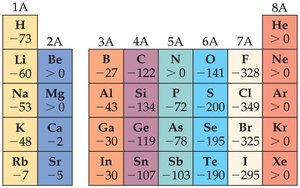
Electron affinity is the energy change when an electron is added to a gaseous atom. It is typically exothermic (negative value), but some elements have positive electron affinities (unstable anions).
General trend: Increases across a period, little change down a group.
Exceptions: Group 2A (full s sublevel), Group 5A (half-full p sublevel), Group 8A (full p sublevel).
Metals, Nonmetals, and Metalloids
Classification and Properties
Elements are classified as metals, nonmetals, or metalloids based on their physical and chemical properties.
Metals
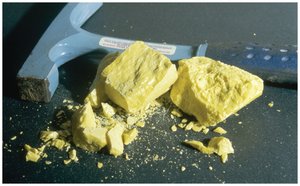
Form cations, have shiny luster, conduct heat and electricity, are malleable and ductile, and are solids at room temperature (except mercury).
Low ionization energies.
Metal Chemistry
Compounds with nonmetals tend to be ionic.
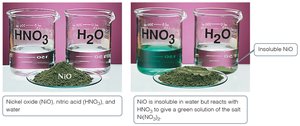
Metal oxides are basic and react with acids.

Nonmetals
Found on the right side of the periodic table.
Can be solid, liquid, or gas; solids are dull, brittle, poor conductors.
Large negative electron affinity; form anions readily.
Nonmetal Chemistry
Substances containing only nonmetals are molecular compounds.
Most nonmetal oxides are acidic.
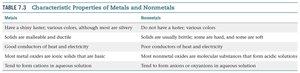
Comparison of Metals and Nonmetals
Metals | Nonmetals |
|---|---|
Shiny luster, various colors | No luster, various colors |
Solids are malleable and ductile | Solids are usually brittle |
Good conductors of heat and electricity | Poor conductors |
Basic oxides | Acidic oxides |
Form cations in aqueous solution | Form anions or oxyanions |
Metalloids
Exhibit properties intermediate between metals and nonmetals.
Several are electrical semiconductors (important in electronics).
Group Trends in the Periodic Table
Alkali Metals (Group 1A)
Soft, metallic solids; found only in compounds in nature.
Low densities, melting points, and ionization energies.

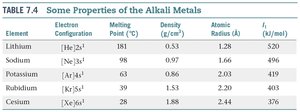
Alkali Metal Chemistry
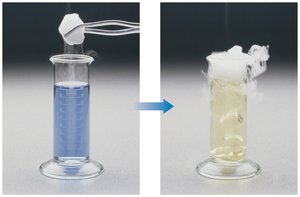
Reactions with water are highly exothermic.
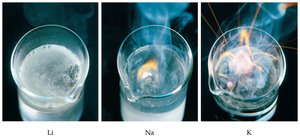
Differences in Alkali Metal Chemistry
Lithium forms oxides, sodium forms peroxides, potassium/rubidium/cesium form superoxides with oxygen.
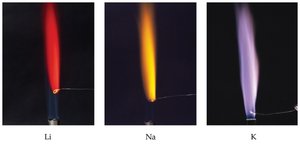
Flame Tests for Alkali Metals
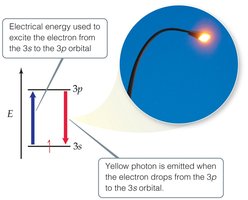
Alkali metals produce characteristic flame colors due to electronic transitions.
Alkaline Earth Metals (Group 2A)
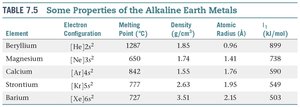
Higher densities and melting points than alkali metals.
Low ionization energies; readily form +2 cations.
Alkaline Earth Metal Chemistry
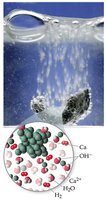
Beryllium does not react with water; magnesium reacts only with steam; others react readily with water.
Reactivity increases down the group.
Group 6A Elements
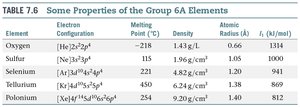
Oxygen, sulfur, selenium are nonmetals; tellurium is a metalloid; polonium is a metal.
Metallic character increases down the group.
Allotropes of Oxygen
Oxygen exists as O2 (dioxygen) and O3 (ozone).
Group 7A – Halogens
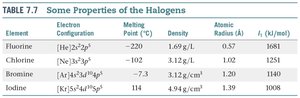
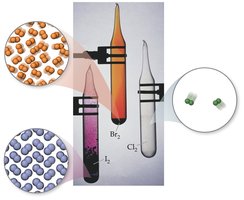
Typical nonmetals with highly negative electron affinities; exist as anions in nature.
React directly with metals to form halides.
Group 8A – Noble Gases
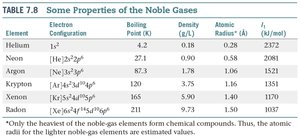
Very large ionization energies; positive electron affinities (do not form stable anions).
Relatively unreactive; found as monatomic gases.
Hydrogen
Electron configuration is 1s1, similar to alkali metals, but hydrogen is a nonmetal.
Forms H+ in acids (covalent compounds) and H– (hydride) when reacting with metals.
Additional info: Academic context and explanations have been expanded for clarity and completeness. All tables have been recreated in HTML format, and only directly relevant images have been included.
