Back
Chapter 7 - Reactions in Aqueous Solution: Study Notes
Study Guide - Smart Notes
 Tailored notes based on your materials, expanded with key definitions, examples, and context.
Chapter 7 - Reactions in Aqueous Solution
LT7.1 Electrolyte Classification
Electrolytes are substances that, when dissolved in water, produce ions and thus conduct electricity. Their classification is essential for understanding their behavior in aqueous solutions.
Strong Electrolytes: Completely dissociate into ions in solution (e.g., NaCl, HNO3).
Weak Electrolytes: Partially dissociate, producing fewer ions (e.g., CH3COOH).
Non-Electrolytes: Do not produce ions; remain as molecules (e.g., sugar, ethanol).
Representation: Use the aqueous subscript (aq) and show dissociation as ions or molecules. For example, .
Particle Diagrams: Visualize ions and molecules in solution to distinguish between strong, weak, and non-electrolytes.
LT7.2 Net Ionic Equations
Net ionic equations focus on the species that actually participate in a chemical reaction, omitting spectator ions. Understanding these equations is crucial for classifying reaction types.
Full Ionic Equation: Shows all ions present in solution.
Net Ionic Equation: Shows only the ions and molecules directly involved in the reaction.
Spectator Ions: Ions that do not participate in the reaction and remain unchanged.
Classification: Reactions can be precipitation, acid-base, or redox.
Example: For the reaction between NaCl and AgNO3: Full ionic: Net ionic:
LT7.3 Precipitation Reactions
Precipitation reactions occur when two solutions are mixed and an insoluble product (precipitate) forms. Solubility rules help predict these outcomes.
Solubility Rules: Guidelines to determine if a compound is soluble or insoluble in water.
Predicting Precipitates: When two soluble salts are mixed, an insoluble salt may form as a precipitate.
Net Ionic Equation: Write the equation for the formation of the precipitate, omitting spectator ions.
Example: Mixing BaCl2 and Na2SO4:
LT7.4 Acid-Base Neutralization
Acid-base neutralization reactions involve the reaction of an acid and a base to form water and a salt. Identifying strong and weak acids/bases is key to writing net ionic equations.
Strong Acids: HCl, HNO3, H2SO4 (completely dissociate).
Strong Bases: NaOH, KOH (completely dissociate).
Net Ionic Equation: For strong acid and strong base:
Weak Acids/Bases: Partially dissociate; net ionic equations may include undissociated molecules.
LT7.5 Oxidation Numbers
Oxidation numbers are assigned to atoms in compounds to track electron transfer in redox reactions. This helps identify which element is oxidized and which is reduced.
Rules: Memorized rules for assigning oxidation numbers (e.g., elements = 0, oxygen = -2, hydrogen = +1).
Oxidation: Increase in oxidation number; loss of electrons.
Reduction: Decrease in oxidation number; gain of electrons.
Example: In , Zn is oxidized, Cu2+ is reduced.
LT7.6 Activity Series
The activity series is a list of elements organized by their ability to be oxidized. It is used to predict whether a redox reaction will occur and to identify the oxidizing agent.
Activity Series: Metals higher in the series will displace metals lower in the series from solution.
Predicting Redox Reactions: Use the series to determine if a reaction is spontaneous.
Oxidizing Agent: The species that causes oxidation by accepting electrons.
Example: occurs because Zn is above Cu in the activity series.
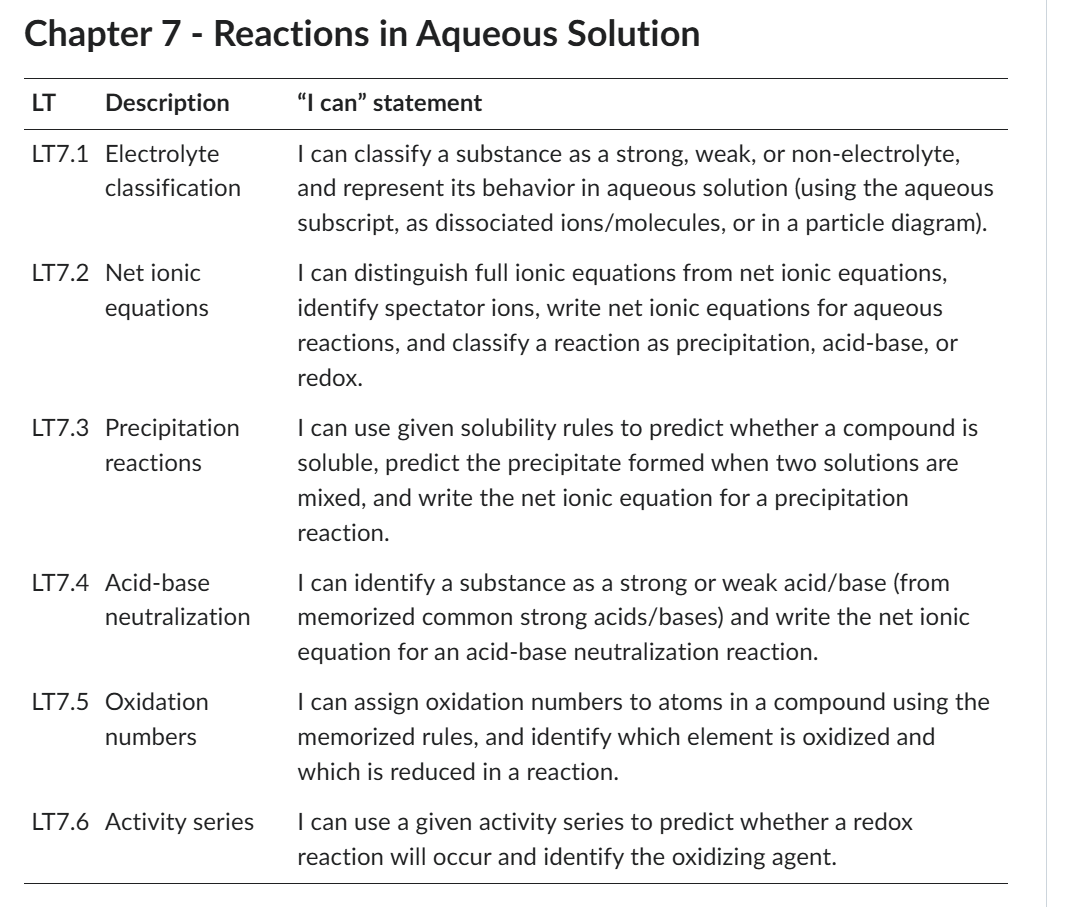
LT | Description | “I can” statement |
|---|---|---|
LT7.1 | Electrolyte classification | I can classify a substance as a strong, weak, or non-electrolyte, and represent its behavior in aqueous solution (using the aqueous subscript, as dissociated ions/molecules, or in a particle diagram). |
LT7.2 | Net ionic equations | I can distinguish full ionic equations from net ionic equations, identify spectator ions, write net ionic equations for aqueous reactions, and classify a reaction as precipitation, acid-base, or redox. |
LT7.3 | Precipitation reactions | I can use given solubility rules to predict whether a compound is soluble, predict the precipitate formed when two solutions are mixed, and write the net ionic equation for a precipitation reaction. |
LT7.4 | Acid-base neutralization | I can identify a substance as a strong or weak acid/base (from memorized common strong acids/bases) and write the net ionic equation for an acid-base neutralization reaction. |
LT7.5 | Oxidation numbers | I can assign oxidation numbers to atoms in a compound using the memorized rules, and identify which element is oxidized and which is reduced in a reaction. |
LT7.6 | Activity series | I can use a given activity series to predict whether a redox reaction will occur and identify the oxidizing agent. |