 Back
Chapter 7: Thermochemistry – Energy and Chemical Reactions
Study Guide - Smart Notes
 Tailored notes based on your materials, expanded with key definitions, examples, and context.
Thermochemistry: The Study of Energy in Chemistry
Nature of Energy
Energy is a fundamental concept in chemistry, influencing the behavior and properties of matter. Thermodynamics is the study of energy and its interconversions, while thermochemistry focuses on the relationships between chemistry and energy. Energy is defined as the ability to do work or transfer heat, and it can be exchanged between objects through contact, such as collisions.
Work: Force acting over a distance. Formula:
Heat: Flow of energy caused by a difference in temperature.
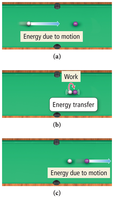
Energy, Heat, and Work
Energy is a quantity that an object can possess, while heat and work are the two primary ways that energy is exchanged between objects.
Classification of Energy
Energy can be classified into different types:
Kinetic Energy: Energy of motion or energy being transferred.
Thermal Energy: Energy associated with temperature; a form of kinetic energy.
Potential Energy: Energy stored in an object, associated with its composition and position.
Chemical Energy: Potential energy due to the structure of atoms, attachments between atoms, and their positions.
Electrostatic Potential Energy: Arises from interactions between charged particles. Formula: , where is a constant, and are charges, and is the distance.
Units of Energy
Energy is measured in several units:
Joule (J): The energy required for a one Newton force to move an object one meter.
Calorie (cal): The energy needed to raise the temperature of one gram of water by 1°C.
kilocalorie (kcal): Energy needed to raise 1000 grams of water by 1°C; used in food Calories.
First Law of Thermodynamics
Energy Conservation
The First Law of Thermodynamics states that energy can be converted from one form to another, but it cannot be created or destroyed. The total energy of the universe remains constant; if one object loses energy, another must gain it.
System and Surroundings
In thermochemistry, the system is the specific portion of the universe being studied, while the surroundings are everything else. Systems can be:
Open: Exchange mass and energy with surroundings.
Closed: Exchange energy but not mass.
Isolated: No exchange of mass or energy.
System + Surroundings = Universe
Energy Flow and Conservation
The symbol denotes change (final amount minus initial amount). Conservation of energy requires that the sum of energy changes in the system and surroundings must be zero.
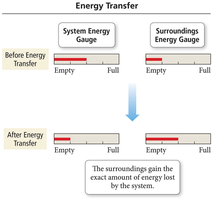
Internal Energy and State Functions
Internal Energy
The internal energy (E) of a system is the sum of the kinetic and potential energies of all particles in the system.
State Function
A state function is a property whose value depends only on the initial and final states, not on the path taken. Examples include internal energy, enthalpy, and altitude.

Energy Diagrams
Energy diagrams visually represent the direction of energy flow during a process. If reactants have less internal energy than products, the change in energy is positive; if more, the change is negative.
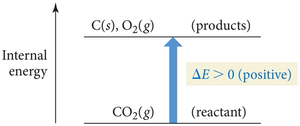
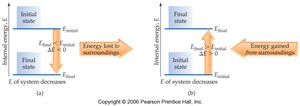
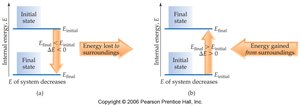
Energy Flow in Chemical Reactions
Energy Exchange
Energy is exchanged between the system and surroundings through heat (q) and work (w). Both are not state functions; their values depend on the process.

Heat Exchange and Thermal Equilibrium
Heat is the exchange of thermal energy between a system and its surroundings, occurring when there is a temperature difference. Energy flows from higher to lower temperature until thermal equilibrium is reached.
Heat Capacity and Specific Heat
Heat Capacity
When a system absorbs heat, its temperature increases. The proportionality constant is called heat capacity (C), measured in J/°C or J/K. The larger the heat capacity, the smaller the temperature rise for a given amount of heat.
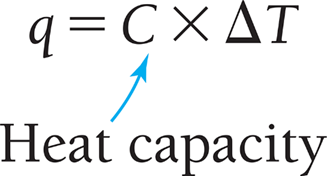
Factors Affecting Heat Capacity
Amount of matter (mass)
Type of material
Specific Heat Capacity
The specific heat capacity (C_s) is the amount of heat required to raise the temperature of one gram of a substance by 1°C. The molar heat capacity is the amount required for one mole.
Specific Heat of Water
Water has a high specific heat capacity, allowing it to absorb significant heat energy with minimal temperature increase. This property keeps coastal areas cooler and is why water is used as a coolant.

Quantifying Heat Energy
The heat absorbed by an object is proportional to its mass, specific heat, and temperature change:
Formula:
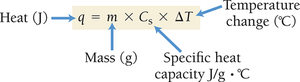
Thermal Energy Transfer
Heat Transfer Between Objects
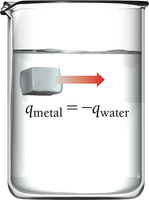
When two objects at different temperatures are in contact, heat flows from the hotter to the colder object. The heat lost by the hot material equals the heat gained by the cold material.
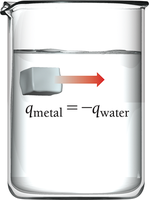
Example: Aluminum and Water
A 32.5 g cube of aluminum at 45.8°C is submerged in 105.3 g of water at 15.4°C. The final temperature at thermal equilibrium can be calculated using:
Pressure–Volume Work
PV Work
Pressure–volume (PV) work is caused by a volume change against an external pressure. When gases expand, is positive, and the system does work on the surroundings, making negative. The formula is:
Calorimetry
Measuring Internal Energy Change
Calorimetry measures thermal energy exchange between a reaction (system) and its surroundings. At constant volume, , and the heat measured in the surroundings equals the negative of the heat of the system.
Bomb Calorimeter
A bomb calorimeter is used to measure for combustion reactions at constant volume. The heat capacity of the calorimeter is called the calorimeter constant ().
Enthalpy and Enthalpy Change
Enthalpy (H)
Enthalpy is the sum of the internal energy and the product of pressure and volume. It is a state function. The enthalpy change () is the heat involved in a reaction at constant pressure:
(at constant pressure)
Endothermic and Exothermic Reactions
Endothermic: ; heat absorbed by the system.
Exothermic: ; heat released by the system.
Enthalpy of Reaction and Calorimetry at Constant Pressure
Enthalpy of Reaction ()
is an extensive property, calculated for the number of moles of reactants as written. The formula is:
Calorimetry at Constant Pressure
Reactions in aqueous solution are typically at constant pressure. The calorimeter is often a nested foam cup. The enthalpy change per mole is calculated by dividing the heat measured by the number of moles reacted.
Relationships Involving Enthalpy Change
Hess’s Law
If a reaction can be expressed as a series of steps, the overall is the sum of the heats of reaction for each step.
Standard Enthalpies of Formation
Standard State and Enthalpy Change ()
The standard state is defined for pure substances at 1 atm and 25°C. The standard enthalpy change () is the enthalpy change when all reactants and products are in their standard states. The standard enthalpy of formation () is the enthalpy change for forming 1 mole of a compound from its elements in their standard states.
Example: Combustion of Octane
To calculate the enthalpy change for the combustion of octane, use the standard enthalpies of formation for all reactants and products, and apply the formula above.
Summary Table: Types of Energy and Their Properties
Type of Energy | Description | Formula |
|---|---|---|
Kinetic Energy | Energy of motion | |
Potential Energy | Energy stored due to position/composition | |
Thermal Energy | Energy associated with temperature | Depends on kinetic energy of particles |
Chemical Energy | Energy stored in chemical bonds | Varies by molecular structure |
Electrostatic Potential Energy | Energy from charged particle interactions |
