 Back
Chapter 7: Thermochemistry – Energy, Heat, and Enthalpy in Chemical Reactions
Study Guide - Smart Notes
 Tailored notes based on your materials, expanded with key definitions, examples, and context.
Thermochemistry
The Nature of Energy
Thermochemistry is the study of energy changes, particularly heat, that accompany chemical reactions. Understanding energy is fundamental to predicting how and why reactions occur.
Energy: The capacity to do work.
Kinetic Energy: Energy of motion.
Potential Energy: Energy due to position or stored energy.
Chemical Energy: A type of potential energy stored in chemical bonds.
Thermal Energy: Associated with the temperature of an object.
Law of Conservation of Energy: Energy cannot be created or destroyed, only transferred.
Work (w): Force multiplied by distance.
Heat (q): Energy transferred from a hotter object to a cooler one.
Units of Energy: Joule (J), calorie (cal), kilowatt-hour (kWh).
Example: 1 calorie is the energy needed to raise 1 g of water by 1°C, equivalent to 4.184 J.
The First Law of Thermodynamics
The First Law states that the total energy of the universe is constant. In chemical reactions, energy is transferred between the system and its surroundings.
System: The part of the universe under study (e.g., a beaker of water).
Surroundings: Everything outside the system (e.g., air, hot plate).
Internal Energy (E): The sum of all kinetic and potential energies in the system.
State: Defined by composition, temperature, and pressure.
State Properties: Depend only on the state, not the path (e.g., volume, density).
Change in Internal Energy (ΔE):
ΔE = q + w: Internal energy change equals heat plus work.
Exothermic Process: (energy released).
Endothermic Process: (energy absorbed).
Temperature vs. Heat: Temperature measures thermal energy; heat is the transfer of thermal energy.

Quantifying Heat and Work
Heat Capacity and Specific Heat
Heat capacity and specific heat are essential for quantifying how much heat is required to change the temperature of a substance.
Heat Capacity (C): Amount of heat needed to raise the temperature of a system by 1°C. Units: J/°C.
Specific Heat (Cs): Amount of heat needed to raise 1 g of a substance by 1°C. Intensive property.
Molar Heat Capacity: Heat required to raise 1 mole of a substance by 1°C.
Formula:
Example: Water has a high specific heat, .
Pressure-Volume Work: Work done when a system changes volume against external pressure.
Formula:
Measuring Energy Changes: Calorimetry
Constant-Volume Calorimetry (Bomb Calorimeter)
Calorimetry measures heat flow in reactions. At constant volume, all energy change is heat.
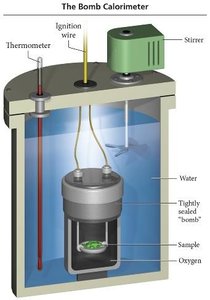
Bomb Calorimeter: Used for combustion reactions at constant volume.
Formula:
Heat of Reaction:
Calorimeter Constant (C_{cal}): Heat absorbed per degree rise in temperature.
Constant-Pressure Calorimetry (Coffee-Cup Calorimeter)
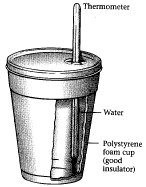
Used to measure heat flow at constant pressure, typically for reactions in solution.
Formula:
Example: Dissolving ammonium nitrate in water is endothermic.
Enthalpy and Thermochemical Equations
Enthalpy (H) and Enthalpy Change (ΔH)
Enthalpy is a state function representing the heat content of a system. The enthalpy change, ΔH, is the heat exchanged at constant pressure.
Formula:
Exothermic: (heat released)
Endothermic: (heat absorbed)
Thermochemical Equations: Show mass and enthalpy relationships; coefficients represent moles; physical states must be specified.
Relationships Involving ΔHrxn
Enthalpy is an extensive property, directly proportional to the amount of substance. The sign and magnitude of ΔH change with reaction direction and scaling.
If a reaction is multiplied by a factor, ΔH is multiplied by that factor.
If a reaction is reversed, the sign of ΔH is reversed.
Hess's Law: ΔH for a reaction is the sum of ΔH values for each step.
Formula:
Standard Enthalpies of Formation
Standard State and Standard Enthalpy Change (ΔH°)
The standard enthalpy change is measured when all reactants and products are in their standard states (pure substances at 1 atm and 25°C).
Standard Enthalpy of Formation (ΔHf°): Enthalpy change for forming 1 mole of a compound from its elements in their standard states.
ΔHf° for elements in their standard state is zero.
Formula:
Example: Ag (s) + ½ Cl2 (g) → AgCl (s), ΔHf° = –127.1 kJ/mol
Enthalpies of Ions in Solution
ΔHf° for individual ions cannot be measured directly; chemists assign ΔHf° for H+ as zero for calculations.
Calculate ΔH for reactions involving ions as for other thermochemical reactions.
Energy Value of Food
Calories and Nutritional Energy
Food energy is measured in kilocalories (kcal), commonly called Calories. Different macronutrients provide different energy values.
Macronutrient | Energy (kcal/g) |
|---|---|
Carbohydrate | 4.0 |
Protein | 4.0 |
Fat | 9.0 |
Alcohol | 7.0 |
Example: If a serving contains 10 g fat, 9 g protein, and 32 g carbohydrate, and total Calories are 250 kcal, percent Calories from fat is:
Fat Calories:
Percent from fat:
