 Back
Chapter 7: Thermochemistry – Energy, Heat, and Enthalpy in Chemical Reactions
Study Guide - Smart Notes
 Tailored notes based on your materials, expanded with key definitions, examples, and context.
Thermochemistry
Introduction to Thermochemistry
Thermochemistry is the branch of chemistry that studies the energy and heat associated with chemical reactions and physical transformations. Understanding energy changes is essential for predicting reaction behavior and for practical applications such as energy production and environmental science.
Energy
Definition and Classification of Energy
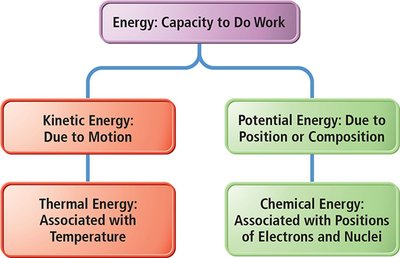
Energy is the capacity to do work or produce heat. In chemistry, energy affects matter and is central to understanding chemical processes. Energy can be classified into several types:
Kinetic Energy: Energy due to motion.
Thermal Energy: Energy associated with temperature; a form of kinetic energy.
Potential Energy: Energy due to position or composition.
Chemical Energy: Energy associated with the positions of electrons and nuclei in atoms and molecules.
Kinetic Energy and Its Formula
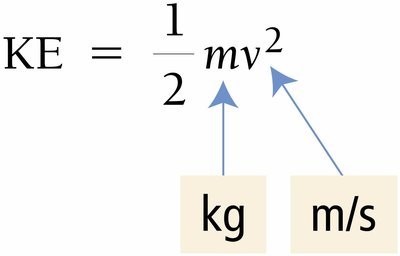
Kinetic energy is directly proportional to an object's mass and the square of its velocity. The formula for kinetic energy is:
where m is mass (kg) and v is velocity (m/s).
Energy Transfer and Work
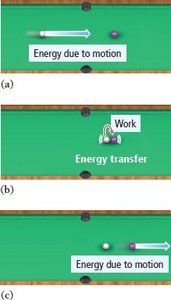
Work is the process of energy transfer resulting from a force acting over a distance. In chemical systems, energy can be transferred as work or heat.
Units of Energy
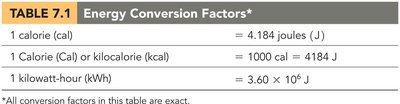
Energy is measured in several units, including joules (J), calories (cal), and kilowatt-hours (kWh). The following table summarizes common energy conversion factors:
Unit | Equivalent |
|---|---|
1 calorie (cal) | 4.184 joules (J) |
1 Calorie (Cal, kcal) | 1000 cal = 4184 J |
1 kilowatt-hour (kWh) | 3.60 × 10⁶ J |
Energy Uses in Various Units
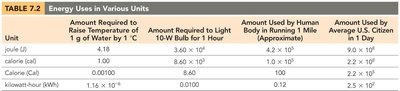
Energy is used in different contexts, such as heating water, lighting bulbs, and human activity. The table below compares energy uses in various units:
Unit | Raise Temp. of 1g Water by 1°C | Light 10-W Bulb for 1 Hour | Run 1 Mile (Human) | Avg. U.S. Citizen 1 Day |
|---|---|---|---|---|
joule (J) | 4.18 | 3.60 × 10⁴ | 4.2 × 10³ | 9.0 × 10⁶ |
calorie (cal) | 1.00 | 8.60 × 10³ | 1.00 × 10³ | 2.2 × 10⁶ |
Calorie (Cal) | 0.00100 | 8.60 | 1.00 | 2.2 × 10³ |
kilowatt-hour (kWh) | 1.16 × 10⁻⁶ | 0.01 | 0.12 | 2.5 × 10³ |
Thermodynamics
Definition and Scope
Thermodynamics is the study of energy and its interconversions. It addresses questions about the possibility, direction, and extent of chemical reactions based on energy changes.
First Law of Thermodynamics
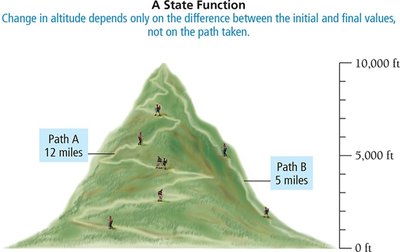
The first law of thermodynamics states that the energy of the universe is constant. Energy can be transferred or converted from one form to another, but it cannot be created or destroyed. The internal energy (E) of a system is the sum of the kinetic and potential energies of all particles in the system.
State Function: A property that depends only on the initial and final states, not the path taken.
Internal Energy Change:
Energy Flow in Chemical Reactions
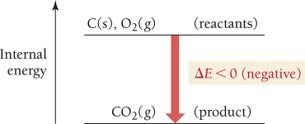
In chemical reactions, energy can flow into or out of the system. For example, the reaction of carbon and oxygen to form carbon dioxide releases energy to the surroundings:
Sign Conventions for Energy Changes
The sign conventions for heat (q), work (w), and internal energy (ΔE) are as follows:
Quantity | Positive (+) | Negative (-) |
|---|---|---|
q (heat) | System gains thermal energy | System loses thermal energy |
w (work) | Work done on the system | Work done by the system |
ΔE (internal energy) | Energy flows into the system | Energy flows out of the system |
Heat and Work
Heat Exchange and Thermal Equilibrium
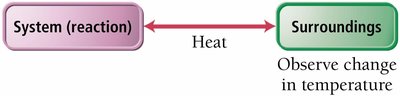
Heat is the exchange of thermal energy between a system and its surroundings, driven by a temperature difference. Heat flows from higher to lower temperature until thermal equilibrium is reached.
Heat Capacity and Specific Heat
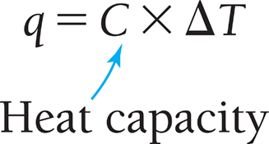
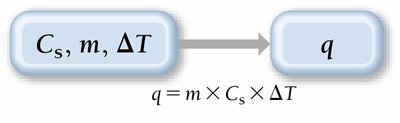
Heat capacity (C) is the amount of heat required to raise the temperature of an object by 1°C. Specific heat capacity (C_s) is the amount of heat required to raise the temperature of 1 gram of a substance by 1°C. The heat absorbed or released can be calculated as:
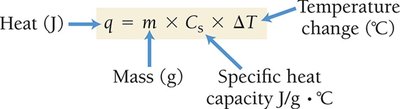
For a specific substance:

Thermal Energy Transfer
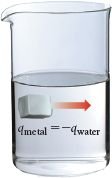
When two objects at different temperatures are placed in contact, heat flows from the hotter to the cooler object. The heat lost by the hot object equals the heat gained by the cold object:
Pressure–Volume Work
Definition and Calculation
Pressure–volume (PV) work is work done by a system when it expands or contracts against an external pressure. The formula for PV work is:
where P_{ext} is the external pressure and ΔV is the change in volume.
Enthalpy
Definition and Relationship to Internal Energy
Enthalpy (H) is a state function defined as the sum of the internal energy and the product of pressure and volume:
The enthalpy change (ΔH) for a reaction at constant pressure is the heat absorbed or released:
If the reaction occurs at constant volume, . For reactions involving gases, .
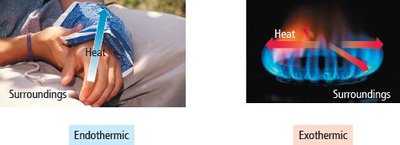
Endothermic and Exothermic Reactions
Reactions can be classified based on the direction of heat flow:
Endothermic: Heat is absorbed by the system (ΔH > 0).
Exothermic: Heat is released by the system (ΔH < 0).
Standard State and Enthalpy of Formation
Thermodynamic Standard States
Standard state conditions are used to compare enthalpy changes:
Gas: Pressure of 1 atm (or 1 bar)
Liquid/Solid: Most stable form at 1 atm and 25°C
Solution: Concentration of 1 M
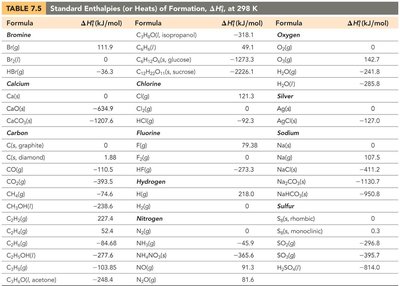
The standard enthalpy change (ΔH°) is measured under these conditions. The standard enthalpy of formation (ΔHf°) is the enthalpy change when 1 mole of a compound forms from its elements in their standard states.
State Functions and Hess’s Law
State Functions
State functions depend only on the initial and final states, not the path taken. Examples include enthalpy (H), temperature (T), volume (V), and pressure (P).
Hess’s Law
Hess’s law states that the total enthalpy change for a reaction is independent of the route taken, as long as the initial and final conditions are the same. This allows calculation of enthalpy changes for complex reactions by summing the enthalpy changes of individual steps.
Energy Use and the Environment
Environmental Implications
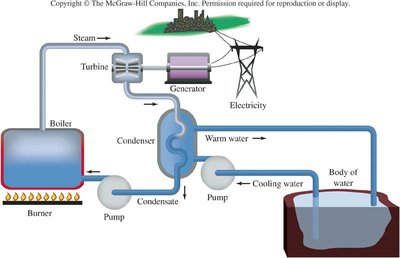
The conservation of energy implies that energy cannot be created or destroyed, only transformed. This principle has profound implications for environmental responsibility and sustainable energy use.
