 Back
Chapter 7: Thermochemistry – Energy, Heat, and Chemical Reactions
Study Guide - Smart Notes
 Tailored notes based on your materials, expanded with key definitions, examples, and context.
Thermochemistry
Introduction to Thermochemistry
Thermochemistry is the study of energy changes that occur during chemical reactions and changes of state. It focuses on the relationship between chemical processes and energy, particularly heat and work.
The Nature of Energy
Key Definitions
Energy: The capacity to do work or produce heat.
Work: Force acting through a distance.
Heat: The transfer of energy caused by a temperature difference.
Thermal Energy: A type of kinetic energy associated with the random motion of particles within an object.
Chemical Energy: Energy associated with the relative positions of atoms and molecules, a form of potential energy.
Energy Conservation and Transfer
Energy can be transferred between a system and its surroundings, but it cannot be created or destroyed (First Law of Thermodynamics).
System: The part of the universe being studied.
Surroundings: Everything outside the system.
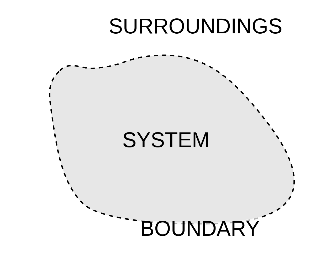
The surroundings gain the exact amount of energy the system loses, and vice versa.
Units of Energy
Joule (J)
Calorie (cal)
Kilojoule (kJ)
Kilocalorie (kcal)
Conversion example:
The First Law of Thermodynamics
Statement and Implications
The first law states that the total energy of the universe is constant. Energy is neither created nor destroyed, but may be transferred or transformed.
Internal Energy (U): The sum of the kinetic and potential energies of all particles in a system.
Change in internal energy:
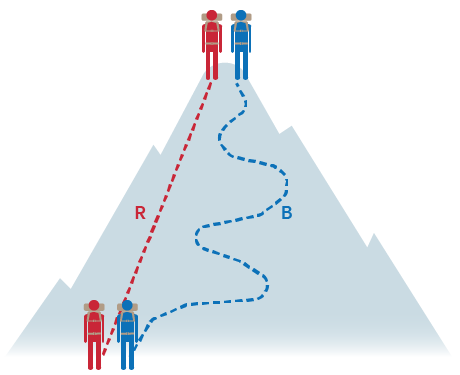
Internal energy is a state function—it depends only on the state, not the path taken.
Energy Diagrams
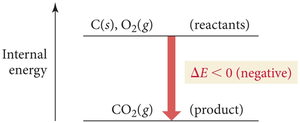
Energy diagrams compare the internal energy of reactants and products.
If products have less energy than reactants, is negative—energy flows out of the system.
If products have more energy than reactants, is positive—energy flows into the system.
Heat and Work
A system can exchange energy with its surroundings through heat and work.
Work done ON the system: Positive
Work done BY the system: Negative
Quantifying Heat and Work
Temperature and Heat
Temperature is a measure of thermal energy, while heat is the transfer of thermal energy. Heat moves from high to low temperature.
Heat Capacity
Symbol | Units | Definition |
|---|---|---|
C | J/°C | Heat capacity: amount of heat required to raise the temperature of an object by 1°C |
Cs | J/g·°C | Specific heat capacity: heat required to raise 1 g of a substance by 1°C |
Cm | J/mol·°C | Molar heat capacity: heat required to raise 1 mol of a substance by 1°C |
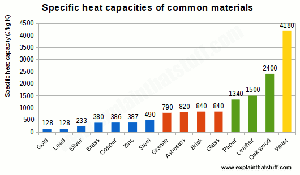
Equations Relating Heat, Specific Heat, and Temperature Change
Where q is heat, m is mass, Cs is specific heat, n is moles, Cm is molar heat capacity, and ΔT is temperature change.
Thermal Energy Transfer
When a warm object is placed in contact with a cooler one, heat flows from the warmer to the cooler until thermal equilibrium is reached.
Pressure-Volume Work
Work is done when a system changes its volume against an external pressure.
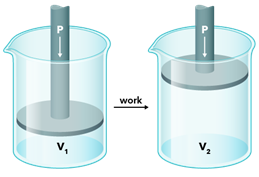
If the system expands, work is done on the surroundings and the internal energy decreases.
Measuring ΔE for Chemical Reactions: Constant-Volume Calorimetry (Bomb Calorimeter)
Bomb Calorimeter
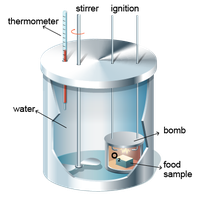
A bomb calorimeter measures changes in internal energy for reactions at constant volume.
(since , work = 0)
Heat released is calculated from the temperature change and heat capacity of the calorimeter.
Enthalpy: The Heat Evolved in a Chemical Reaction at Constant Pressure
Definition and Properties
Enthalpy (ΔH): The heat evolved in a chemical reaction at constant pressure.
Endothermic: Absorbs heat, feels cold,
Exothermic: Releases heat, feels warm,
Stoichiometry Involving ΔH
Thermochemical equations relate the amount of heat absorbed or released to the quantities of reactants and products.
Constant Pressure Calorimetry: Measuring ΔHrxn (Coffee Cup Calorimeter)
Coffee Cup Calorimeter
Measures heat evolved at constant pressure, allowing determination of ΔHrxn.
Bomb calorimetry: constant volume, measures ΔE
Coffee cup calorimetry: constant pressure, measures ΔH
Hess’s Law: Relationships Involving ΔHrxn
Hess’s Law
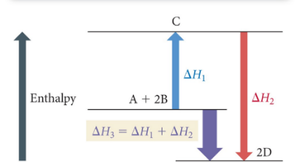
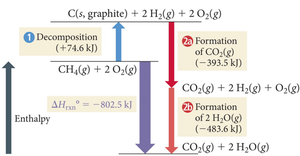
The change in enthalpy for a reaction is the sum of the enthalpy changes for each step.
If a chemical equation is multiplied by a factor, ΔHrxn is multiplied by the same factor.
If a chemical equation is reversed, ΔHrxn changes sign.
If a reaction is the sum of several steps, ΔHrxn is the sum of the ΔH for each step.
Determining Enthalpies of Reaction from Standard Enthalpies of Formation
Standard Enthalpy of Formation
ΔHf°: Enthalpy change when 1 mole of a compound is formed from its elements in their standard states.
ΔHf° for elements in their standard state = 0
Standard state conditions: 25°C, 1 atm, 1 M concentration.
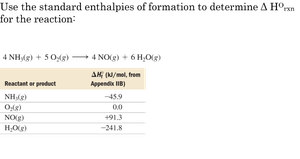
Calculating ΔHrxn Using Standard Enthalpies of Formation
Energy Use and the Environment
Primary Sources of Energy
Coal
Natural Gas
Petroleum
Nuclear
Renewable
Types of Air Pollution
Sulfur Oxides (SOx): Produced from burning coal; causes acid rain and respiratory irritation.
Carbon Monoxide (CO): Produced from incomplete combustion; displaces oxygen in blood.
Nitrogen Oxides (NOx): Produced from high-temperature burning; forms smog.
Ozone (O3): Produced from reactions involving fossil fuel combustion; irritates lungs.
