 Back
Chapter 8: Basic Concepts of Chemical Bonding – Study Guide
Study Guide - Smart Notes
 Tailored notes based on your materials, expanded with key definitions, examples, and context.
Basic Concepts of Chemical Bonding
Introduction to Chemical Bonds
Chemical bonds are the forces that hold atoms or ions together in compounds. These bonds arise from the sharing or transfer of electrons between atoms, resulting in stable arrangements. The main types of chemical bonds are ionic bonds (electrostatic attraction between ions) and covalent bonds (sharing of electrons between atoms).
Ionic bonds: Formed by the transfer of electrons, typically between metals and nonmetals (e.g., NaCl).
Covalent bonds: Formed by the sharing of electron pairs between atoms, usually between nonmetals (e.g., Cl2).
Valence Electrons and the Octet Rule
Valence electrons are the electrons in the outermost shell of an atom and are crucial in chemical bonding. The octet rule states that atoms tend to gain, lose, or share electrons to achieve eight valence electrons, resulting in a stable noble gas configuration (ns2np6).
Atoms are stable when surrounded by eight electrons (four electron pairs).
Hydrogen is an exception, requiring only two electrons (duet rule).
Lewis Structures and Covalent Bonding
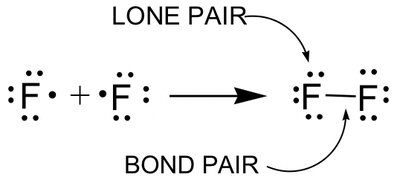
Lewis structures (or Lewis dot structures) visually represent the arrangement of valence electrons in molecules. Shared electron pairs are shown as lines (bonds), and unshared pairs (lone pairs) as dots.
Each shared pair constitutes one chemical bond.
Single, double, and triple bonds represent one, two, or three shared pairs, respectively.
Example: The Lewis structure for fluorine (F2) shows each atom sharing one pair of electrons, with three lone pairs remaining on each atom.
Drawing Lewis Structures: Step-by-Step Method
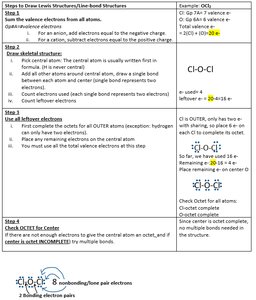
Lewis structures can be constructed systematically using the following steps:
Sum the valence electrons from all atoms. For ions, add or subtract electrons according to the charge.
Draw the skeletal structure: Place the central atom (usually written first in the formula; H is never central) and connect other atoms with single bonds.
Distribute leftover electrons: Complete octets for outer atoms first, then place remaining electrons on the central atom.
Check the octet for the central atom: If incomplete, form multiple bonds as needed.
Example: Lewis structure for OCl2:
Example: Lewis structure for BrO3-:

Example: Lewis structure for HCN:

Exceptions to the Octet Rule
While the octet rule is widely applicable, there are important exceptions:
Odd number of electrons: Molecules like ClO, NO, and NO2 have unpaired electrons.
Less than an octet: Common in compounds of boron or beryllium (e.g., BF3).
More than an octet (expanded octet): Atoms from the third period and beyond can accommodate more than eight electrons (e.g., PCl5, SF6, ICl4-).
Expanded octets are possible due to available d orbitals and are favored when the central atom is large and surrounded by small, electronegative atoms.
Formal Charge and Alternative Lewis Structures
Formal charge helps determine the most reasonable Lewis structure when multiple possibilities exist. It is calculated as:
The sum of formal charges must equal the charge on the molecule or ion.
The most stable structure has the smallest formal charges and places negative charges on the most electronegative atoms.
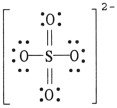
Example: Formal charge calculation for SO42-:
Bond Polarity, Electronegativity, and Dipole Moments
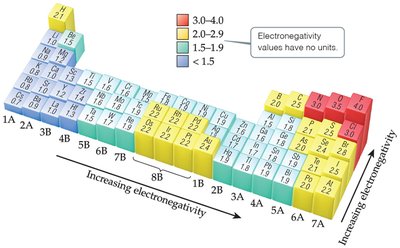
Bond polarity arises when electron pairs are unequally shared between atoms. Electronegativity is the ability of an atom to attract electrons in a bond. The greater the difference in electronegativity, the more polar the bond.
Nonpolar covalent bond: Electrons are shared equally (e.g., Cl2).
Polar covalent bond: Electrons are shared unequally (e.g., HCl).
Ionic bond: Large electronegativity difference leads to electron transfer (e.g., NaCl).
Electronegativity increases across a period and decreases down a group. The polarity of a molecule can be indicated by a dipole arrow pointing toward the more electronegative atom.
Resonance Structures
Some molecules cannot be represented by a single Lewis structure. Resonance structures are multiple valid Lewis structures differing only in the placement of electrons. The true structure is a hybrid of these possibilities.
Resonance is common in molecules with multiple bonds (e.g., ozone, SO3).
Bond lengths in resonance hybrids are intermediate between single and double bonds.
Example: Resonance structures for SO3:

Bond Enthalpy and Enthalpy of Reactions
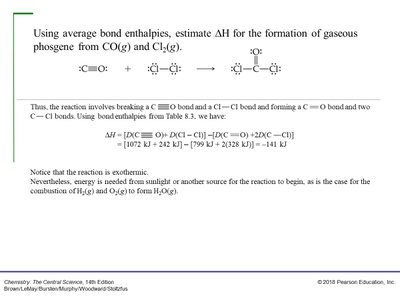
Bond enthalpy is the energy required to break a bond. The enthalpy change for a reaction () can be estimated using bond enthalpies:
Multiple bonds are stronger and shorter than single bonds.
Bond enthalpy values are typically provided in tables for calculations.
Example: Calculating for the formation of phosgene:
Bond Strength and Bond Length
The bond length is the distance between the nuclei of bonded atoms. As the number of shared electron pairs increases (single, double, triple bonds), bond length decreases and bond strength increases.
Single bonds: longest and weakest
Double bonds: intermediate
Triple bonds: shortest and strongest
Example: C-N, C=N, and C≡N bonds comparison:
Bond strength increases and bond length decreases from C-N to C≡N.
Summary Table: Steps to Draw Lewis Structures
Step | Description |
|---|---|
1 | Sum valence electrons from all atoms (adjust for ions) |
2 | Draw skeletal structure (central atom, connect with single bonds) |
3 | Distribute leftover electrons (complete octets for outer atoms first) |
4 | Check octet for central atom; form multiple bonds if needed |
Additional info: This guide covers the essential concepts and skills for Chapter 8: Basic Concepts of Chemical Bonding, including Lewis structures, formal charge, bond polarity, resonance, and bond enthalpy calculations. Practice problems and stepwise examples are included to reinforce understanding.
