 Back
Chapter 8: Basic Concepts of Chemical Bonding (General Chemistry Study Notes)
Study Guide - Smart Notes
 Tailored notes based on your materials, expanded with key definitions, examples, and context.
Basic Concepts of Chemical Bonding
Introduction to Chemical Bonding
Chemical bonding is fundamental to understanding the properties and behaviors of substances. The microscopic properties of molecules, such as atomic connectivity and three-dimensional shape, are determined by the nature of the chemical bonds present. Atoms or ions are strongly attracted to one another through chemical bonds, which involve the sharing or transfer of electrons.
Chemical bonds are the forces that hold atoms together in compounds.
Electrons are either shared (covalent bonds) or transferred (ionic bonds) between atoms.
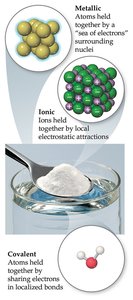
Types of Chemical Bonds
There are three primary types of chemical bonds, each with distinct characteristics and examples:
Metallic Bonds: Occur between metal atoms. Metal nuclei are surrounded by a 'sea of electrons' that are delocalized and free to move, giving rise to properties such as conductivity and malleability. Example: Sodium (Na)
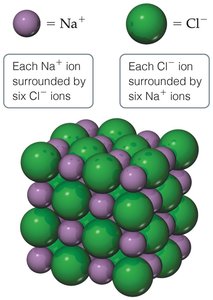
Ionic Bonds: Usually form between metals and non-metals. These bonds result from electrostatic attractions between oppositely charged ions. Example: Sodium chloride (NaCl)
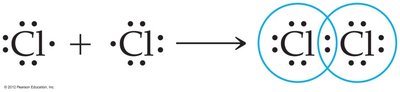
Covalent Bonds: Occur between non-metal atoms. Electrons are shared between atoms, resulting in the formation of molecules. Example: Chlorine gas (Cl2)
Lewis Symbols and the Octet Rule
Lewis Symbols
Lewis symbols are a visual representation of the valence electrons in an atom. Valence electrons are those found in the outermost, incomplete shell and are involved in bonding. G. N. Lewis developed a method to denote these electrons using dots around the element symbol.
Each dot represents a valence electron.
Unpaired dots indicate electrons available for bonding.
Electrons are placed on four sides of a square around the element's symbol.


The Octet Rule
The octet rule states that atoms tend to gain, lose, or share electrons until they are surrounded by eight valence electrons, achieving a stable noble gas configuration (ns2np6). This rule guides the formation of most chemical bonds.
An octet consists of full s and p subshells.
Atoms are stable when surrounded by 8 electrons (four electron pairs).
The Octet Rule in Ionic Bonding
In ionic bonding, one element (usually a metal) gives up an electron (low ionization energy), while another (usually a non-metal) gains an electron (high electron affinity). The transfer of electrons results in ions with complete octets.
Sodium (Na) becomes Na+ ([Ne])
Chlorine (Cl) becomes Cl− ([Ar])
Both ions achieve a noble gas configuration.

Properties of Ionic Substances
Structure and Physical Properties
Ionic substances exhibit characteristic physical properties due to the strong electrostatic forces between ions:
Brittle
High melting points
Crystalline structure
Cleave along smooth lines
Covalent Bonding
Nature of Covalent Bonds
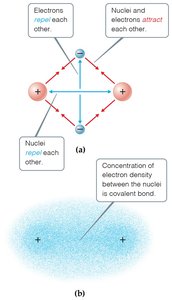
Covalent bonds are formed by the sharing of electron pairs between atoms, typically non-metals. Most chemical substances are covalent rather than ionic. Covalent bonding allows atoms to achieve noble-gas electronic configurations.
Electrostatic interactions include attractions between electrons and nuclei, repulsions between electrons, and repulsions between nuclei.
Lewis Structures for Covalent Bonds
Lewis structures represent the arrangement of electrons in covalent molecules. Each pair of shared electrons constitutes one chemical bond, typically shown as a line between atoms, while unshared pairs are shown as dots.
Single bonds: One pair of shared electrons
Double bonds: Two pairs of shared electrons
Triple bonds: Three pairs of shared electrons


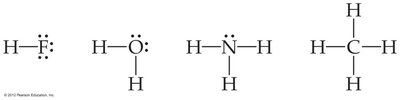
Covalent Bonds: Multiple Bonds
Multiple bonds occur when more than one pair of electrons is shared between two atoms. Bond length decreases as bond order increases (single > double > triple).
Single bond: H–H
Double bond: O=O
Triple bond: N≡N


Bond Polarity and Electronegativity
Bond Polarity
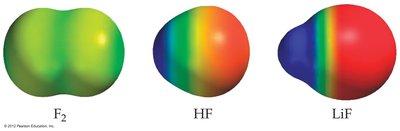
Bond polarity describes the unequal sharing of electrons in a covalent bond. If electrons are shared equally, the bond is nonpolar; if not, the bond is polar. If the difference in electronegativity is very large, the bond becomes ionic.
Nonpolar covalent bond: Electrons shared equally (e.g., F2)
Polar covalent bond: One atom attracts electrons more strongly (e.g., HF)
Ionic bond: Complete transfer of electrons (e.g., NaBr)
Electronegativity
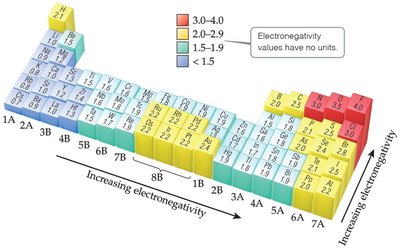
Electronegativity is the ability of an atom in a molecule to attract electrons to itself. It is related to both ionization energy and electron affinity. The Pauling scale is commonly used to quantify electronegativity.
Electronegativity increases across a period and decreases down a group.
Fluorine (F) is the most electronegative element (4.0).
Dipoles, Bond Polarity, and Electronegativity
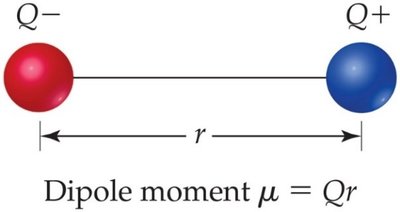
Electronegativity differences close to zero result in nonpolar covalent bonds. Unequal sharing produces a bond dipole, characterized by a dipole moment (μ), which is measured in debyes (D).
Dipole moment formula:
Greater electronegativity difference leads to more polar bonds.
Polar Covalent Bonds
The polarity of molecules can be indicated by δ+ and δ− symbols or by arrows pointing toward the more electronegative atom. The dipole moment and bond length are related to the degree of polarity.
Example: HF (high polarity), HI (low polarity)
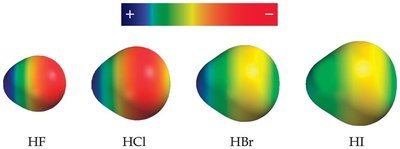
Table: Bond Lengths, Electronegativity Differences, and Dipole Moments of Hydrogen Halides
Compound | Bond Length (Å) | Electronegativity Difference | Dipole Moment (D) |
|---|---|---|---|
HF | 0.92 | 1.9 | 1.82 |
HCl | 1.27 | 0.9 | 1.08 |
HBr | 1.41 | 0.7 | 0.82 |
HI | 1.61 | 0.4 | 0.44 |
Drawing Lewis Structures
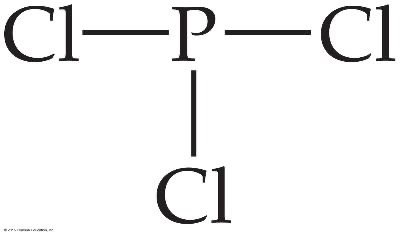
Steps for Drawing Lewis Structures (Covalent Molecules)
Lewis structures help visualize the arrangement of electrons in molecules. The following steps outline the process:
Sum the valence electrons from all atoms, accounting for overall charge (add for anions, subtract for cations).
Write the symbols for the atoms, show which atoms are attached to which, and connect them with single bonds.
Identify the central atom (usually the least electronegative, except hydrogen).
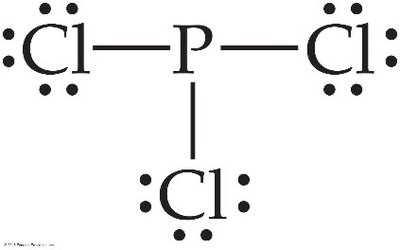
Complete the octets around all atoms bonded to the central atom (except hydrogen, which only has two electrons).
Place any remaining electrons on the central atom.
If necessary, form multiple bonds to satisfy the octet rule for the central atom.


Example: Drawing Lewis Structure for NO+
N: 5 valence electrons
O: 6 valence electrons
NO+: subtract one electron for positive charge (total = 10 valence electrons)
Connect N and O with a single bond, distribute remaining electrons, and form multiple bonds if needed to satisfy the octet rule.
Formal Charge and Resonance Structures
Formal Charge Calculation
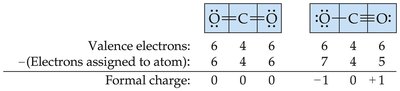
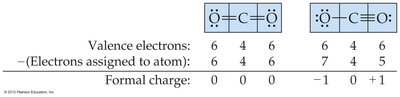
When more than one Lewis structure is possible, formal charge helps determine the most reasonable structure. Formal charge is the hypothetical charge an atom would have if all bonding electrons were shared equally.
All nonbonding electrons are assigned to the atom where they are found.
Half of the bonding electrons are assigned to each atom in a bond.
Formula: Where V = number of valence electrons in the isolated atom, B = number of bonds, NB = number of nonbonding electrons.
Best Lewis Structure Criteria
The best Lewis structure has the fewest charges and places negative charges on the most electronegative atoms.
Example: Calculating Formal Charges for CN−
Carbon: 4 valence electrons, 2 nonbonding electrons, 3 bonds (triple bond), FC = 4 − 3 − 2 = −1
Nitrogen: 5 valence electrons, 2 nonbonding electrons, 3 bonds, FC = 5 − 3 − 2 = 0
The sum of formal charges equals the net charge of the molecule.
Example: The formal charge calculation for CN− demonstrates how the sum of formal charges matches the overall charge of the molecule.
Additional info: These notes cover the foundational concepts of chemical bonding, including types of bonds, Lewis structures, the octet rule, bond polarity, electronegativity, dipole moments, and formal charge calculations. Mastery of these topics is essential for understanding molecular structure and reactivity in general chemistry.
