 Back
BackChapter 8: Chemical Reactions – Structured Study Notes
Study Guide - Smart Notes
 Tailored notes based on your materials, expanded with key definitions, examples, and context.
Chemical Reactions
Introduction
Chemical reactions are fundamental processes in chemistry, involving the transformation of substances through the breaking and forming of chemical bonds. This chapter covers the interpretation and writing of chemical equations, balancing equations, patterns of chemical reactivity, combustion analysis, stoichiometric calculations, limiting reactants, and reaction yields.
Writing and Balancing Chemical Equations
Interpreting and Writing Chemical Equations
A chemical equation uses formulas to express the identities and quantities of substances involved in a physical or chemical change. Reactants are written on the left, products on the right, and a yield arrow points from reactants to products. The equation must be balanced so that the same number and type of each atom appear on both sides, obeying the law of conservation of mass.
Reactants: Substances consumed in the reaction.
Products: Substances formed in the reaction.
States of Matter: Indicated by (g) for gas, (l) for liquid, (s) for solid, and (aq) for aqueous.
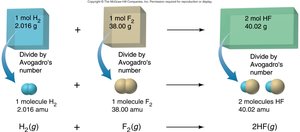
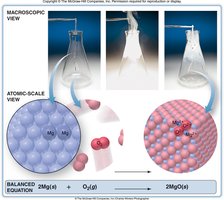
Balancing Chemical Equations
Balancing chemical equations is essential to ensure the law of conservation of mass is obeyed. This is achieved by writing stoichiometric coefficients to the left of chemical formulas. The process often involves trial-and-error and is facilitated by changing coefficients of compounds before elements, treating polyatomic ions as units, and carefully counting atoms.
Do not change chemical formulas; only adjust coefficients.
Check that all atoms balance after each adjustment.
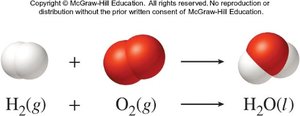
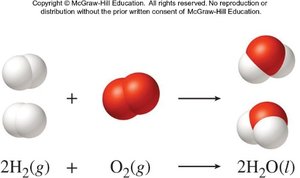
Example: Balancing the combustion of octane:
Unbalanced:
Balanced:
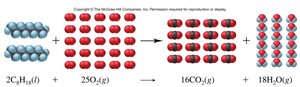
Balancing from Molecular Scenes
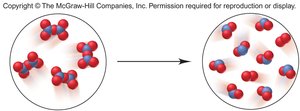
Visual representations can help deduce formulas and balance equations. For example, a scene with 4 N2O5 molecules converting to 8 NO2 and 2 O2 molecules is balanced as:
Patterns of Chemical Reactivity
Types of Reactions
Chemical reactions can be classified into several types:
Combination Reaction: Two or more reactants form one product. Example:
Decomposition Reaction: One reactant forms two or more products. Example:
Combustion Reaction: A compound reacts with O2 to produce CO2 and H2O. Example:
Combustion Analysis
Determination of Empirical Formula
Combustion analysis is used to experimentally determine the empirical formula of a compound. The sample is combusted, and the masses of CO2 and H2O produced are measured to calculate the amounts of C and H in the original sample. The remaining mass is attributed to O.
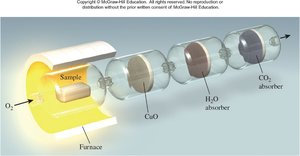
Empirical formula is the simplest whole-number ratio of atoms in a compound.
Molecular formula is determined by dividing the molar mass by the empirical formula mass.
Example: For glucose, empirical formula is CH2O, molecular formula is C6H12O6.
Calculations with Balanced Chemical Equations
Stoichiometric Calculations
Balanced equations allow prediction of product amounts from given reactant quantities. The stoichiometric coefficients indicate the ratios in which substances react and are produced.
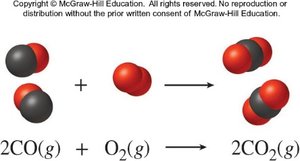
Example:
2 moles of CO are equivalent to 2 moles of CO2.
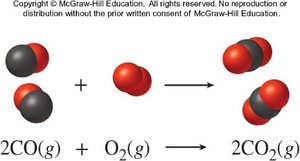
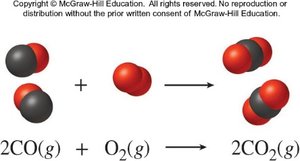
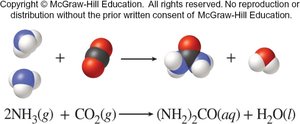
Worked Example: Urea Synthesis
Urea is synthesized from ammonia and carbon dioxide:
Use stoichiometric ratios to calculate product and reactant amounts.
Worked Example: Nitrous Oxide Production
Nitrous oxide is produced by heating ammonium nitrate:
Use molar masses and stoichiometric ratios to convert between grams and moles.
Limiting Reactants and Reaction Yield
Limiting Reactant
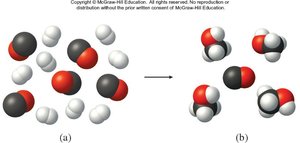
The limiting reactant is the reactant used up first in a reaction, determining the maximum amount of product formed. Excess reactants are present in greater quantities than necessary.
Example:
Calculate required moles for each reactant to identify the limiting reactant.
Worked Example: Alka-Seltzer Reaction
Alka-Seltzer tablets react with water to produce CO2 gas:
Convert reactant masses to moles, determine limiting reactant, calculate excess reactant and product mass.
Reaction Yield
Theoretical yield is the maximum product formed from the limiting reactant. Actual yield is the amount actually obtained. Percent yield is calculated as:
Summary Table: Types of Chemical Reactions
Type | General Form | Example |
|---|---|---|
Combination | A + B → AB | H2 + Br2 → 2HBr |
Decomposition | AB → A + B | 2KClO3 → 2KCl + 3O2 |
Combustion | Compound + O2 → CO2 + H2O | 2HCO2H + O2 → 2CO2 + 2H2O |
Chapter Summary: Key Points
Interpreting and writing chemical equations
Balancing chemical equations
Reaction types: combination, decomposition, combustion
Combustion analysis and empirical formula determination
Stoichiometric calculations with balanced equations
Limiting and excess reactants
Theoretical and actual yield, percent yield
