 Back
BackChapter 8: Electron Configurations and Periodic Trends – Study Notes
Study Guide - Smart Notes
 Tailored notes based on your materials, expanded with key definitions, examples, and context.
Electron Configurations and Periodic Trends
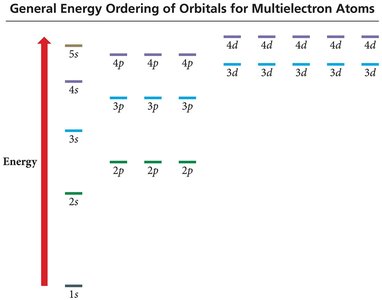
General Rules for Filling Orbitals with Electrons
Understanding how electrons fill atomic orbitals is essential for predicting chemical properties and periodic trends. The arrangement of electrons in an atom is governed by several fundamental principles:
Aufbau Principle: Electrons occupy the lowest energy orbitals first, filling in the order s → p → d → f.
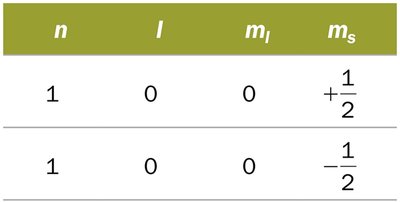
Pauli Exclusion Principle: No two electrons in an atom can have the same set of four quantum numbers. Each orbital can hold a maximum of two electrons with opposite spins.
Hund’s Rule: When filling orbitals of equal energy (degenerate orbitals), one electron enters each orbital before any orbital gets a second electron.
Quantum Numbers and Electron Spin
Each electron in an atom is described by a unique set of four quantum numbers:
Principal quantum number (n): Indicates the main energy level.
Angular momentum quantum number (l): Indicates the sublevel (s, p, d, f).
Magnetic quantum number (ml): Specifies the orbital within a sublevel.
Spin quantum number (ms): Specifies the electron's spin direction (+1/2 or -1/2).
Electron Configurations and Orbital Diagrams
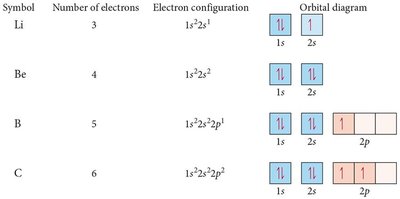
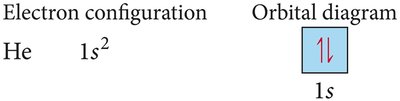
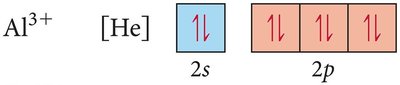
Electron configurations show the distribution of electrons among orbitals. Orbital diagrams use arrows to represent electrons and their spins in each orbital box.
Example: The electron configuration and orbital diagrams for Li, Be, B, and C are shown below.
Example: Helium's electron configuration and orbital diagram:
Periodic Table and Electron Configuration Blocks
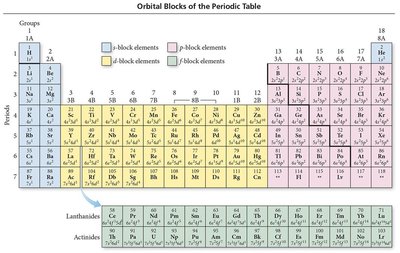
The periodic table is divided into blocks (s, p, d, f) based on the type of orbital being filled. The position of an element in the table helps determine its electron configuration.
s-block: Groups 1A and 2A (alkali and alkaline earth metals)
p-block: Groups 3A to 8A (main group elements)
d-block: Transition metals
f-block: Lanthanides and actinides
Counting Electrons and Determining Ion Charge
The number of electrons in a neutral atom equals the number of protons. For ions, the charge is determined by the difference between protons and electrons:
Ion charge = number of protons − number of electrons

Valence and Core Electrons
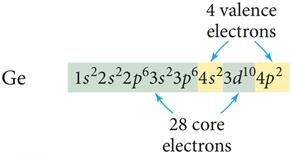
Valence electrons are those in the outermost principal energy level and are primarily responsible for chemical behavior. Core electrons are those in inner shells.
Example: Germanium (Ge) has 4 valence electrons (in the n=4 shell) and 28 core electrons.
Electron Configurations of Main Group Elements
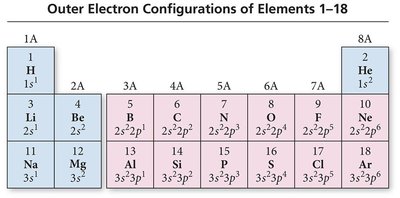
The outer electron configurations of main group elements (Groups 1A–8A) follow predictable patterns, which can be summarized as follows:
Electron Configurations of Transition Metals
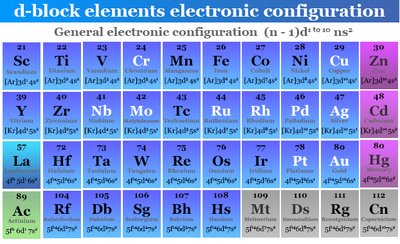
Transition metals (d-block elements) have electron configurations that often involve the (n-1)d and ns orbitals. Some transition metals exhibit irregular configurations due to stability associated with half-filled or fully filled d subshells.
Periodic Trends in Electron Configuration and Properties
Periodic trends arise from the arrangement of electrons and the structure of the periodic table. Key trends include:
Atomic radius: Increases down a group, decreases across a period.
Ionization energy: Decreases down a group, increases across a period.
Electron affinity: Generally becomes more negative across a period.
Electronegativity: Increases across a period, decreases down a group.
Metallic character: Increases down a group, decreases across a period.
Summary Table: Electron Configurations and Quantum Numbers
Symbol | Number of electrons | Electron configuration | Orbital diagram |
|---|---|---|---|
Li | 3 | 1s22s1 | [↑↓] [↑] |
Be | 4 | 1s22s2 | [↑↓] [↑↓] |
B | 5 | 1s22s22p1 | [↑↓] [↑↓] [↑] |
C | 6 | 1s22s22p2 | [↑↓] [↑↓] [↑][↑] |
Additional info: Orbital diagrams use boxes for orbitals and arrows for electrons, with paired arrows indicating opposite spins.
