 Back
Chapter 8: Gases – Properties, Laws, and Applications
Study Guide - Smart Notes
 Tailored notes based on your materials, expanded with key definitions, examples, and context.
Gases: Properties and Measurement
Introduction to Gases
Gases are a fundamental state of matter characterized by their ability to expand and fill the shape of their container. They play a crucial role in biological, environmental, and industrial processes. Understanding the properties and behavior of gases is essential for applications ranging from respiratory therapy to chemical synthesis.
Kinetic Molecular Theory of Gases
The kinetic molecular theory explains the behavior of gases based on the motion of their particles:
Random Motion: Gas particles move randomly with high velocities.
Negligible Forces: Attractive or repulsive forces between molecules are very small.
Large Volume: The volume occupied by gas particles is much less than the volume of the container.
Constant Motion: Particles move rapidly in straight lines and collide with the container walls, exerting pressure.
Temperature Relation: The Kelvin temperature is proportional to the average kinetic energy of the molecules.
Properties That Describe a Gas
Gases are described by four main properties:
Pressure (P): The force exerted by gas particles against the walls of the container. Units: atm, mmHg, Torr, Pa, psi.
Volume (V): The space occupied by the gas, measured in liters (L) or milliliters (mL).
Temperature (T): Determines the kinetic energy of gas particles, measured in Kelvin (K).
Amount (n): The quantity of gas present, measured in moles (mol).
Property | Description | Units |
|---|---|---|
Pressure (P) | Force against container walls | atm, mmHg, Torr, Pa, psi |
Volume (V) | Space occupied by gas | L, mL |
Temperature (T) | Kinetic energy factor | K |
Amount (n) | Quantity of gas | mol |
Pressure and Atmospheric Pressure
Pressure is a measure of gas particle collisions with the sides of a container. Atmospheric pressure is the pressure exerted by a column of air from the top of the atmosphere to the Earth's surface, and it decreases with altitude.
Standard atmospheric pressure at sea level: 1 atm = 760 mmHg = 760 Torr
Barometers are used to measure atmospheric pressure.


Units of Pressure
Unit | Abbreviation | Equivalent to 1 atm |
|---|---|---|
Atmosphere | atm | 1 atm |
Millimeters of Hg | mmHg | 760 mmHg |
Torr | Torr | 760 Torr |
Inches of Hg | inHg | 29.9 inHg |
Pounds per square inch | psi | 14.7 psi |
Pascal | Pa | 101325 Pa |
Kilopascal | kPa | 101.325 kPa |
Gas Laws
Boyle’s Law: Pressure and Volume
Boyle’s law describes the inverse relationship between the pressure and volume of a gas at constant temperature and amount:
When volume increases, pressure decreases.
When volume decreases, pressure increases.
Equation:
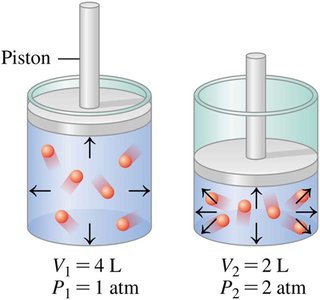
Example: If a gas sample has a volume of 8.0 L at 8.0 atm, and the volume is changed to 2.0 L, the new pressure is 32 atm (assuming constant temperature and moles).
Application: Breathing and Boyle’s Law
Boyle’s law is directly related to the mechanics of breathing:
During inhalation, lung volume increases and pressure decreases, causing air to flow in.
During exhalation, lung volume decreases and pressure increases, causing air to flow out.


Charles’s Law: Temperature and Volume
Charles’s law states that the volume of a gas is directly proportional to its Kelvin temperature at constant pressure and amount:
When temperature increases, volume increases.
When temperature decreases, volume decreases.
Equation:
Example: A balloon with a volume of 785 mL at 21°C (294 K) will have a volume of 729 mL at 0°C (273 K).
Gay-Lussac’s Law: Temperature and Pressure
Gay-Lussac’s law states that the pressure of a gas is directly proportional to its Kelvin temperature at constant volume and amount:
When temperature increases, pressure increases.
When temperature decreases, pressure decreases.
Equation:
Example: If a gas has a pressure of 2.0 atm at 18°C (291 K), the pressure increases to 2.3 atm at 62°C (335 K).
Combined Gas Law
The combined gas law relates pressure, volume, and temperature when the amount of gas is constant:
Example: A gas with a volume of 675 mL at 35°C and 646 mmHg will have a volume of 314 mL at -95°C and 802 mmHg.
Avogadro’s Law: Volume and Moles
Avogadro’s law states that the volume of a gas is directly proportional to the number of moles at constant temperature and pressure:
Example: 0.75 mole of helium occupies 1.5 L; 1.2 moles will occupy 2.4 L at the same conditions.
Standard Temperature and Pressure (STP) and Molar Volume
At STP (0°C, 1 atm), 1 mole of any gas occupies 22.4 L. This is used as a conversion factor in gas calculations.
Example: 2.75 moles of N2 gas at STP occupy 61.6 L.
The Ideal Gas Law
Ideal Gas Law Equation
The ideal gas law combines all four properties into a single equation:
P: Pressure (atm or mmHg)
V: Volume (L)
n: Moles
R: Ideal gas constant (0.0821 L·atm/mol·K or 62.4 L·mmHg/mol·K)
T: Temperature (K)
Example: What is the pressure of 0.350 mole of N2O at 22°C in a 5.00-L container?
Dalton’s Law of Partial Pressures
Partial Pressure and Gas Mixtures
Dalton’s law states that the total pressure of a gas mixture is the sum of the partial pressures of each gas:
Example: A scuba tank contains O2 at 0.450 atm and He at 855 mmHg. The total pressure in mmHg is:
Composition of Air
Gas | Percentage (%) | Partial Pressure (mmHg) |
|---|---|---|
Nitrogen (N2) | 78.2 | 594 |
Oxygen (O2) | 21.0 | 160 |
Other gases | 0.8 | 6 |
Total | 100 | 760 |

Applications and Health Connections
Respiratory Therapy and Blood Gases
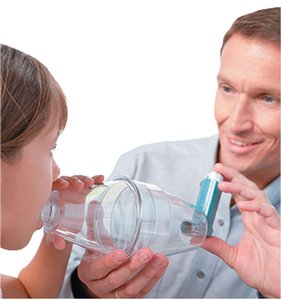
Respiratory therapists use gas laws to assess and treat patients, measuring breathing capacity, oxygen and carbon dioxide concentrations, and blood pH. Gas exchange in the lungs and tissues is governed by partial pressures.

Gas Exchange During Breathing
Gas | Inspired Air (mmHg) | Alveolar Air (mmHg) | Expired Air (mmHg) |
|---|---|---|---|
Nitrogen (N2) | 594 | 573 | 569 |
Oxygen (O2) | 160 | 100 | 116 |
Carbon dioxide (CO2) | 0.3 | 40 | 28 |
Water vapor (H2O) | 5.7 | 47 | 47 |
Total | 760 | 760 | 760 |
Partial Pressures in Blood and Tissues
Gas | Oxygenated Blood (mmHg) | Deoxygenated Blood (mmHg) | Tissues (mmHg) |
|---|---|---|---|
Oxygen (O2) | 100 | 40 | 30 or less |
Carbon dioxide (CO2) | 40 | 46 | 50 or greater |
Summary Table: Gas Laws
Name of Gas Law | Relationship | Properties That Do Not Change |
|---|---|---|
Boyle’s law | T, n | |
Charles’s law | P, n | |
Gay-Lussac’s law | V, n | |
Avogadro’s law | P, T | |
Combined gas law | n | |
Ideal gas law | None | |
Dalton’s law | None |
Key Terms and Concepts
Pressure: Force per unit area exerted by gas particles.
Volume: Space occupied by gas.
Temperature: Measure of kinetic energy; must be in Kelvin for calculations.
Mole: Amount of substance; relates to Avogadro’s law and molar volume.
Partial Pressure: Pressure exerted by a single gas in a mixture.
STP: Standard Temperature and Pressure (0°C, 1 atm).
Ideal Gas Constant (R): 0.0821 L·atm/mol·K or 62.4 L·mmHg/mol·K.
Additional info: These notes expand on the original slides and textbook excerpts, providing definitions, equations, and examples for each gas law, as well as relevant tables and images to reinforce understanding. All images included are directly relevant to the explanation of the adjacent paragraph.
