 Back
BackChapter 8: Introduction to Solutions and Aqueous Reactions – Comprehensive Study Notes
Study Guide - Smart Notes
 Tailored notes based on your materials, expanded with key definitions, examples, and context.
Introduction to Solutions and Aqueous Reactions
Overview of Solutions
Solutions are homogeneous mixtures composed of a solute (minor component) and a solvent (major component). When substances like table salt dissolve in water, they form a solution where the solute is distributed uniformly throughout the solvent.
Solute: The substance dissolved in the solvent.
Solvent: The substance in which the solute is dissolved, usually present in greater quantity.
Homogeneous mixture: A mixture with uniform composition throughout.
Solution Concentration
Categories of Solution Concentration
Solutions are described as dilute or concentrated based on the relative amount of solute present.
Dilute solution: Contains a small amount of solute compared to solvent.
Concentrated solution: Contains a large amount of solute compared to solvent.
Molarity (M)
Molarity is the most common quantitative measure of solution concentration in chemistry. It is defined as the number of moles of solute per liter of solution.
Formula:

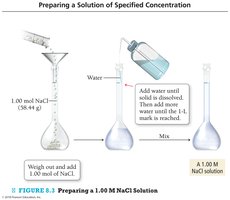
Example: To prepare 1.00 L of a 1.00 M NaCl solution, dissolve 1.00 mol (58.44 g) NaCl in water and dilute to 1.00 L.
Using Molarity in Calculations
Molarity can be used as a conversion factor between moles of solute and liters of solution.
Conversion:
Example: 0.500 M NaCl solution contains 0.500 mol NaCl per liter.


Solution Dilution
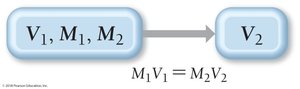
To prepare a less concentrated solution from a more concentrated stock solution, add more solvent. The amount of solute remains unchanged, only the volume changes.
Formula:
Application: Used to calculate the volume needed for dilution or the concentration after dilution.
Solution Stoichiometry
Stoichiometric Calculations with Solutions
Molarity allows chemists to relate the volume of a solution to the amount of solute, which is essential for stoichiometric calculations in reactions involving solutions.
Key Point: Use molarity and volume to find moles of reactant or product.
Example: 20.0 mL of 0.50 M NaCl contains .

Types of Aqueous Solutions and Solubility
Solubility and Dissolution
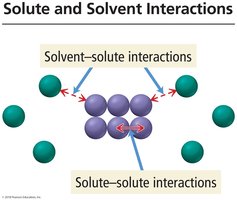
Solubility depends on the interactions between solute and solvent particles. "Like dissolves like" is a guiding principle: polar solutes dissolve in polar solvents, and nonpolar solutes in nonpolar solvents.
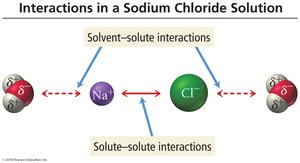
Solute-solute interactions: Forces holding solute particles together.
Solvent-solvent interactions: Forces holding solvent molecules together.
Solute-solvent interactions: Forces between solute and solvent; if strong enough, the solute dissolves.
Charge Distribution in Water
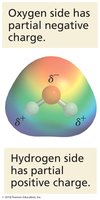
Water is a polar molecule with an uneven distribution of charge: oxygen is partially negative (δ–), and hydrogen is partially positive (δ+).
Dissolution of Ionic Compounds
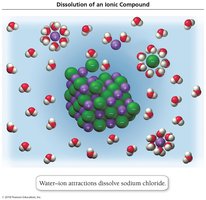
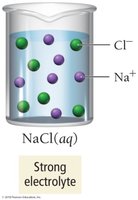
When ionic compounds like NaCl dissolve in water, the ions are separated and surrounded by water molecules, allowing them to move freely and conduct electricity.
Electrolyte and Nonelectrolyte Solutions
Electrolytes vs. Nonelectrolytes
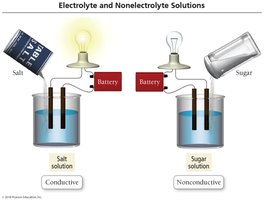
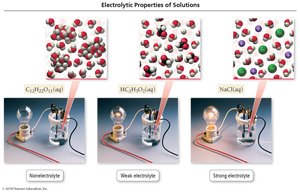
Electrolytes are substances that dissolve in water to produce a solution that conducts electricity. Nonelectrolytes do not conduct electricity when dissolved.
Electrolyte: Forms ions in solution; conducts electricity (e.g., NaCl).
Nonelectrolyte: Does not form ions; does not conduct electricity (e.g., sugar).
Classification of Electrolytes
Strong electrolytes: Completely dissociate into ions (e.g., NaCl, CaCl2).
Weak electrolytes: Partially dissociate (e.g., acetic acid).
Nonelectrolytes: Dissolve as intact molecules (e.g., C12H22O11).
Solubility of Ionic Compounds
Solubility and Insolubility
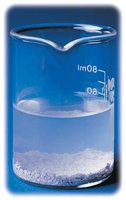
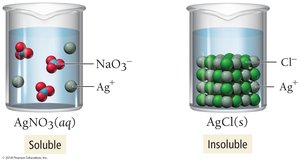
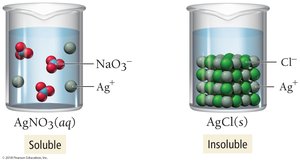
Not all ionic compounds are soluble in water. Solubility depends on the nature of the ions and their interactions with water.
Soluble: Dissolves in water (e.g., AgNO3).
Insoluble: Does not dissolve (e.g., AgCl).
Precipitation Reactions
Formation of Precipitates
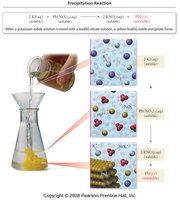
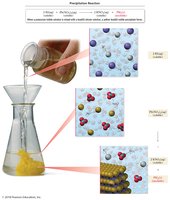
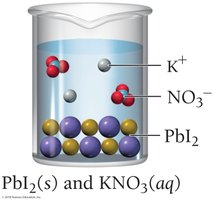
Precipitation reactions occur when two aqueous solutions of ionic compounds are mixed and an insoluble product (precipitate) forms.
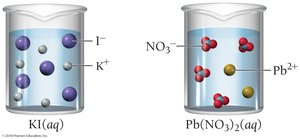
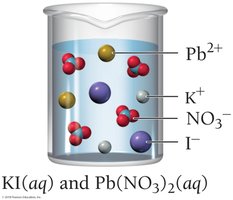
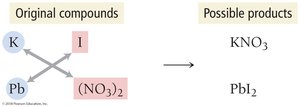
Example: 2 KI(aq) + Pb(NO3)2(aq) → PbI2(s) + 2 KNO3(aq)
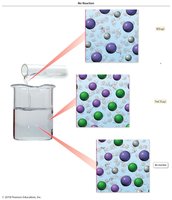
No Precipitate Formation
If all ions remain soluble, no reaction occurs.
Predicting Precipitation Reactions
Identify ions in reactants.
Determine possible products by exchanging ions.
Use solubility rules to predict if a product will precipitate.
Balance the equation.
Representing Aqueous Reactions
Molecular, Complete Ionic, and Net Ionic Equations
Reactions in solution can be represented in three ways:
Molecular equation: Shows compounds as intact molecules.
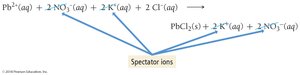
Complete ionic equation: Shows all strong electrolytes as ions.
Net ionic equation: Shows only the ions and molecules directly involved in the reaction, omitting spectator ions.
Acids and Bases
Properties and Classification
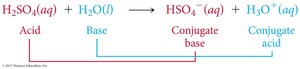
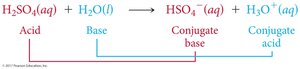
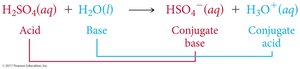
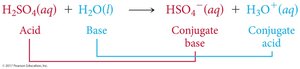
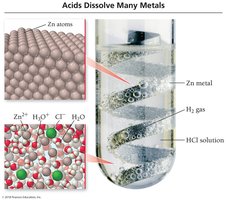
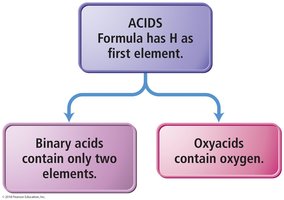
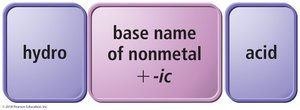
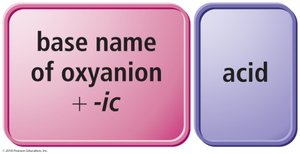
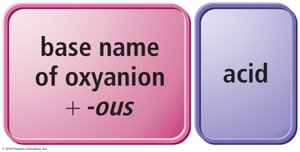
Acids are molecular compounds that produce H+ ions in water. Bases produce OH– ions. Acids are classified as binary acids (H+ and a nonmetal) or oxyacids (H+ and a polyatomic ion).
Arrhenius acid: Produces H+ in water.
Arrhenius base: Produces OH– in water.
Acid–Base Reactions
Neutralization Reactions
Acid–base reactions involve the combination of H+ from the acid and OH– from the base to form water. The cation from the base and the anion from the acid form a salt.
General net ionic equation:
Example: HCl(aq) + NaOH(aq) → NaCl(aq) + H2O(l)
Acid–Base Titrations
Titration Process
Titration is a technique used to determine the concentration of an unknown solution by reacting it with a solution of known concentration (titrant). The endpoint is detected by an indicator, and the equivalence point is when moles of acid equal moles of base.
Key formula: (for strong acid–strong base titrations)
Gas-Evolution Reactions
Formation of Gases
Gas-evolution reactions produce a gas as a product, often resulting in bubbling. These reactions can occur directly or through decomposition of an intermediate product.
Example: NaHCO3(aq) + HCl(aq) → NaCl(aq) + H2O(l) + CO2(g)
Oxidation–Reduction (Redox) Reactions
Electron Transfer and Oxidation States
Redox reactions involve the transfer of electrons between reactants. Oxidation is the loss of electrons, and reduction is the gain of electrons. Oxidation states are assigned to track electron flow.
Oxidation: Increase in oxidation state; loss of electrons.
Reduction: Decrease in oxidation state; gain of electrons.
Reducing agent: Causes reduction; is itself oxidized.
Oxidizing agent: Causes oxidation; is itself reduced.
Rules for Assigning Oxidation States
Free elements: 0
Monatomic ions: Equal to their charge
Sum in compounds: 0
Sum in polyatomic ions: Equals ion charge
Group I metals: +1; Group II metals: +2
Nonmetals: Follow priority table
Redox and the Activity Series
The activity series ranks metals by their tendency to lose electrons. A metal higher in the series will reduce ions of metals lower in the series.
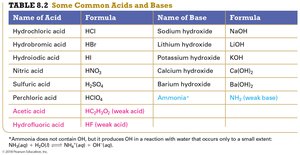
Summary Table: Common Acids and Bases
Name of Acid | Formula | Name of Base | Formula |
|---|---|---|---|
Hydrochloric acid | HCl | Sodium hydroxide | NaOH |
Hydrobromic acid | HBr | Lithium hydroxide | LiOH |
Hydroiodic acid | HI | Potassium hydroxide | KOH |
Nitric acid | HNO3 | Calcium hydroxide | Ca(OH)2 |
Sulfuric acid | H2SO4 | Barium hydroxide | Ba(OH)2 |
Acetic acid | HC2H3O2 (weak acid) | Ammonia* | NH3 (weak base) |
Hydrofluoric acid | HF (weak acid) |
*Ammonia does not contain OH–, but produces OH– in water by reaction.
