 Back
Chapter 8: Introduction to Solutions and Aqueous Reactions – Study Notes
Study Guide - Smart Notes
 Tailored notes based on your materials, expanded with key definitions, examples, and context.
Solutions and Solution Concentration
Definition and Properties of Solutions
A solution is a homogeneous mixture of two or more substances. The substance present in the largest amount is called the solvent, while the substance(s) present in smaller amounts are called solute(s). Solutions can be described as dilute (small amount of solute relative to solvent) or concentrated (large amount of solute relative to solvent).
Solute: The substance dissolved in the solvent.
Solvent: The substance in which the solute is dissolved.
Homogeneous mixture: Uniform composition throughout.
Quantitative Description: Molarity
Molarity (M) is the most common unit for expressing solution concentration in chemistry. It is defined as the number of moles of solute per liter of solution:
Formula:
Example: If 10.0 g of NaCl (molar mass = 58.44 g/mol) are dissolved in 2.0 L of water, the molarity is , so .
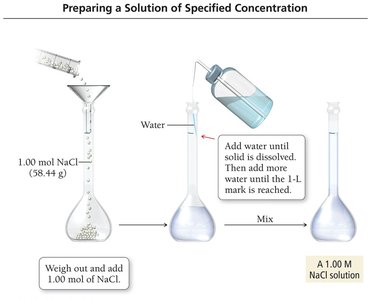
Using Molarity in Calculations
Molarity can be used as a conversion factor between moles of solute and liters of solution. This is useful for stoichiometric calculations in reactions involving solutions.
Conversion:
Example: A 0.500 M NaCl solution contains 0.500 mol NaCl per liter.


Practice: Solution Concentration
Calculating Molarity
To calculate the molarity of a solution, use the mass of solute, its molar mass, and the volume of solution.
Example: 0.773 g of Pb(NO3)2 (molar mass = 331.21 g/mol) in 100.0 mL (0.100 L) gives , so .
Solution Stoichiometry
Stoichiometric Calculations with Solutions
Molarity allows conversion between volume and moles for reactants and products in chemical reactions. This is essential for determining the amounts needed or produced in reactions involving solutions.
Example: To find the moles of sodium ions in 20.0 mL of 0.50 M NaCl: NaCl, which gives 0.010 mol Na+.

Dilution of Solutions
Effects of Dilution on Concentration
Dilution is the process of reducing the concentration of a solution by adding more solvent. The amount of solute remains constant, but the total volume increases. The relationship is given by:
Formula:
Key Point: Moles of solute before dilution = moles of solute after dilution.
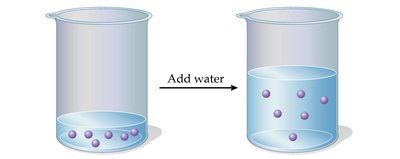
Solute-Solvent Interactions and Dissolution
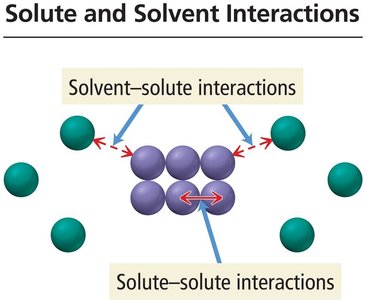
Solute and Solvent Interactions
When a solute dissolves, attractive forces between the solute and solvent compete with those within the solute and solvent. If the solute-solvent attractions are strong enough, the solute dissolves.
Solute-solvent interactions: Responsible for dissolution.
Solute-solute and solvent-solvent interactions: Must be overcome for dissolution to occur.
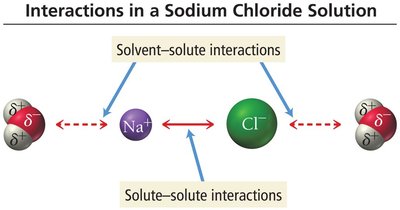
Dissolution of Ionic Compounds
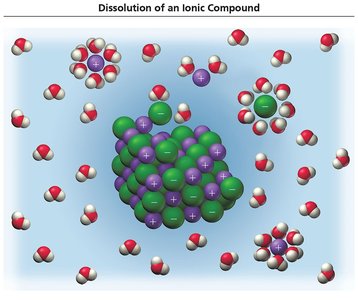
When ionic compounds such as NaCl dissolve in water, the ions are separated and surrounded by water molecules, which insulate them from each other and allow them to move freely.
Result: The solution contains free ions, which can conduct electricity.
Electrolytes and Nonelectrolytes
Electrolyte Solutions
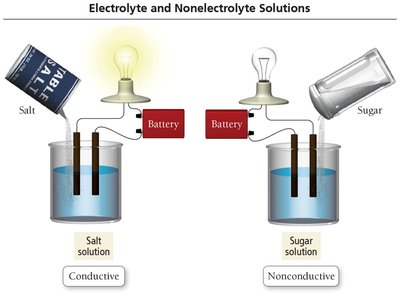
Electrolytes are substances that dissolve in water to produce a solution that conducts electricity. Nonelectrolytes do not conduct electricity when dissolved.
Electrolyte: Conducts electricity (e.g., NaCl solution).
Nonelectrolyte: Does not conduct electricity (e.g., sugar solution).
Electrolyte Strength
Electrolytes are classified as strong or weak based on their degree of dissociation in water.
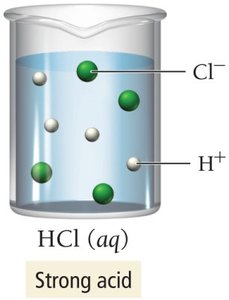
Strong electrolytes: Completely dissociate into ions (e.g., NaCl).
Weak electrolytes: Partially dissociate (e.g., acetic acid).
Nonelectrolytes: Do not form ions (e.g., sugar).
Solubility of Ionic Compounds
Solubility Rules
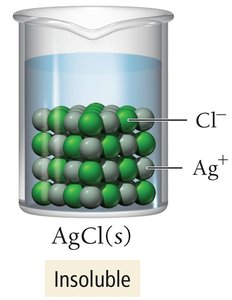
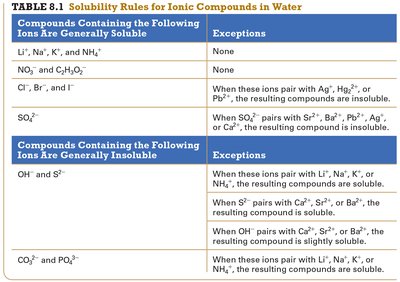
Not all ionic compounds are soluble in water. Solubility depends on the ions present and their interactions. Solubility rules help predict whether a compound will dissolve.
Soluble: Dissolves in water.
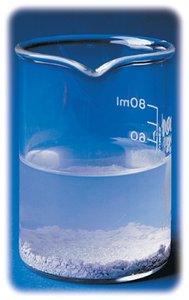
Insoluble: Does not dissolve; forms a solid (precipitate).
Precipitation Reactions
Formation of Precipitates
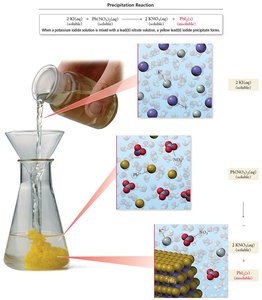
Precipitation reactions occur when two solutions of ionic compounds are mixed and an insoluble compound forms as a solid (precipitate).
Example:
Aqueous Reactions and Ionic Equations
Molecular, Complete Ionic, and Net Ionic Equations
Chemical equations for reactions in solution can be written in three forms:
Molecular equation: Shows compounds as intact molecules.
Complete ionic equation: Shows all strong electrolytes as ions.
Net ionic equation: Shows only the ions and compounds that participate in the reaction; spectator ions are omitted.
Acids and Bases
Acid and Base Definitions
Acids are molecular compounds that produce H+ ions in water. Bases produce OH- ions. Strong acids and bases dissociate completely; weak acids and bases dissociate partially.
Arrhenius acid: Produces H+ in water.
Arrhenius base: Produces OH- in water.
Acid-Base Reactions and Titrations
Neutralization Reactions
When an acid reacts with a base, a neutralization reaction occurs, producing water and a salt. Titrations are used to determine the concentration of an unknown solution by reacting it with a solution of known concentration.
Oxidation-Reduction (Redox) Reactions
Redox Reactions and Oxidation Numbers
Redox reactions involve the transfer of electrons between reactants. Oxidation is the loss of electrons; reduction is the gain of electrons. Oxidation numbers are assigned to track electron flow.
Oxidizing agent: Causes oxidation; is reduced.
Reducing agent: Causes reduction; is oxidized.
Summary Table: Solubility Rules for Ionic Compounds in Water
Compounds Containing the Following Ions Are Generally Soluble | Exceptions |
|---|---|
Li+, Na+, K+, and NH4+ | None |
NO3- and C2H3O2- | None |
Cl-, Br-, and I- | When these ions pair with Ag+, Hg22+, or Pb2+, the resulting compound is insoluble. |
SO42- | When SO42- pairs with Sr2+, Ba2+, Pb2+, or Ca2+, the resulting compound is insoluble. |
Compounds Containing the Following Ions Are Generally Insoluble | Exceptions |
OH- and S2- | When these ions pair with Li+, Na+, K+, or NH4+, the resulting compounds are soluble. When S2- pairs with Ca2+, Sr2+, or Ba2+, the resulting compound is soluble. When OH- pairs with Ca2+, Sr2+, or Ba2+, the resulting compound is slightly soluble. |
CO32- and PO43- | When these ions pair with Li+, Na+, K+, or NH4+, the resulting compounds are soluble. |
