 Back
Chapter 8: Solutions and Aqueous Reactions – General Chemistry Study Notes
Study Guide - Smart Notes
 Tailored notes based on your materials, expanded with key definitions, examples, and context.
Solutions and Concentrations
Definition and Examples
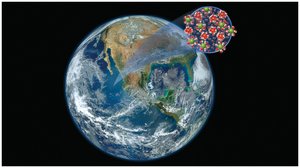
A solution is a homogeneous mixture composed of a solvent and one or more solutes. When water (H2O) is the solvent, the solution is termed an aqueous solution. Common examples include oceans, lakes, blood, and beverages. The substance dissolved in the solvent is called the solute.
Concentration Units
Concentration describes the quantity of solute dissolved in a specific quantity of solvent. Several units are used:
Mass-to-mass: mg/kg (mass solute/mass solvent)
Parts per million (ppm): 1 ppm = 1 mg/kg = 1 g/106 g
Mass-to-volume: mg/L (mass solute/volume solvent)
Molarity (M): mol/L (moles solute/volume solvent)
Molality: mol/kg (moles solute/mass solvent)
Common Ions in Solution
Many types of ions are soluble in water, including Na+, K+, Mg2+, Ca2+, Cl-, SO42-, and others. Milli-mole (mmol) and milli-molar (mM) are commonly used for small concentrations:
1 mmol = 10-3 mol
1 mM = 1 mmol/L = 10-3 M
Comparison of Seawater and Human Serum
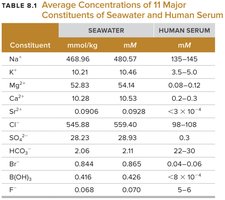
The table below compares the average concentrations of major ions in seawater and human serum.
Constituent | Seawater (mmol/kg) | Seawater (mM) | Human Serum (mM) |
|---|---|---|---|
Na+ | 468.96 | 480.57 | 135–145 |
K+ | 10.21 | 10.46 | 3.5–5.0 |
Mg2+ | 52.38 | 54.14 | 0.2–0.3 |
Ca2+ | 10.28 | 10.53 | 0.2–0.3 |
Sr2+ | 0.0906 | 0.0928 | < 3 × 10⁻⁴ |
Cl- | 545.88 | 559.40 | 98–108 |
SO42- | 28.23 | 28.93 | 0.3 |
HCO3- | 2.06 | 2.11 | 22–30 |
Br- | 0.844 | 0.865 | 0.04–0.06 |
B(OH)3 | 0.146 | 0.149 | 0.01 |
F- | 0.068 | 0.070 | 5–6 |
Calculating Mass, Moles, and Volume from Concentration
Mass and Moles Calculations
To determine the number of moles or grams of a solute in a solution, use the following steps:
Calculate moles:
Convert moles to mass:
Note: Ions have the same mass as their neutral atoms because electrons have negligible mass.
Unit Conversions
Concentration units can be converted as needed, e.g., mg/mL to molarity (M) using molar mass and volume relationships.
Dilutions
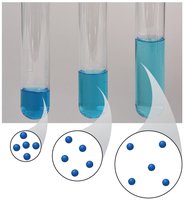
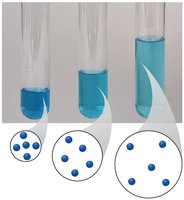
Diluting a solution decreases the concentration of solute(s) by adding more solvent. The number of moles of solute remains constant, but the volume increases.
Key equation:
Electrolyte Solutions
Definition and Importance
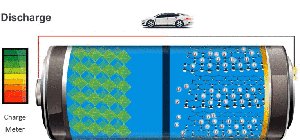
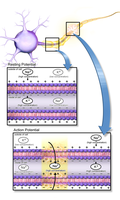
Electrolyte solutions contain dissolved ions, which allow for the conduction of electricity. These are crucial for batteries and biological functions such as muscular activity.
Common ions: H+, Na+, K+, Cl-, OH-, SO42-
Electrolyte Strength
Strong vs Weak Electrolytes
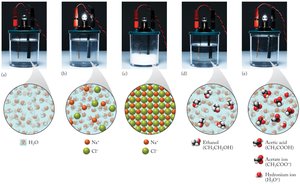
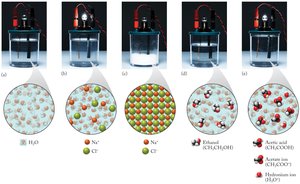
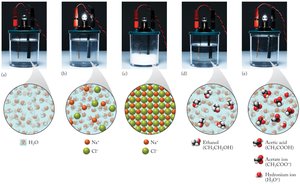
Electrolytes are classified based on their ability to dissociate in water:
Strong electrolytes: Completely dissociate into ions (e.g., NaCl)
Weak electrolytes: Partially dissociate (e.g., acetic acid)
Non-electrolytes: Do not produce ions (e.g., ethanol)
Solubility of Ionic Compounds
Solubility Rules and Dissociation
Solubility determines whether a compound will dissolve in water and dissociate into ions. Soluble compounds dissociate completely, while insoluble compounds remain as solids.
Example: NaCl is soluble, AgCl is insoluble.
“Salt” refers to any ionic compound that can dissociate in water.
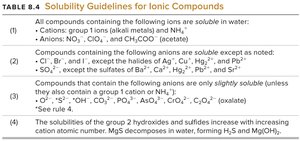
Solubility Guidelines
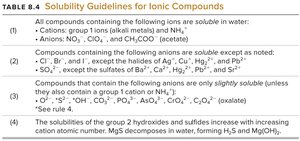
The following table summarizes solubility rules for ionic compounds:
Rule | Description |
|---|---|
1 | All compounds containing group 1 cations (alkali metals) and NH4+ are soluble. Anions: NO3-, ClO4-, CH3COO- (acetate) are soluble. |
2 | Compounds containing Cl-, Br-, I- are soluble except with Ag+, Hg22+, Pb2+. SO42- is soluble except with Ba2+, Hg2+, Pb2+, Sr2+. |
3 | Compounds with O2-, S2-, CO32-, PO43-, C2O42- are only slightly soluble unless paired with group 1 cation or NH4+. |
4 | Group 2 hydroxides and sulfides increase in solubility with increasing cation atomic number. |
Precipitation Reactions
Definition and Equations
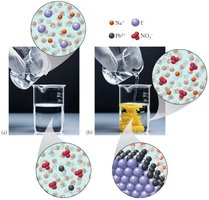
A precipitation reaction occurs when two soluble compounds react in water to form an insoluble compound (precipitate). The reaction can be written in three forms:
Molecular equation:
Total ionic equation:
Net ionic equation:
Saturated and Supersaturated Solutions
Solubility and Crystal Formation
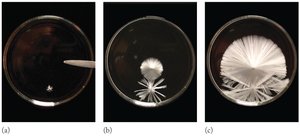
Solubility of ionic compounds in water increases with temperature. A saturated solution contains the maximum amount of dissolved solute for a given temperature. Supersaturation occurs when a saturated solution is cooled, sometimes allowing more solute to remain dissolved than is typical. Spontaneous precipitation can occur, often initiated by a seed crystal.
Acids and Bases
Acids: Properties and Types
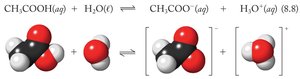
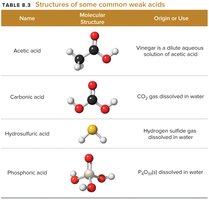
Acids are molecules that dissociate in water to release H+ ions, often in the form of hydronium ion (H3O+). Acids are classified as:
Strong acids: Completely dissociate (e.g., HCl, HNO3)
Weak acids: Partially dissociate (e.g., acetic acid)
Polyprotic Acids
Polyprotic acids contain more than one dissociable hydrogen atom. Examples include:
Monoprotic: HCl
Diprotic: H2CO3
Triprotic: H3PO4
Naming Acids
Binary acids: Use "hydro-" prefix and "-ic acid" suffix (e.g., HCl: hydrochloric acid)
Oxoacids: If the oxoanion ends in "-ate," use "-ic acid"; if "-ite," use "-ous acid" (e.g., HNO3: nitric acid from nitrate)
Bases: Properties and Types
Bases are molecules that accept H+ ions. The Bronsted-Lowry definition states:
Acid: Donates H+
Base: Accepts H+
Strong bases (e.g., NaOH, KOH) completely dissociate in water, producing OH- ions. Weak bases (e.g., NH3) only partially dissociate.
Amphoteric/Amphiprotic Substances
Substances that can act as both an acid and a base are called amphoteric or amphiprotic. Water is a classic example.
Acid-Base Reactions and Neutralization
Neutralization Reactions
Acid-base reactions that produce water are called neutralization reactions. For strong acid-strong base reactions:
Molecular equation:
Total ionic equation:
Net ionic equation:
Titrations
Principles and Process
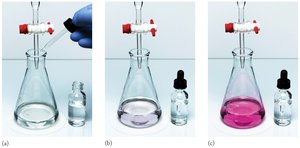
Titrations are analytical techniques used to determine the concentration of a solute by reacting it with a solution of known concentration (titrant). The equivalence point is reached when the exact number of moles of titrant needed for the reaction have been added. An indicator dye is often used to signal the endpoint.
Redox Reactions
Reduction and Oxidation
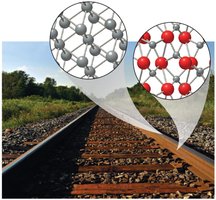
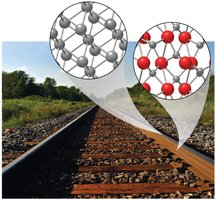
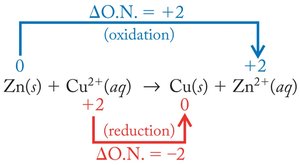
Redox reactions involve the transfer of electrons between reactants. Reduction is the gain of electrons, and oxidation is the loss of electrons. The mnemonic "OIL RIG" helps remember: Oxidation Is Loss, Reduction Is Gain.
Assigning Oxidation Numbers
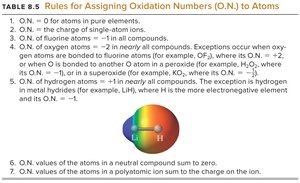
Oxidation numbers are assigned based on a set of rules:
O.N. = 0 for pure elements
O.N. = charge for single-atom ions
O.N. of fluorine = -1 in all compounds
O.N. of oxygen = -2 in nearly all compounds (exceptions exist)
O.N. of hydrogen = +1 in nearly all compounds (except in metal hydrides)
Sum of O.N. values in a neutral compound is zero
Sum of O.N. values in a polyatomic ion equals the ion's charge
Reductants vs Oxidants
An oxidant (oxidizing reagent) accepts electrons and is reduced in the reaction. A reductant (reducing reagent) donates electrons and is oxidized. For example, in the reaction:
Zn is the reductant, Cu2+ is the oxidant.
Practice Problems
Solubility and Redox Practice
Practice problems involve predicting solubility, assigning oxidation numbers, and identifying oxidants and reductants. For example:
Assign oxidation numbers to all reactants and products.
Label each reactant as oxidant or reductant.
Determine the net number of electrons transferred.
Additional info: These notes expand on brief points from the original slides, providing definitions, examples, and equations for clarity and completeness.
