 Back
Chapter 8: The Quantum-Mechanical Model of the Atom – Study Notes
Study Guide - Smart Notes
 Tailored notes based on your materials, expanded with key definitions, examples, and context.
Chapter 8: The Quantum-Mechanical Model of the Atom
Schrödinger's Cat and Quantum Strangeness
The "Schrödinger's Cat" thought experiment illustrates the peculiar nature of quantum mechanics, where a system can exist in multiple states simultaneously until observed. This concept, known as superposition, does not translate to the macroscopic world, but is fundamental to understanding atomic behavior.

Learning Goals and Key Skills
Describe the quantum-mechanical model of the atom
Discuss the wave-like and particle-like characteristics of light
Convert between frequency and wavelength
Calculate the energy of a single photon
Explain the Bohr Model and emission spectra
Describe the wave characteristics of electrons
Understand the four quantum numbers: n, l, ml, ms
Describe the shape and size of atomic orbitals
The Wave Nature of Light
Electromagnetic Radiation and Its Properties
Light is a form of energy consisting of oscillating electric and magnetic fields, known as electromagnetic radiation. In a vacuum, electromagnetic waves travel at the speed of light, c = 3.00 \times 10^8 \text{ m/s}. Understanding the dual nature of light is essential for explaining atomic structure and electron behavior.
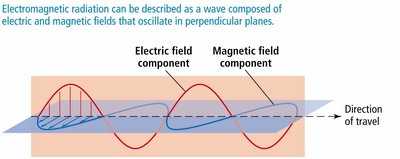
Wave-Like Characteristics of Electromagnetic Radiation
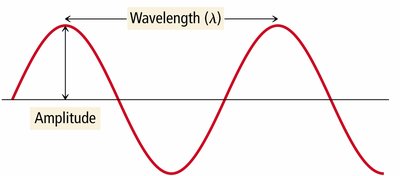
Light waves are characterized by three main properties:
Amplitude: The vertical height of a crest or depth of a trough, related to the intensity of the wave.
Wavelength (\(\lambda\)): The distance between two adjacent crests, measured in meters.
Frequency (\(\nu\)): The number of cycles passing a point per second, measured in Hz (s-1).
The relationship between wavelength, frequency, and the speed of light is given by:
The Electromagnetic Spectrum
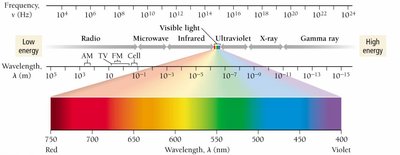
The electromagnetic spectrum encompasses all types of electromagnetic radiation, from radio waves to gamma rays. Visible light is only a small portion of this spectrum, ranging from approximately 400 nm (violet) to 750 nm (red).
Interference and Diffraction
Interference of Waves
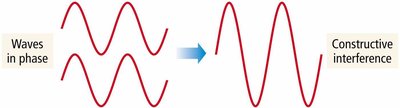
Electromagnetic waves can interact through interference:
Constructive interference: Waves in phase combine to produce a wave with greater amplitude.
Destructive interference: Waves out of phase cancel each other, reducing amplitude.
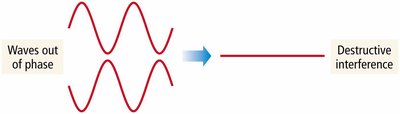
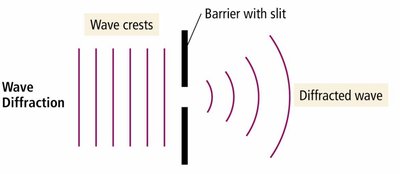
Diffraction
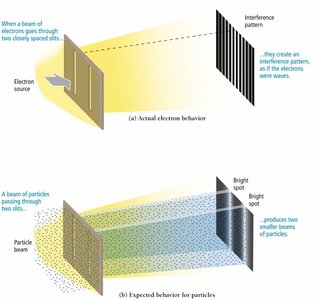
Diffraction occurs when a wave bends around an obstacle or passes through a slit, producing characteristic patterns.
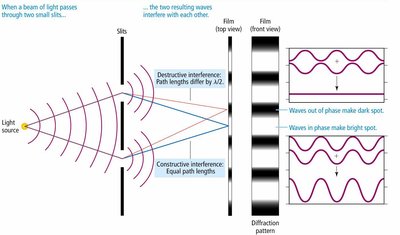
Double Slit Experiment
The double slit experiment demonstrates both interference and diffraction, revealing the wave nature of light.
Particle-Like Characteristics of Light
Phenomena Explained by Particle Model
Blackbody radiation: Emission of light from hot objects.
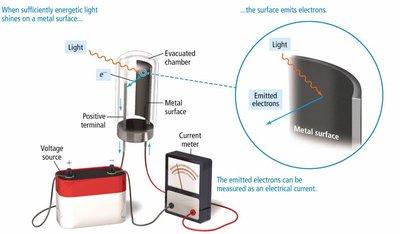
Photoelectric effect: Emission of electrons from metal surfaces when light shines on them.
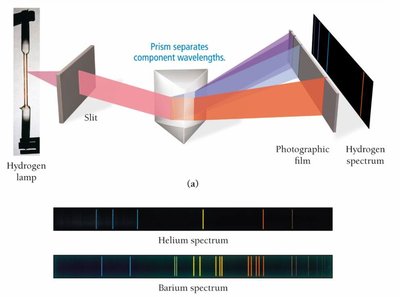
Emission spectra: Light emitted from electronically excited gas atoms.
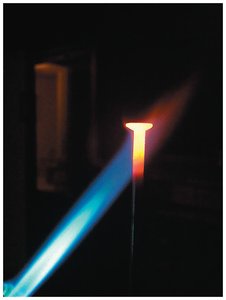
Photons and Quantum of Light
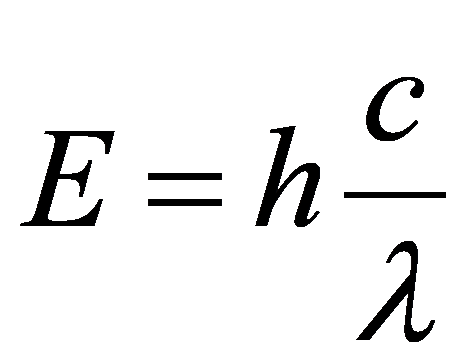
Light energy is quantized in packets called photons. The energy of a photon is given by:
or
h: Planck's constant,
c: Speed of light,
\(\nu\): Frequency
\(\lambda\): Wavelength

Atomic Spectroscopy and the Bohr Model
Emission Spectra
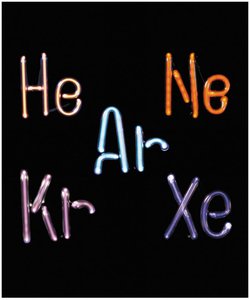
Each element produces a unique emission spectrum, acting as a fingerprint. When electrons transition between energy levels, they emit photons of specific wavelengths.
The Bohr Model
Niels Bohr proposed that electrons orbit the nucleus at specific distances with quantized energies. Electron transitions between these orbits result in emission or absorption of light.
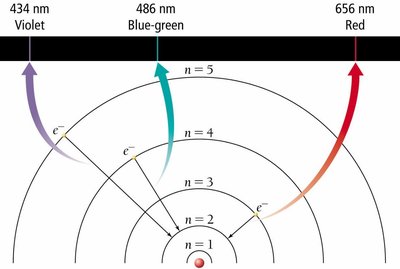
Excitation and Relaxation
When an electron absorbs energy, it moves to a higher energy level (excitation). When it returns to a lower energy level, it emits light (relaxation).
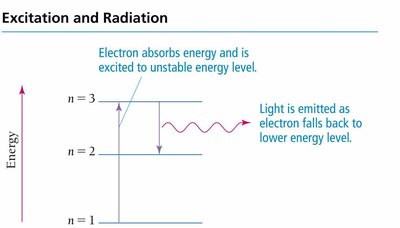
Energy Change in Hydrogen Atom
The energy change for an electron transition in a hydrogen atom is given by:
The Wave Nature of Matter
Electron Diffraction and de Broglie Wavelength
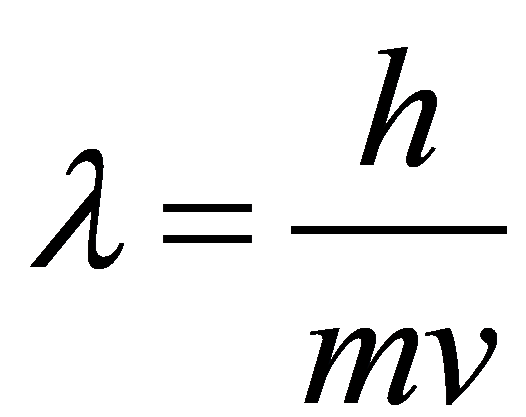
Electrons exhibit wave-like behavior, such as diffraction and interference. The wavelength of a particle is given by the de Broglie equation:
h: Planck's constant
m: Mass of the particle
v: Velocity of the particle
Heisenberg Uncertainty Principle
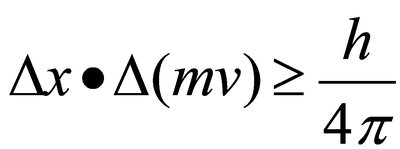
It is impossible to simultaneously know the exact position and momentum of a subatomic particle. The uncertainty principle is mathematically expressed as:
Quantum Mechanics and Probability Distribution
Probability Density and Orbitals
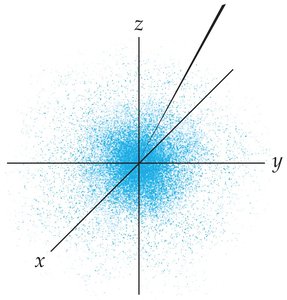
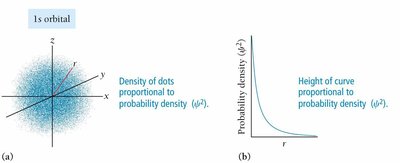
Quantum mechanics describes the probability of finding an electron in a certain region, known as the probability density or electron density. Orbitals are regions of space with high probability of finding electrons.
Each orbital has a characteristic shape and energy
Wave functions describe these orbitals
One orbital can hold a maximum of two electrons
Quantum Numbers and Atomic Orbitals
The Four Quantum Numbers
Quantum numbers are used to describe the properties of atomic orbitals and electrons:
n (Principal quantum number): Determines the size and energy of the orbital (positive integers).
l (Angular momentum quantum number): Determines the shape of the orbital (0 to n-1).
ml (Magnetic quantum number): Determines the orientation of the orbital (-l to +l).
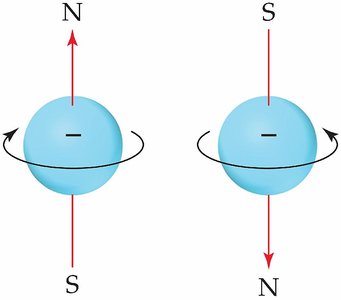
ms (Spin quantum number): Specifies the spin of the electron (+1/2 or -1/2).
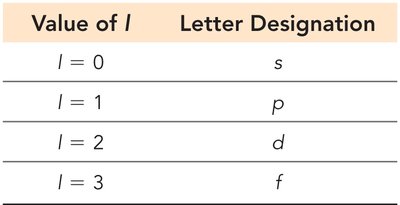
Letter designations for l values:
Value of l | Letter Designation |
|---|---|
l = 0 | s |
l = 1 | p |
l = 2 | d |
l = 3 | f |
Magnetic and Spin Quantum Numbers
The magnetic quantum number (ml) specifies the orientation of the orbital, while the spin quantum number (ms) specifies the electron's spin direction.
Shapes of Atomic Orbitals
s Orbitals (l = 0)
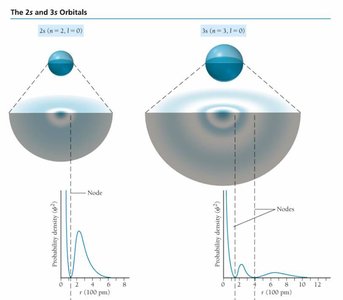
s orbitals are spherical in shape. The 1s orbital is the lowest energy orbital, while 2s and 3s orbitals are larger and contain nodes (regions where the probability of finding an electron is zero).
p Orbitals (l = 1)
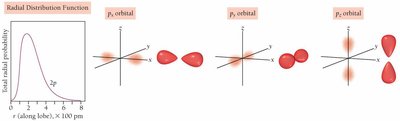
p orbitals have two lobes of electron density and are oriented along the x, y, and z axes. Each principal quantum number n ≥ 2 contains three p orbitals.
d Orbitals (l = 2)
d orbitals have more complex shapes and are present in principal quantum numbers n ≥ 3. There are five d orbitals for each n ≥ 3.
f Orbitals (l = 3)
f orbitals are even more complex and are present in principal quantum numbers n ≥ 4. There are seven f orbitals for each n ≥ 4.
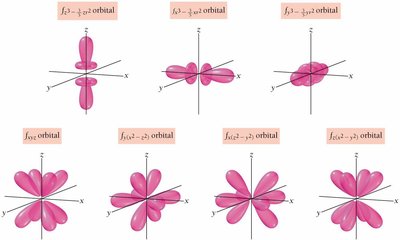
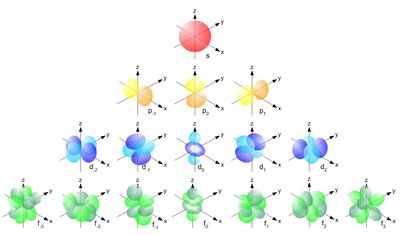
Summary of Orbital Shape and Relationship to ml
Atoms are often drawn as spheres because electrons occupy many different orbitals, and the overall shape is obtained by superimposing all orbitals.
Additional info: These notes provide a comprehensive overview of the quantum-mechanical model of the atom, including the wave and particle nature of light, quantum numbers, and atomic orbitals, suitable for General Chemistry students.
