 Back
BackChapter 9: Chemical Bonding I – Lewis Theory (General Chemistry II Study Notes)
Study Guide - Smart Notes
 Tailored notes based on your materials, expanded with key definitions, examples, and context.
Chapter 9: Chemical Bonding I – Lewis Theory
Introduction to Chemical Bonding
Chemical bonding describes the forces that hold atoms together in compounds. There are three primary types of chemical bonds: ionic, covalent, and metallic. Understanding these bonds is essential for explaining the properties and behaviors of substances.
Ionic bonds: Electrostatic forces between oppositely charged ions (e.g., NaCl).
Covalent bonds: Sharing of electrons between atoms (e.g., H2O).
Metallic bonds: Metal nuclei floating in a 'sea' of delocalized electrons (e.g., Na metal).
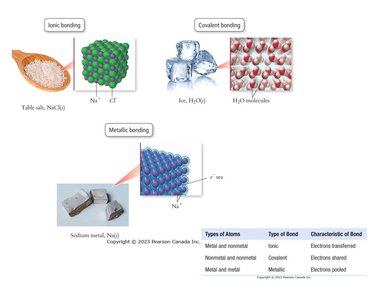
These bonds can be classified by the types of atoms involved and the nature of electron distribution:
Types of Atoms | Type of Bond | Characteristic of Bond |
|---|---|---|
Metal and nonmetal | Ionic | Electrons transferred |
Nonmetal and nonmetal | Covalent | Electrons shared |
Metal and metal | Metallic | Electrons pooled |
Intramolecular vs. Intermolecular Forces
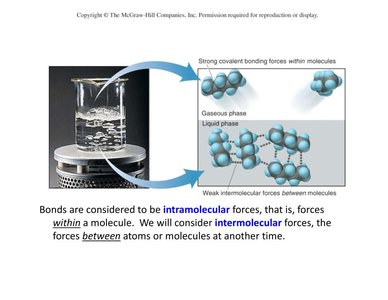
Bonds within a molecule are called intramolecular forces. These are distinct from intermolecular forces, which are the forces between molecules. Intramolecular forces are generally much stronger and determine the chemical identity of a substance.
Physical Properties and Bond Types
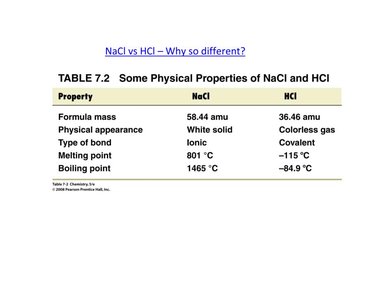
The type of bonding in a compound greatly affects its physical properties. For example, sodium chloride (NaCl) is an ionic solid with a high melting point, while hydrogen chloride (HCl) is a covalent compound and a gas at room temperature.
Property | NaCl | HCl |
|---|---|---|
Formula mass | 58.44 amu | 36.46 amu |
Physical appearance | White solid | Colorless gas |
Type of bond | Ionic | Covalent |
Melting point | 801 °C | -115 °C |
Boiling point | 1465 °C | -84.9 °C |
Lewis Structures and the Octet Rule
Writing Lewis Symbols
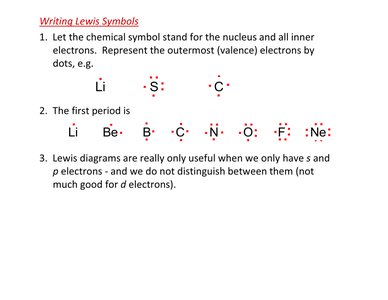
Lewis symbols represent the valence electrons of an atom as dots around the chemical symbol. These diagrams are most useful for main group elements (s and p block).
Each dot represents a valence electron.
For example, the first period elements are represented as:
Li • Be : B :• C :•• N :••• O :•••• F :••••• Ne :••••••
Lewis Structures and the Octet Rule
The octet rule states that atoms tend to gain, lose, or share electrons to achieve a full outer shell of eight electrons (except for hydrogen, which achieves two). Lewis structures help visualize this process.
Lewis symbols show the number of valence electrons available for bonding.
Noble gases are unreactive due to their filled valence shells.
Ionic Bonding and Lattice Energies
Ionic Bond Formation
Ionic bonds form when electrons are transferred from a metal to a nonmetal, resulting in the formation of cations and anions. For example, sodium reacts with chlorine to form sodium chloride:
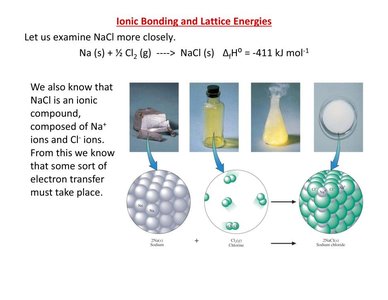
Each atom achieves an octet by electron transfer, forming stable ions.
Observations from Lewis Symbols
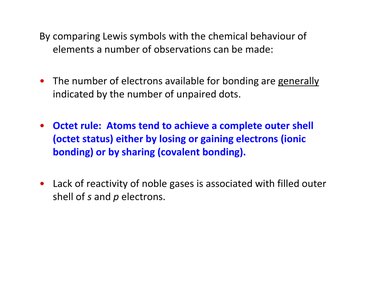
The number of unpaired dots indicates the number of electrons available for bonding.
Atoms achieve octet status by losing/gaining (ionic) or sharing (covalent) electrons.
Noble gases are unreactive due to filled s and p subshells.
Energetics of Ionic Bond Formation
The formation of ionic bonds involves ionization energy (IE) and electron affinity (EA):
Ionization energy: Energy required to remove an electron from an atom (always positive).
Electron affinity: Energy released when an atom gains an electron (usually negative).
For sodium chloride:
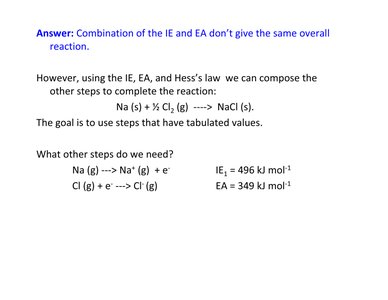
However, the overall reaction is exothermic due to the release of lattice energy when ions form a crystal lattice.
Lattice Energy
Lattice energy is the energy released when gaseous ions combine to form an ionic solid. It is always exothermic and depends on the charges and sizes of the ions.
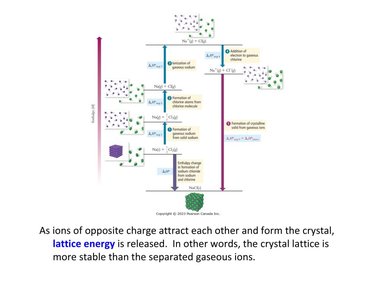
Lattice energy increases with higher ionic charges and smaller ionic radii.
Coulomb's Law and Lattice Energy Trends
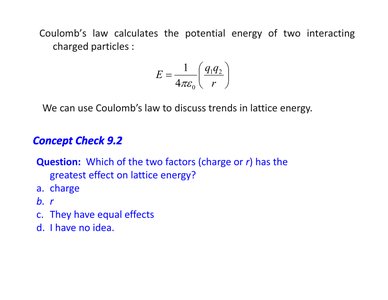
Coulomb's law describes the potential energy between two charged particles:
Lattice energy increases with greater charge magnitude and decreases with larger ionic radius.
Comparing Lattice Energies
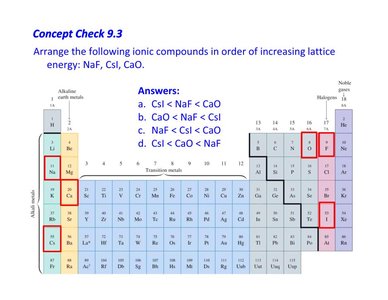
Lattice energies can be compared across compounds. For example, CaO has a much higher lattice energy than NaF due to higher charges on Ca2+ and O2−:
Compound | Lattice Energy (kJ mol-1) |
|---|---|
NaF | -910 |
CaO | -3414 |
Covalent Bonding and Lewis Structures
Covalent Bonding
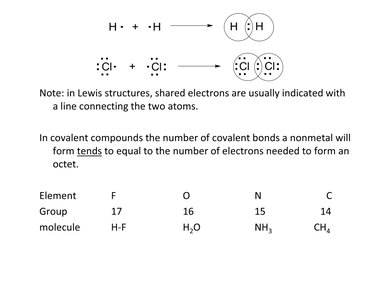
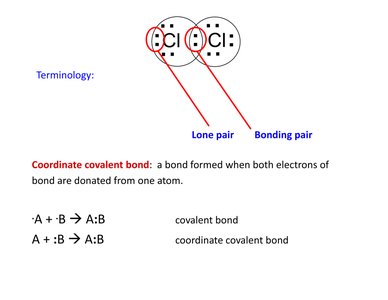
Covalent bonds form when two atoms share electrons to achieve a stable octet. This type of bonding is typical between nonmetals.
Each shared pair of electrons constitutes one covalent bond.
Lewis structures use lines to represent shared pairs (bonds).
Coordinate Covalent Bonds
A coordinate covalent bond is formed when both electrons in a shared pair come from the same atom. This is indicated in Lewis structures and is important in complex ions and molecules.
Multiple Bonds
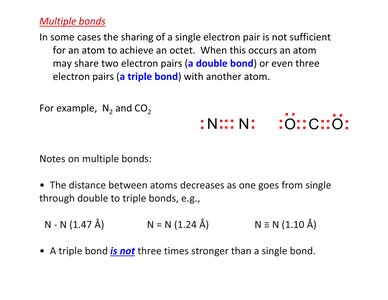
Atoms may share more than one pair of electrons, forming double or triple bonds. For example, N2 has a triple bond, and CO2 has double bonds between carbon and oxygen.
Bond length decreases as bond order increases (single > double > triple).
Triple bonds are not three times as strong as single bonds, but they are stronger and shorter.
Drawing Lewis Structures
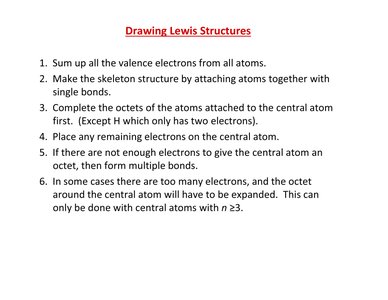
Steps for drawing Lewis structures:
Sum all valence electrons from all atoms.
Arrange atoms and connect with single bonds (skeleton structure).
Complete octets of outer atoms first, then central atom.
Place remaining electrons on the central atom.
If central atom lacks an octet, form multiple bonds as needed.
For atoms with n ≥ 3, the octet can be expanded.
Bond Energies and Bond Lengths
Energetics of Covalent Bonds
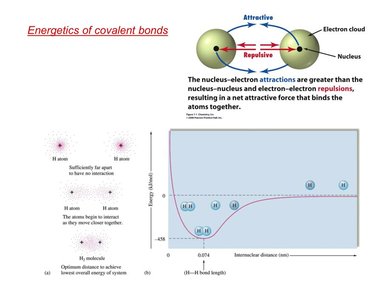
The formation of covalent bonds involves a balance between attractive and repulsive forces. The optimal bond length is where the energy is minimized.
Bond Enthalpy and Bond Energy
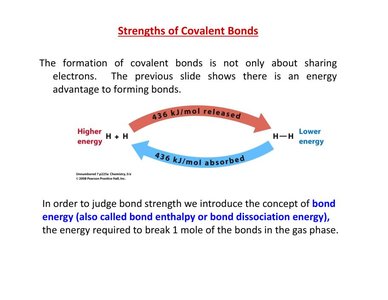
Bond enthalpy (or bond energy) is the energy required to break one mole of a bond in the gas phase. It is always positive because energy is required to break bonds.
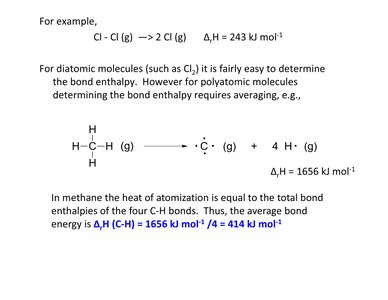
For diatomic molecules, bond enthalpy is straightforward (e.g., Cl2).
For polyatomic molecules, average bond energies are used.
For example, in methane:
for 4 C–H bonds, so average bond energy is .
Strengths of Covalent Bonds
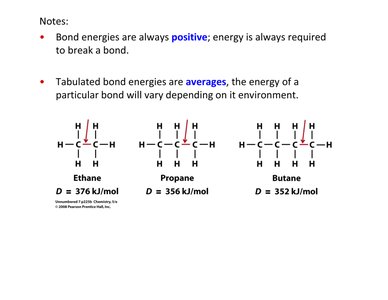
Bond energy is a measure of bond strength. The higher the bond energy, the stronger the bond. Bond energies are always averages and depend on the molecular environment.
Bond energies are always positive (energy required to break a bond).
Tabulated values are averages for a given bond type.
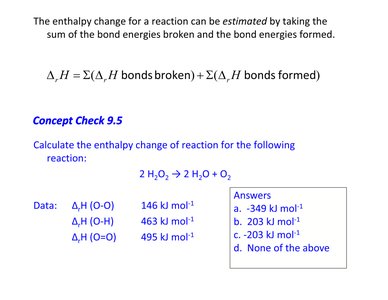
Estimating Enthalpy Changes Using Bond Energies
The enthalpy change for a reaction can be estimated by summing the bond energies of bonds broken and subtracting the bond energies of bonds formed:
Summary Table: Types of Chemical Bonds
Bond Type | Formation | Example | Key Feature |
|---|---|---|---|
Ionic | Electron transfer | NaCl | High melting point, crystalline solid |
Covalent | Electron sharing | H2O | Discrete molecules, lower melting point |
Metallic | Electron pooling | Na metal | Conductive, malleable |
Additional info: These notes cover the foundational aspects of chemical bonding, focusing on Lewis theory, the octet rule, ionic and covalent bonding, lattice energy, and bond energetics. Mastery of these concepts is essential for understanding molecular structure and reactivity in general chemistry.
