 Back
BackChapter 9: Chemical Bonding I – The Lewis Model and Ionic Bonding
Study Guide - Smart Notes
 Tailored notes based on your materials, expanded with key definitions, examples, and context.
Chapter 9: Chemical Bonding I – The Lewis Model and Ionic Bonding
Introduction to Chemical Bonding
Chemical bonding describes the connectivity between atoms in compounds. There are three primary types of chemical bonds: ionic, covalent, and metallic. Each bond type arises from different interactions between atoms and results in distinct physical and chemical properties.
Ionic Bonding: Electrostatic forces hold ions together, typically between metals and nonmetals.
Covalent Bonding: Results from the sharing of electrons between atoms, usually between nonmetals.
Metallic Bonding: Involves metal nuclei floating in a 'sea of electrons,' characteristic of metals.
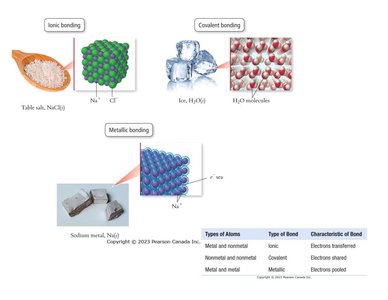
Example: Salt (NaCl) is an ionic compound, while sugar (C12H22O11) is a molecular compound.
Intramolecular vs. Intermolecular Forces
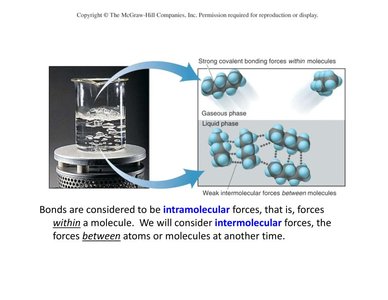
Bonds within a molecule are called intramolecular forces. These are much stronger than intermolecular forces, which are the forces between molecules. Understanding the distinction is crucial for explaining physical properties such as boiling and melting points.
Comparison of Ionic and Covalent Compounds
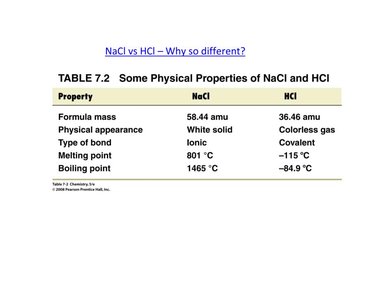
Ionic and covalent compounds exhibit different physical properties due to the nature of their bonding.
Property | NaCl | HCl |
|---|---|---|
Formula mass | 58.44 amu | 36.46 amu |
Physical appearance | White solid | Colorless gas |
Type of bond | Ionic | Covalent |
Melting point | 801 °C | -115 °C |
Boiling point | 1465 °C | -84.9 °C |
Lewis Symbols and the Octet Rule
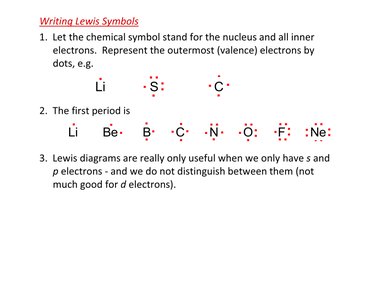
Lewis symbols are a convenient way to represent the valence electrons of atoms. The chemical symbol stands for the nucleus and inner electrons, while dots represent the outermost (valence) electrons.
Lewis diagrams are most useful for elements with only s and p electrons.
The number of unpaired dots generally indicates the number of electrons available for bonding.
Octet Rule: Atoms tend to achieve a complete outer shell (eight electrons) by losing, gaining, or sharing electrons.
Lewis Structures and Chemical Properties
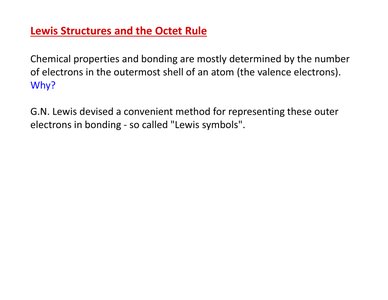
Chemical properties and bonding are determined by the number of electrons in the outermost shell (valence electrons). G.N. Lewis devised a method for representing these electrons in bonding, known as "Lewis symbols." The octet rule explains why noble gases are unreactive and why other elements form bonds.
Ionic Bonding and Lattice Energies
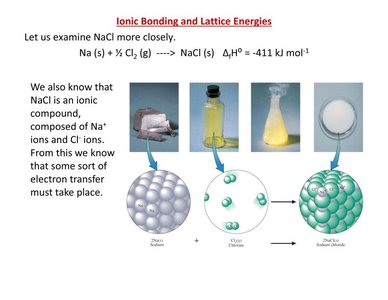
Ionic bonding involves the transfer of electrons from one atom to another, resulting in the formation of ions. The formation of NaCl from sodium and chlorine is a classic example:
Na (s) + ½ Cl2 (g) → NaCl (s)
NaCl is composed of Na+ and Cl- ions.
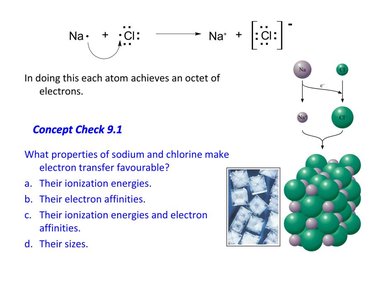
Example: Electron transfer allows each atom to achieve an octet of electrons.
Energetics of Ionic Bond Formation
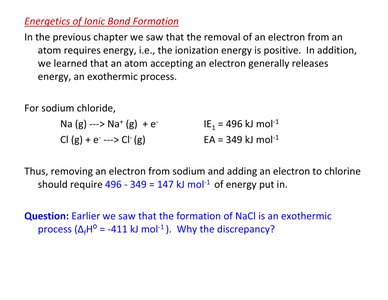
The removal of an electron from an atom requires energy (ionization energy), while the addition of an electron releases energy (electron affinity). For sodium chloride:
Na (g) → Na+ (g) + e- IE1 = 496 kJ mol-1
Cl (g) + e- → Cl- (g) EA = 349 kJ mol-1
Thus, the net energy required is 496 - 349 = 147 kJ mol-1. However, the overall formation of NaCl is exothermic due to lattice energy.
Lattice Energy
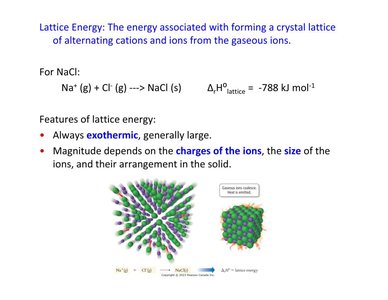
Lattice energy is the energy released when ions of opposite charge attract each other and form a crystal lattice. It is always exothermic and generally large, making the crystal lattice more stable than separated gaseous ions.
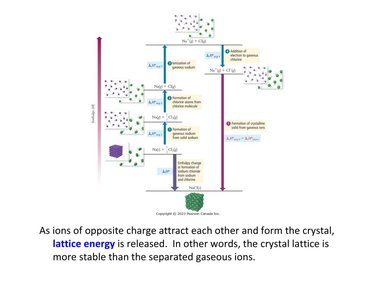
Features of lattice energy:
Always exothermic
Magnitude depends on the charges of the ions, the size of the ions, and their arrangement in the solid
Coulomb's Law and Lattice Energy Trends
Coulomb's law calculates the potential energy of two interacting charged particles:
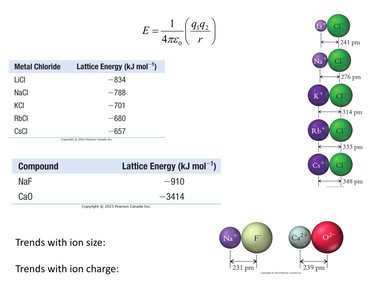
This law helps explain trends in lattice energy, which depend on ion charge and size.
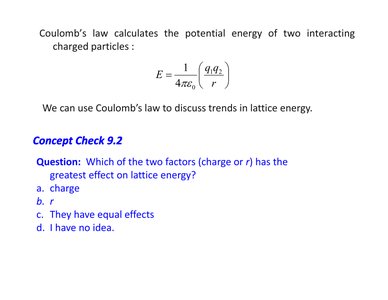
Trends:
Higher charge increases lattice energy
Smaller ion size increases lattice energy
Concept Checks and Applications
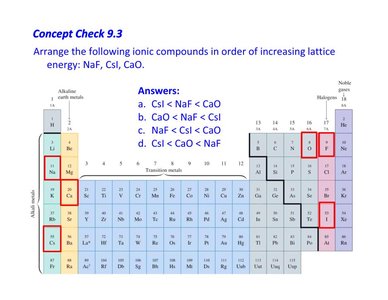
Concept checks throughout the chapter reinforce understanding of electron transfer, energetics, and lattice energy trends. For example, arranging ionic compounds in order of increasing lattice energy requires consideration of ion size and charge.
Summary Table: Types of Chemical Bonds
Types of Atoms | Type of Bond | Characteristic of Bond |
|---|---|---|
Metal and nonmetal | Ionic | Electrons transferred |
Nonmetal and nonmetal | Covalent | Electrons shared |
Metal and metal | Metallic | Electrons pooled |
Additional info: The notes cover the foundational concepts of chemical bonding, focusing on the Lewis model, ionic bonding, and lattice energy. These are essential for understanding the structure and properties of compounds in general chemistry.
