 Back
BackChapter 9: Periodic Properties of the Elements – Electron Configurations and Periodic Trends
Study Guide - Smart Notes
 Tailored notes based on your materials, expanded with key definitions, examples, and context.
Periodic Properties of the Elements
Introduction to Electron Configurations
Quantum-mechanical theory describes the behavior of electrons in atoms, where electrons occupy specific regions called orbitals. The arrangement of electrons in these orbitals is known as the electron configuration. Understanding electron configurations is essential for predicting chemical properties and periodic trends.
Orbital: A region in an atom where there is a high probability of finding electrons.
Electron Configuration: A notation that shows the distribution of electrons among the orbitals of an atom.
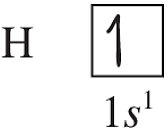
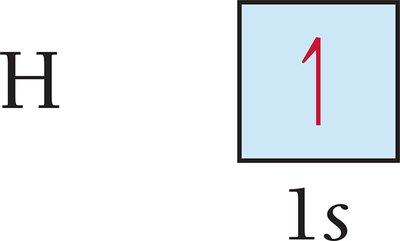
Example: The electron configuration for hydrogen is 1s1.


Electron Spin and the Pauli Exclusion Principle
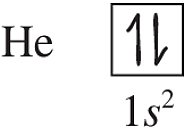
Electrons possess a property called spin, described by the quantum number ms (values: +1/2 or -1/2). The Pauli Exclusion Principle states that no two electrons in an atom can have the same set of four quantum numbers. Thus, an orbital can hold a maximum of two electrons with opposite spins.
Spin Quantum Number (ms): Indicates the two possible orientations of an electron's spin (+1/2 or -1/2).
Pauli Exclusion Principle: No two electrons in the same atom can have identical quantum numbers.
Example: Helium (He) has two electrons in the 1s orbital, each with opposite spins.
Aufbau Principle and Orbital Filling Order
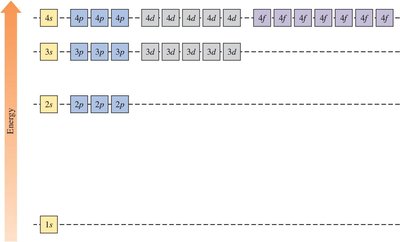
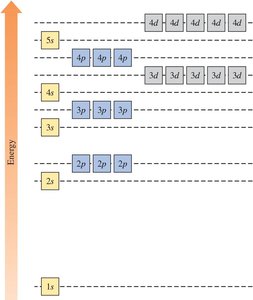
The Aufbau Principle states that electrons fill orbitals starting from the lowest energy level to the highest. The order of filling is determined by the relative energies of the orbitals, which can be visualized in an energy level diagram.
Order of filling: 1s → 2s → 2p → 3s → 3p → 4s → 3d → 4p → 5s → 4d → 5p → 6s → 4f → 5d → 6p → 7s → 5f → 6d → 7p
Electrons fill the 4s orbital before the 3d orbital due to energy differences.
Orbital Diagrams
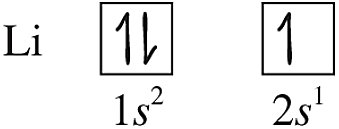
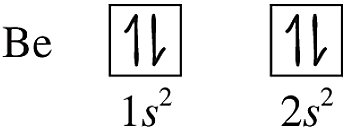
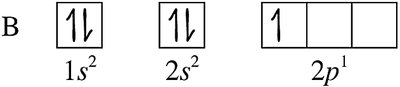
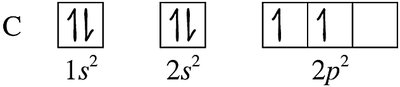
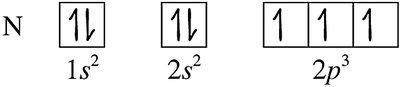
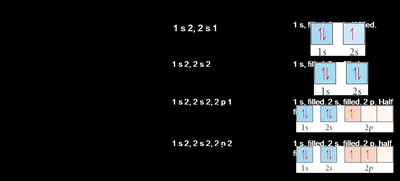
Orbital diagrams use boxes to represent orbitals and arrows to represent electrons. The direction of the arrow indicates the electron's spin. These diagrams help visualize the arrangement of electrons and their spins in each orbital.
Each box represents an orbital; each arrow represents an electron.
Paired arrows (opposite directions) indicate paired electrons with opposite spins.
Hund’s Rule
Hund’s Rule states that electrons will occupy degenerate orbitals (orbitals of equal energy) singly before pairing up. This minimizes electron-electron repulsions and leads to greater stability.
For p, d, and f sublevels, one electron enters each orbital until all are half-filled before any pairing occurs.
Example: Nitrogen (N) has three unpaired electrons in the 2p orbitals.
Sublevel Splitting in Multielectron Atoms
In hydrogen, all orbitals with the same principal quantum number (n) have the same energy (degenerate). In multielectron atoms, sublevels split due to electron-electron interactions, shielding, and penetration. The energy order is s < p < d < f for a given n.
Degenerate Orbitals: Orbitals with the same energy.
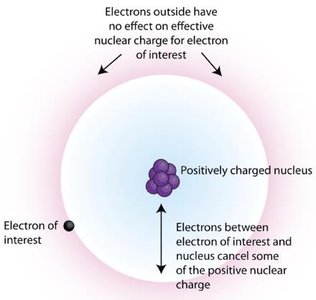
Shielding: Core electrons shield valence electrons from the full nuclear charge.
Penetration: The ability of an electron to get close to the nucleus, affecting its energy.
Shielding and Effective Nuclear Charge (Zeff)
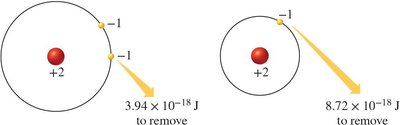
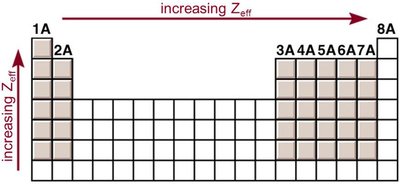
Each electron in a multielectron atom experiences attraction to the nucleus and repulsion from other electrons. The effective nuclear charge (Zeff) is the net positive charge experienced by an electron, accounting for shielding by other electrons.
Coulomb’s Law: Describes the force between charged particles.
Zeff = Z – σ, where Z is the number of protons and σ is the shielding constant.

Filling Orbitals with Electrons: Summary of Principles
Aufbau Principle: Fill lowest energy orbitals first.
Pauli Exclusion Principle: Maximum two electrons per orbital, with opposite spins.
Hund’s Rule: Fill degenerate orbitals singly before pairing electrons.
Electron Configuration Notation and Examples
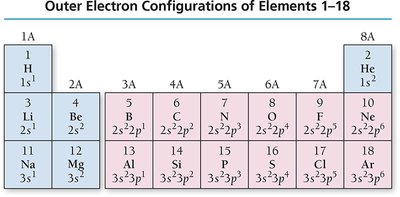
Electron configurations are written by listing the sublevels in order of filling, with the number of electrons as a superscript. Noble gas shorthand uses the symbol of the previous noble gas in brackets to represent core electrons.
Example: Kr (krypton): 1s2 2s2 2p6 3s2 3p6 4s2 3d10 4p6
Example: Rb (rubidium): [Kr] 5s1
Valence and Core Electrons
Valence electrons are those in the outermost principal energy level and are primarily responsible for chemical behavior. Core electrons are in lower energy levels and do not participate directly in bonding.
The main group number corresponds to the number of valence electrons.
The period number corresponds to the principal energy level of the valence electrons.
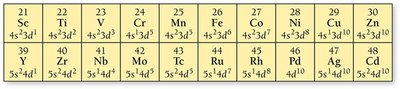
Irregular Electron Configurations in Transition Metals
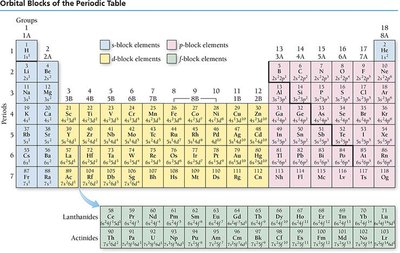
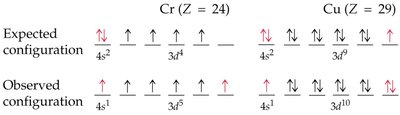
Some transition metals have irregular electron configurations due to the stability associated with half-filled or fully filled d subshells. For example, chromium (Cr) and copper (Cu) have observed configurations that differ from the expected order.
Cr: Expected: 4s2 3d4; Observed: 4s1 3d5
Cu: Expected: 4s2 3d9; Observed: 4s1 3d10
Electron Configuration and Ion Charge
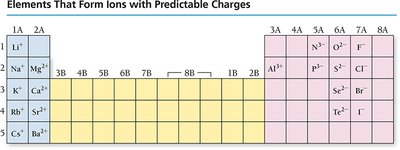
The charge of ions formed by elements is predictable based on their position in the periodic table. Atoms tend to form ions that achieve the same electron configuration as the nearest noble gas.
Group 1A: 1+ ions; Group 2A: 2+ ions; Group 7A: 1− ions; Group 6A: 2− ions, etc.
Isoelectronic species have the same electron configuration but different nuclear charges.
Periodic Trends: Atomic and Ionic Radii
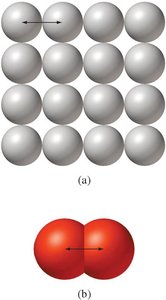
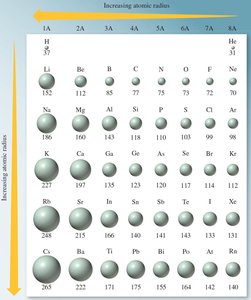
The atomic radius is a measure of the size of an atom, while the ionic radius refers to the size of an ion. Atomic radius increases down a group and decreases across a period due to increasing nuclear charge and electron shielding.
More energy levels (down a group) = larger atom.
More valence electrons (across a period) = smaller atom due to increased nuclear pull.
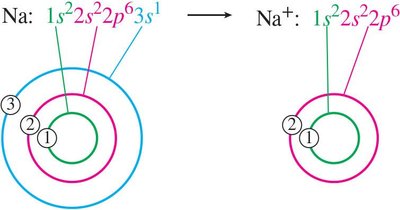
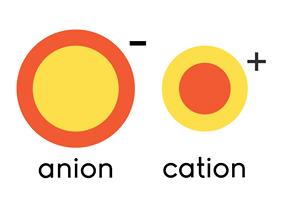
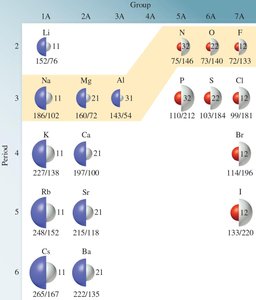
Cations (positive ions) are smaller than their parent atoms; anions (negative ions) are larger.
Ionization Energy
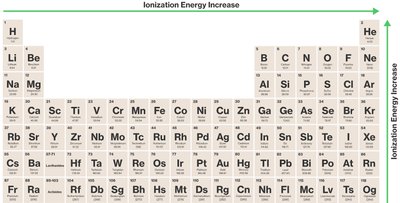
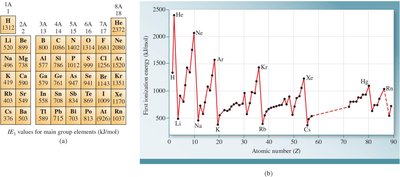
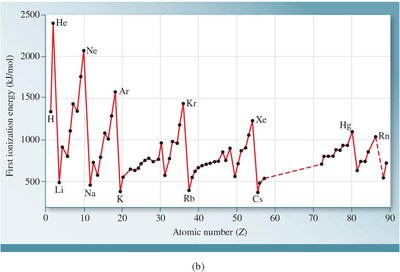
Ionization energy (IE) is the minimum energy required to remove an electron from one mole of gaseous atoms. IE increases across a period and decreases down a group, reflecting the increasing difficulty of removing electrons as nuclear charge increases or as electrons are closer to the nucleus.
IE increases left to right across a period (Zeff increases).
IE increases bottom to top within a group (electrons are closer to the nucleus).
There are exceptions due to electron configurations (e.g., Group 2A to 3A, 5A to 6A).
Electron Affinity
Electron affinity (EA) is the energy change when an atom gains an electron. A more positive EA means the process is more favorable. EA generally increases across a period and up a group, similar to ionization energy trends, but with exceptions due to electron configurations.
EA increases left to right across a period.
EA increases bottom to top within a group.
Exceptions occur when adding an electron would pair it in a half-filled orbital or place it in a higher energy level.
Summary Table: Periodic Trends
Trend | Across a Period (→) | Down a Group (↓) |
|---|---|---|
Atomic Radius | Decreases | Increases |
Ionization Energy | Increases | Decreases |
Electron Affinity | Increases | Decreases |
Zeff | Increases | Decreases |
Practice and Application
Practice writing electron configurations for various elements and ions.
Predict periodic trends and explain exceptions using electron configurations and effective nuclear charge.
