 Back
BackChapter 9: Periodic Properties of the Elements – Study Notes
Study Guide - Smart Notes
 Tailored notes based on your materials, expanded with key definitions, examples, and context.
Periodic Properties of the Elements
The Explanatory Power of the Quantum-Mechanical Model
The quantum-mechanical model explains the arrangement of electrons in atoms and how this arrangement determines the chemical properties of elements. The number of valence electrons—those in the outermost principal energy level—largely dictates an element’s reactivity and chemical behavior. Elements with the same number of valence electrons exhibit similar chemical properties, which is the basis for the organization of the periodic table into groups.
Noble Gases (Group 8A): Have full valence shells (8 electrons, except He with 2), making them highly stable and unreactive.
Alkali Metals (Group 1A): Have 1 valence electron; highly reactive as they seek to lose this electron to achieve noble gas configuration.
Alkaline Earth Metals (Group 2A): Have 2 valence electrons; also reactive, tending to lose both electrons.
Halogens (Group 7A): Have 7 valence electrons; highly reactive as they seek to gain one electron to complete their valence shell.
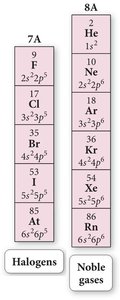
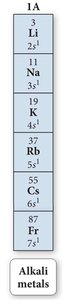
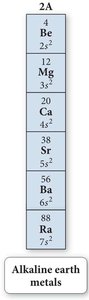
Valence Electrons and Chemical Properties
Elements in the same group have similar valence electron configurations, leading to similar chemical properties. For example, all halogens have the general configuration ns2np5, and all alkali metals have ns1.
Trends in Atomic Radii
Definition and Measurement
The atomic radius is defined as the average distance from the nucleus to the boundary of the surrounding cloud of electrons. It is typically measured in picometers (pm) and determined from the distances between nuclei in bonded atoms.
Trends in Atomic Radii
Down a Group: Atomic radius increases as the principal quantum number (n) increases, resulting in electrons occupying larger orbitals further from the nucleus.
Across a Period (Left to Right): Atomic radius decreases due to increasing effective nuclear charge (Zeff), which pulls electrons closer to the nucleus.
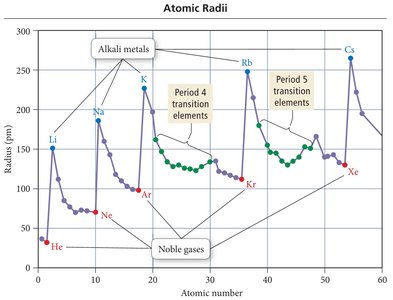
Effective Nuclear Charge (Zeff)
The effective nuclear charge is the net positive charge experienced by valence electrons. It increases across a period as protons are added to the nucleus, but core electrons remain the same, resulting in a stronger pull on the valence electrons and a smaller atomic radius.
Atomic Radii in Transition Metals
For transition metals, atomic radii remain relatively constant across a period because electrons are added to inner d orbitals, which do not shield the outer electrons as effectively.
Electron Configuration of Ions
Main Group Ions
Cations (positive ions): Formed by losing electrons, typically from the highest energy level (valence shell).
Anions (negative ions): Formed by gaining electrons, filling the valence shell to achieve noble gas configuration.
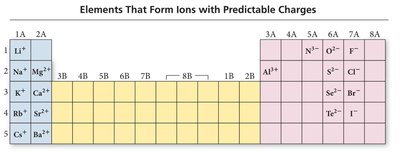
Transition Metal Ions
Transition metals lose electrons from the highest principal quantum number (ns) before losing from the (n-1)d orbitals, even though the d orbitals are filled after the s orbitals during electron filling.
Magnetic Properties of Ions
Paramagnetic: Ions with unpaired electrons; attracted to magnetic fields.
Diamagnetic: Ions with all electrons paired; not attracted to magnetic fields.
Ionic Radii
Trends in Ionic Radii
Cations are smaller than their parent atoms because the loss of electrons results in a greater effective nuclear charge per electron, pulling the remaining electrons closer.
Anions are larger than their parent atoms because the addition of electrons increases electron-electron repulsion and reduces the effective nuclear charge per electron.
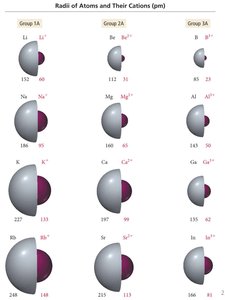
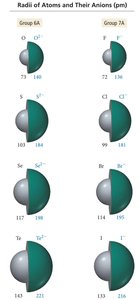
Ionization Energy (IE)
Definition and Trends
Ionization energy is the energy required to remove an electron from a gaseous atom or ion. It is always positive because energy must be supplied to overcome the attraction between the electron and the nucleus.
Down a Group: IE decreases because valence electrons are farther from the nucleus and easier to remove.
Across a Period: IE increases due to increasing Zeff, making electrons harder to remove.
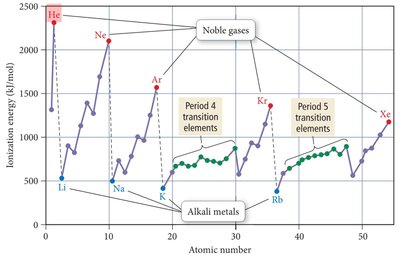
Exceptions to Ionization Energy Trends
There are notable drops in IE between groups 2A and 3A (e.g., Be to B) and between 5A and 6A (e.g., N to O) due to electron configurations and increased electron repulsion in doubly occupied orbitals.
Electron Affinity (EA)
Definition and Trends
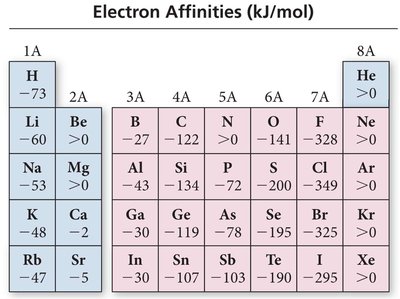
Electron affinity is the energy change associated with the addition of an electron to a gaseous atom. A more negative value indicates a greater tendency to accept an electron.
Across a Period: EA generally becomes more negative (more favorable) as Zeff increases.
Down a Group: No clear trend, but halogens have the most negative EAs, reflecting their strong tendency to gain electrons and form anions.
Metallic Character
Definition and Trends
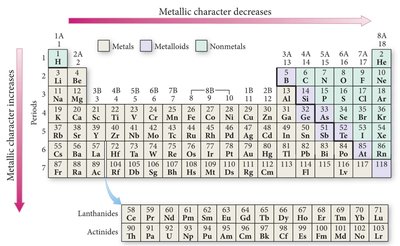
Metallic character refers to the tendency of an element to lose electrons and form positive ions (cations). Metals are typically malleable, ductile, shiny, and good conductors of heat and electricity.
Down a Group: Metallic character increases as ionization energy decreases.
Across a Period: Metallic character decreases as ionization energy increases.
Reactivity of Alkali Metals and Halogens
Alkali Metals
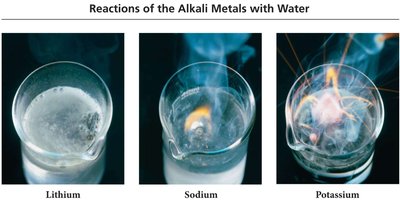
Alkali metals are highly reactive, especially with water and halogens. Their reactivity increases down the group due to decreasing ionization energy.
Typical reaction with halogens:
Reaction with water:
Halogens
Halogens are strong oxidizing agents and readily gain electrons to form anions. They react with metals to form ionic halides and with hydrogen to form hydrogen halides (acids).
Summary of Periodic Trends
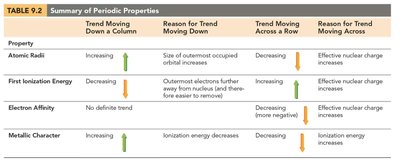
Property | Trend Down a Group | Reason Down a Group | Trend Across a Period | Reason Across a Period |
|---|---|---|---|---|
Atomic Radii | Increasing | Size of outermost occupied orbital increases | Decreasing | Effective nuclear charge increases |
First Ionization Energy | Decreasing | Valence electrons further from nucleus, easier to remove | Increasing | Effective nuclear charge increases |
Electron Affinity | No definite trend | Decreasing (more negative) | Effective nuclear charge increases | |
Metallic Character | Increasing | Ionization energy decreases | Decreasing | Ionization energy increases |
Practice Questions
Arrange the elements in order of decreasing radius: S, Ca, F, Rb, Si
Write the electron configuration and orbital diagram for each ion and predict whether each will be paramagnetic or diamagnetic: (a) Co2+, (b) N3–, (c) Ca2+
Based on periodic trends, which element in each pair has the higher first IE? (a) Sn or I, (b) Ca or Sr, (c) C or P, (d) F or S
Arrange the following elements in order of decreasing first IE: S, Ca, F, Rb, Si
