 Back
Chapter 9: Periodic Properties of the Elements – Structured Study Notes
Study Guide - Smart Notes
 Tailored notes based on your materials, expanded with key definitions, examples, and context.
Periodic Properties of the Elements
Historic Perspective and the Periodic Law
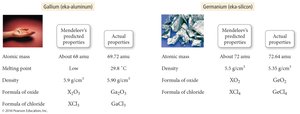
The modern periodic table was developed by Dmitri Mendeleev, who proposed that the properties of elements are periodic functions of their atomic weights. Today, we know that these properties are periodic functions of atomic numbers. The periodic law states: "When elements are arranged in order of increasing atomic mass, certain sets of properties recur periodically." Elements with similar physical and chemical properties are grouped in columns, known as families.
Periods: Rows in the periodic table.
Families/Groups: Columns in the periodic table; elements in a family share similar properties.
Mendeleev’s periodic table allowed for the prediction of undiscovered elements based on their properties.
Organization of the Periodic Table
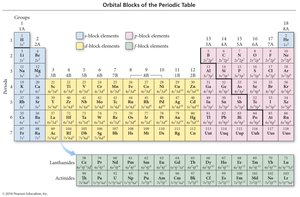
Elements are arranged by increasing atomic number (number of protons). The periodic table provides element names, symbols, and their arrangement into periods and families.
Electron Configuration and Quantum Numbers
Quantum mechanics describes the arrangement of electrons around the nucleus using four quantum numbers:
n: Principal energy level
l: Orbital type (s, p, d, f)
ml: Orientation of orbital
ms: Spin of electron
The Pauli exclusion principle states that no two electrons can have the same four quantum numbers.
Writing Atomic Electron Configurations
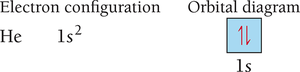
Electron configurations show the distribution of electrons among orbitals. For example, helium (He, atomic number 2) has the configuration 1s2.
Energy level (n): Indicates the shell
Orbital type (l): Indicates subshell (s, p, d, f)
Number of electrons: Superscript after orbital
Aufbau Principle and Energy Ordering
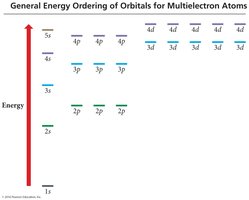
Electrons fill the lowest available energy levels first (Aufbau principle). The n + l rule helps determine the order of filling:
Electrons enter the subshell with the lowest value of n + l.
If two subshells have the same n + l, electrons fill the one with lower n first.
Shielding, Penetration, and Effective Nuclear Charge (Zeff)
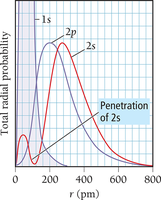
In multielectron atoms, electrons experience both attraction to the nucleus and repulsion from other electrons. Shielding reduces the net attraction to the nucleus, while penetration describes how well an electron can approach the nucleus through the electron cloud.
Effective nuclear charge (Zeff): The net positive charge experienced by an electron.
Shielding ability: s > p > d > f
Electron Configurations of Elements and Ions
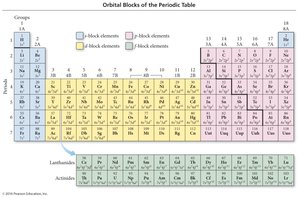
Electron configurations determine the chemical behavior of elements. Valence electrons are those in the outermost shell and are involved in bonding and ion formation.
Cations: Formed by loss of electrons (metals)
Anions: Formed by gain of electrons (nonmetals)
Transition metals and inner transition metals have d and f electrons in their valence shells, leading to unique electron configurations and stability patterns (e.g., half-filled d or f subshells).
Anomalous Electron Configurations
Some elements, especially transition and inner transition metals, have electron configurations that deviate from the predicted order due to sublevel splitting and energy differences between s and d orbitals.
Example: Chromium (Cr) and Copper (Cu) have actual configurations that differ from the Aufbau principle predictions.
Magnetic Properties
Atoms or ions with unpaired electrons are paramagnetic (attracted to magnetic fields), while those with all paired electrons are diamagnetic (slightly repelled).
Periodic Trends: Effective Nuclear Charge, Atomic Radius, Ionization Energy, Electron Affinity, and Metallic Character
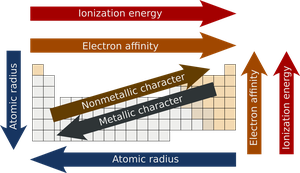
Periodic trends arise from changes in effective nuclear charge and electron configurations across periods and groups.
Effective nuclear charge (Zeff): Increases across a period, decreases down a group.
Atomic radius: Increases down a group, decreases across a period.
Ionization energy: Increases across a period, decreases down a group.
Electron affinity: Generally increases across a period, decreases down a group.
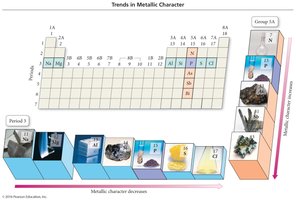
Metallic character: Decreases across a period, increases down a group.
Atomic and Ionic Radii
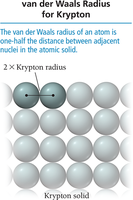
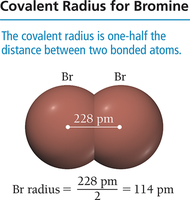
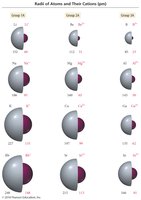
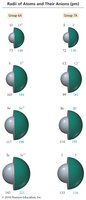
Atomic radius is measured in several ways, including van der Waals and covalent radii. Cations are smaller than their parent atoms, while anions are larger.
Van der Waals radius: Half the distance between nuclei in adjacent atoms in a solid.
Covalent radius: Half the distance between nuclei in bonded atoms.
Ionization Energy
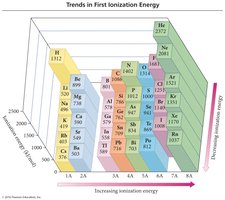
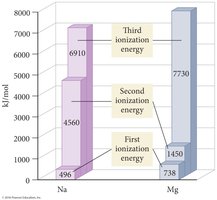
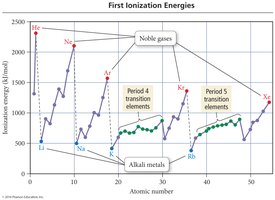
Ionization energy (IE) is the energy required to remove an electron from an atom in the gas phase. The first IE increases across a period and decreases down a group due to changes in Zeff and atomic size.
IE is endothermic (positive ΔH).
Successive ionization energies increase as electrons are removed.
Electron Affinity
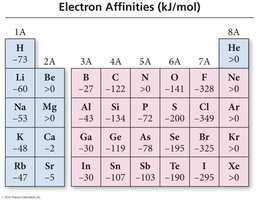
Electron affinity (EA) is the energy change when an atom gains an electron. EA generally increases across a period and decreases down a group. Halogens have the highest EA, and noble gases have low or positive EA values.
EA can be exothermic or endothermic.
Higher (more negative) EA means greater stability for the resulting anion.
Metallic and Nonmetallic Character
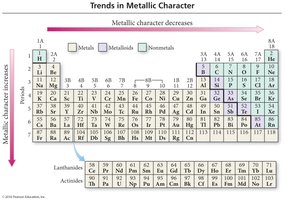
Metallic character describes how closely an element's properties match those of metals. Metals are malleable, ductile, good conductors, and easily ionized. Nonmetals are brittle, dull, and poor conductors.
Metallic character decreases across a period and increases down a group.
Nonmetals are found at the top right of the periodic table; metals are at the bottom left.
Summary Table: Periodic Trends
Property | Across a Period | Down a Group |
|---|---|---|
Atomic Radius | Decreases | Increases |
Ionization Energy | Increases | Decreases |
Electron Affinity | Increases (more negative) | Decreases |
Metallic Character | Decreases | Increases |
Example: Sodium (Na) has a larger atomic radius and lower ionization energy than chlorine (Cl), reflecting its position on the periodic table and its metallic character.
