 Back
BackChapter 9: Thermochemistry – Energy, Heat, and Work in Chemical Reactions
Study Guide - Smart Notes
 Tailored notes based on your materials, expanded with key definitions, examples, and context.
Thermochemistry: The Study of Energy in Chemical Reactions
Nature of Energy, Work, and Heat
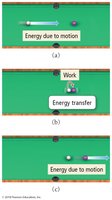
Thermochemistry explores how energy is transferred during chemical reactions and physical changes. Energy is the capacity to do work, and it can be exchanged between objects through contact, such as collisions.
Energy: Anything with the capacity to do work.
Work: Force acting over a distance.
Heat: Flow of energy caused by a difference in temperature.
Energy can be transferred as heat or work, either into or out of a system.
Classification of Energy
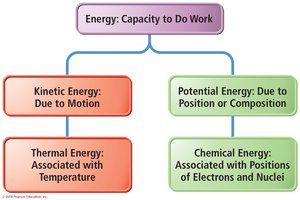
Energy is classified as kinetic or potential, with several forms relevant to chemistry.
Kinetic Energy: Energy of motion or energy being transferred.
Thermal Energy: Energy associated with temperature; a form of kinetic energy.
Potential Energy: Energy stored in an object or associated with its composition and position.
Chemical Energy: Potential energy due to the structure and arrangement of atoms in molecules.
Electrical, Light, Nuclear: Other forms relevant in specific contexts.
Manifestations and Transformations of Energy
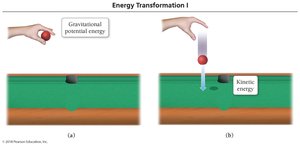
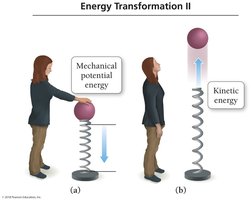
Energy can be transformed from one type to another, such as potential energy converting to kinetic energy.
Example: Dropping a ball converts gravitational potential energy to kinetic energy.
Units of Energy and Conversion
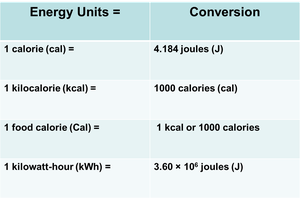
Energy is measured in several units, with the joule (J) as the SI unit. Other units include calories (cal), kilocalories (kcal), and kilowatt-hours (kWh).
Kinetic Energy Formula:
1 J = 1 kg·m2/s2 = 1 N·m
1 cal = 4.184 J
1 kcal = 1000 cal = 1 food Calorie (Cal)
1 kWh = J
The First Law of Thermodynamics: Conservation of Energy
Law of Conservation of Energy
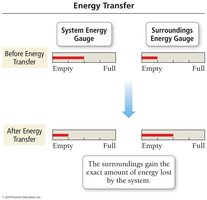
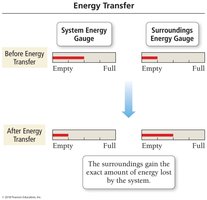
The first law states that energy cannot be created or destroyed, only transferred or converted. The total energy in the universe remains constant.
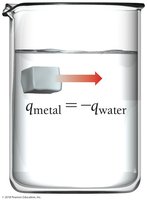
Energy gained or lost by a system equals the energy lost or gained by the surroundings.
System and Surroundings
In thermochemistry, the system is the part of the universe being studied, and the surroundings are everything else.
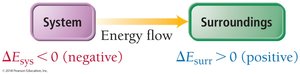
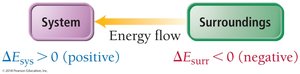
Energy can flow from system to surroundings (exothermic) or from surroundings to system (endothermic).
Energy Flow and Conservation
Conservation of energy requires that the sum of energy changes in the system and surroundings is zero.
denotes change: final amount minus initial amount.
Internal Energy and State Functions
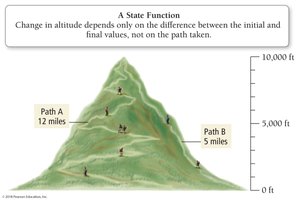
The internal energy of a system is the sum of kinetic and potential energies of all particles. The change in internal energy depends only on initial and final states, not the path taken.
State Function: Depends only on initial and final conditions.
Energy Diagrams: Exothermic and Endothermic Processes
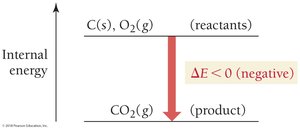
Exothermic Process
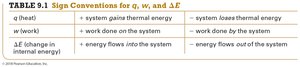
In exothermic reactions, energy flows out of the system into the surroundings. The internal energy of the system decreases.
(negative)
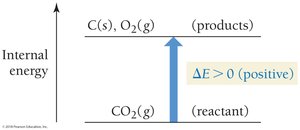
Endothermic Process
In endothermic reactions, energy flows into the system from the surroundings. The internal energy of the system increases.
(positive)
Summary of Energy Flow
Energy flowing out of the system is negative (withdrawal).
Energy flowing into the system is positive (deposit).
Energy Exchange: Heat and Work
Heat and Work as Energy Exchange
Energy is exchanged between system and surroundings through heat (q) and work (w).
q and w are not state functions; they depend on the process.

Heat Exchange and Thermal Equilibrium
Heat is the exchange of thermal energy between system and surroundings, occurring when there is a temperature difference. Heat flows from high to low temperature until thermal equilibrium is reached.
Heat Capacity and Specific Heat
Heat capacity (C) is the quantity of heat absorbed to raise the temperature of an object by 1°C or 1 K.
Units: J/°C or J/K
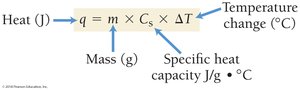
Specific heat capacity (): Amount of heat required to raise 1 g of a substance by 1°C.
Units: J/(g·°C)
Molar heat capacity: Amount of heat required to raise 1 mol of a substance by 1°C.
Quantifying Heat Energy
Where m = mass, = specific heat, = temperature change
Heat Transfer and Final Temperature
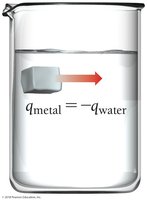
When two objects at different temperatures are in contact, heat flows until both reach the same final temperature. The heat lost by the hot material equals the heat gained by the cold material.
Work: Pressure–Volume Work
Pressure–Volume (PV) Work
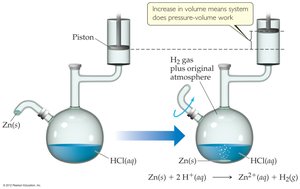
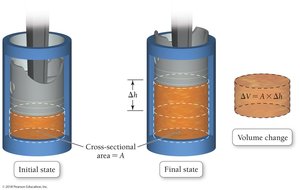
Work is done when a gas expands or contracts against an external pressure.
Work is negative when the system does work on the surroundings (expansion).
1 atm·L = 101.3 J
Energy Exchange Summary
Heat:
Work:

Calorimetry: Measuring Energy Changes
Calorimetry at Constant Volume (Bomb Calorimeter)
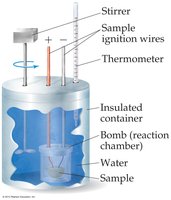
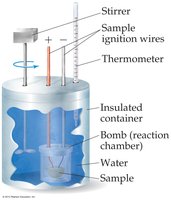
Calorimetry measures energy changes by observing temperature changes in the surroundings. At constant volume, , so .
Bomb calorimeter: Sealed, insulated container filled with water.
Calorimetry at Constant Pressure (Coffee-Cup Calorimeter)
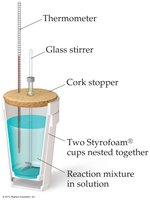
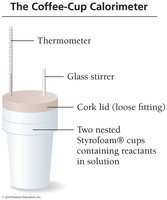
Reactions in solution are often measured at constant pressure using nested foam cups. The heat change for the system is measured by the heat change for the water.
Enthalpy: Heat at Constant Pressure
Definition and Calculation of Enthalpy
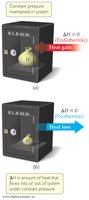
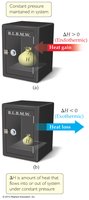
Enthalpy (H) is the internal energy plus the product of pressure and volume. At constant pressure, the change in enthalpy () equals the heat gained or lost.
(at constant pressure)
Endothermicity and Exothermicity
Endothermic: (heat absorbed)
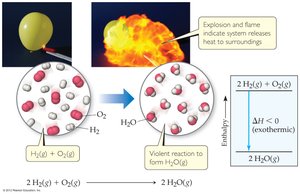
Exothermic: (heat released)
Enthalpy of Reaction
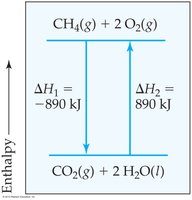
Enthalpy is an extensive property; it depends on the amount of substance.
Reversing a reaction changes the sign of .
Hess’s Law: Calculating Enthalpy Changes
Hess’s Law
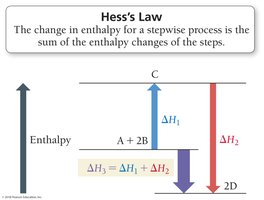
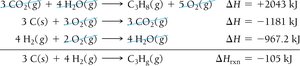
If a reaction can be expressed as a series of steps, the overall enthalpy change is the sum of the enthalpy changes for each step.
Manipulate reactions with known values to obtain the desired reaction.
Multiply or reverse reactions as needed, adjusting accordingly.
Bond Energies and Enthalpy Calculations
Bond Energies
Bond energy is the energy required to break one mole of a bond in a compound. Average bond energies are used to estimate .
Bond breaking is endothermic (positive ).
Bond making is exothermic (negative ).
Standard Enthalpy of Formation
Definition and Calculation
The standard enthalpy of formation () is the enthalpy change for forming one mole of a compound from its elements in their standard states.
Standard state: Pure substance at 1 atm and 25°C.
for pure elements in their standard state = 0 kJ/mol.
Lattice Energy and the Born–Haber Cycle
Lattice Energy
Lattice energy is the energy released when an ionic solid forms from its ions in the gas phase. It is always exothermic and depends on ion size and charge.
Larger ions = smaller lattice energy
Larger charge = larger lattice energy
Born–Haber Cycle
The Born–Haber cycle uses Hess’s law to calculate lattice energy by summing enthalpy changes for each step in the formation of an ionic compound.
Energy in Foods and Fuels
Energy Sources
Most energy in food comes from carbohydrates and fats. The majority of energy consumed in society comes from fossil fuels, which are not renewable.
Summary Table: Energy Units and Conversions
Energy Units | Conversion |
|---|---|
1 calorie (cal) | 4.184 joules (J) |
1 kilocalorie (kcal) | 1000 calories (cal) |
1 food Calorie (Cal) | 1 kcal or 1000 calories |
1 kilowatt-hour (kWh) | 3.60 × 10⁶ joules (J) |
Summary Table: Specific Heat Capacities
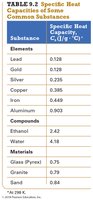
Substance | Specific Heat Capacity, Cs (J/g·°C) |
|---|---|
Lead | 0.128 |
Gold | 0.128 |
Silver | 0.235 |
Copper | 0.385 |
Aluminum | 0.903 |
Ethanol | 2.42 |
Water | 4.18 |
Glass (Pyrex) | 0.75 |
Granite | 0.79 |
Sand | 0.84 |
Additional info: Academic context and examples were added to clarify concepts and formulas, and to ensure completeness for exam preparation.
