 Back
Chapters 5-7 Study Guide: Molecular Geometry, Intermolecular Forces, and Stoichiometry
Study Guide - Smart Notes
 Tailored notes based on your materials, expanded with key definitions, examples, and context.
Chapter 5: Shapes of Molecules and Theories of Chemical Bonding
Electron-Pair Geometry and Molecular Geometry
Understanding the three-dimensional arrangement of atoms in a molecule is essential for predicting its properties and reactivity. The electron-pair geometry considers all electron groups (bonding and lone pairs) around a central atom, while the molecular geometry considers only the arrangement of atoms.
Lewis Structure: Draw the Lewis structure to identify bonding and lone pairs.
Steric Number: The steric number is the sum of bonded atoms and lone pairs on the central atom.
Geometry Examples: Common geometries include linear, trigonal planar, tetrahedral, trigonal bipyramidal, and octahedral.
Practice: Determine the geometry for CO2, XeF4, IF5, SeO2.
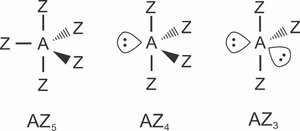
Example: For IF5, the steric number is 6 (5 bonds + 1 lone pair), leading to an octahedral electron geometry and square pyramidal molecular geometry.
Bond Dipoles and Molecular Polarity
A bond dipole arises from differences in electronegativity between two atoms. A molecule is polar if it has a net dipole moment.
Polar Covalent Bonds: Draw arrows indicating bond dipoles.
Permanent Dipole: For polar molecules, indicate the overall dipole direction.
Example: CHCl3 is polar; CCl4 is nonpolar.
Hybridization and Valence Bond Theory
Hybridization describes the mixing of atomic orbitals to form new hybrid orbitals suitable for bonding. Valence Bond Theory explains how these orbitals overlap to form bonds.
Types: sp, sp2, sp3 hybridizations.
Sigma (σ) Bonds: Formed by head-on overlap of orbitals.
Pi (π) Bonds: Formed by side-on overlap of p orbitals.
Counting Bonds: Single bonds are σ; double bonds have 1 σ and 1 π; triple bonds have 1 σ and 2 π.
Example: In N2H2, each N atom is sp2 hybridized.
Chirality and Stereocenters
A molecule is chiral if it cannot be superimposed on its mirror image. Stereocenters are atoms (usually carbon) bonded to four different groups.
Identify Stereocenters: Look for carbons with four distinct substituents.
Example: 2-butanol is chiral; 1-butanol is not.
Valence Bond Theory vs. Molecular Orbital Theory
Valence Bond Theory focuses on localized bonds formed by overlapping atomic orbitals. Molecular Orbital Theory describes electrons as delocalized over the entire molecule, forming bonding and antibonding orbitals.
Molecular Orbital Diagrams: Fill orbitals with electrons, calculate bond order:
Paramagnetic: Molecules with unpaired electrons; attracted to magnetic fields.
Diamagnetic: Molecules with all electrons paired; repelled by magnetic fields.
Example: O2 is paramagnetic; N2 is diamagnetic.
Chapter 6: Intermolecular Forces and Molecular Properties
Types of Intermolecular Forces
Intermolecular forces determine physical properties such as boiling point, solubility, and viscosity.
London Dispersion Forces: Present in all molecules; strongest in large, polarizable molecules.
Dipole-Dipole Forces: Occur between polar molecules.
Hydrogen Bonding: Strong dipole-dipole interaction involving H bonded to N, O, or F.
Ion-Dipole Forces: Occur between ions and polar molecules.
Example: CH3CH2CH2CH2OH exhibits hydrogen bonding; CH3CH2CH2CH2CH3 exhibits only dispersion forces.
Influence of Shape and Size
The shape and size of a molecule affect its physical properties. Polarizability refers to how easily the electron cloud can be distorted.
Boiling Point: Larger, more polarizable molecules have higher boiling points.
Solubility: "Like dissolves like"—polar molecules dissolve in polar solvents.
Viscosity: Stronger intermolecular forces increase viscosity.
Example: Br2 is a liquid at room temperature due to stronger dispersion forces compared to Cl2.
Chapter 7: Stoichiometry and Chemical Reactions
Balancing Chemical Equations
Balancing equations ensures the conservation of mass and atoms. Combustion reactions involve a hydrocarbon reacting with O2 to produce CO2 and H2O.
Steps: Write reactants and products, balance atoms one element at a time.
Example: C8H18(l) + O2(g) CO2(g) + H2O(g)
Stoichiometric Calculations
Stoichiometry allows calculation of reactant and product quantities.
Limiting Reactant: The reactant that is completely consumed first.
Theoretical Yield: Maximum amount of product possible.
Percent Yield:
Excess Reactant: Amount left after reaction.
Example: If 25.0 g P2O5 reacts with 36.0 g H2O, calculate theoretical yield and percent yield.
Empirical and Molecular Formulas
The empirical formula is the simplest ratio of elements; the molecular formula gives the actual number of atoms in a molecule.
Percent Composition: Calculate mass percent of each element.
Empirical Formula: Convert mass percent to moles, find simplest ratio.
Molecular Formula: , where
Example: A compound is 24.2% Cu, 27.0% Cl, and 48.8% O by mass. Find empirical formula.
Combustion Analysis
Combustion analysis is used to determine the composition of compounds containing C, H, and O. The sample is combusted, and the masses of CO2 and H2O produced are measured.
Steps: Calculate moles of C and H from CO2 and H2O, determine O by difference.
Example: A 1.02 g sample produces 1.50 g CO2 and 0.41 g H2O; molecular mass is 176 g/mol. Find empirical and molecular formulas.
