 Back
BackCharles’s Law: The Temperature–Volume Relationship of Gases
Study Guide - Smart Notes
 Tailored notes based on your materials, expanded with key definitions, examples, and context.
Gases
Temperature and Volume: Charles’s Law
Charles’s Law describes the direct relationship between the temperature and volume of a gas when the pressure and the amount of gas remain constant. This law is fundamental in understanding how gases behave under varying thermal conditions.
Charles’s Law Statement: The volume (V) of a gas is directly proportional to its temperature (T, in Kelvin) when pressure (P) and the number of moles (n) are constant.
Direct Relationship: If the temperature of a gas increases, its volume increases; if the temperature decreases, its volume decreases.
Mathematical Expression:
Temperature Units: All temperatures must be converted to Kelvin (K) for gas law calculations.
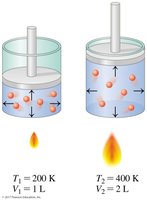
Physical Explanation: As temperature increases, gas molecules move faster and exert greater force on the container walls, causing the volume to expand if pressure is held constant.
Key Concepts and Applications
Direct Relationship Example: If a gas is heated from 200 K to 400 K at constant pressure, its volume doubles (e.g., from 1 L to 2 L).
Everyday Application: Hot air balloons rise because heating the air inside the balloon increases its volume, making it less dense than the cooler air outside.

Solving Problems Using Charles’s Law
To solve problems involving Charles’s Law, follow these steps:
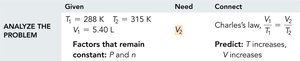
State the given and needed quantities. Convert all temperatures to Kelvin.
Rearrange the equation to solve for the unknown.
Substitute the values and calculate the answer.
Example Problem
Problem: A sample of helium gas has a volume of 5.40 L at 15 °C. What is the final volume after the temperature increases to 42 °C, at constant pressure and amount of gas?
Step 1: Convert temperatures to Kelvin.
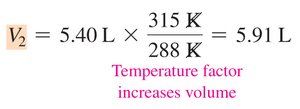
Step 2: Rearrange Charles’s Law to solve for the unknown volume.
Step 3: Substitute values and solve.
Summary Table: Charles’s Law Relationships
Change in Temperature (T) | Change in Volume (V) | Relationship |
|---|---|---|
Increases | Increases | Direct |
Decreases | Decreases | Direct |
Practice Questions
When the volume of a gas decreases, what happens to its temperature (at constant pressure and moles)? Answer: Temperature decreases.
When the temperature of a gas decreases, what happens to its volume? Answer: Volume decreases.
If the volume changes from 12 L to 4 L, what happens to the temperature? Answer: Temperature decreases.
If the temperature changes from 15 °C to 45 °C, what happens to the volume? Answer: Volume increases.
