 Back
BackCHE 131 Exam 3 Study Guidance – General Chemistry Concepts
Study Guide - Smart Notes
 Tailored notes based on your materials, expanded with key definitions, examples, and context.
Q1. An isotope with a high value of N/Z will tend to decay through:
Background
Topic: Nuclear Chemistry – Radioactive Decay
This question tests your understanding of nuclear stability and the types of radioactive decay that occur depending on the neutron-to-proton ratio (N/Z) in an isotope.
Key Terms:
N/Z ratio: The ratio of neutrons (N) to protons (Z) in a nucleus.
Types of decay: α (alpha), β (beta), γ (gamma), electron capture, positron emission.
Step-by-Step Guidance
Recall that isotopes with a high N/Z ratio have more neutrons than protons, making them neutron-rich.
Consider which decay process reduces the number of neutrons and increases the number of protons.
Review the characteristics of each decay type: α decay removes both neutrons and protons, β decay converts a neutron to a proton, γ decay does not change N or Z, electron capture and positron emission affect proton count.
Try solving on your own before revealing the answer!
Q2. According to valence bond theory, the triple bond in ethyne (acetylene, C2H2) consists of:
Background
Topic: Chemical Bonding – Valence Bond Theory
This question tests your understanding of how sigma (σ) and pi (π) bonds are formed in multiple bonds, specifically in a triple bond.
Key Terms:
σ (sigma) bond: Formed by head-on overlap of orbitals.
π (pi) bond: Formed by side-on overlap of p orbitals.
Triple bond: Consists of one σ bond and two π bonds.
Step-by-Step Guidance
Recall the structure of ethyne (C2H2): two carbon atoms connected by a triple bond.
Identify the types of bonds in a triple bond: one σ bond and two π bonds.
Review how valence bond theory describes the formation of these bonds using orbital overlap.
Try solving on your own before revealing the answer!
Q3. Which of the following elements has the smallest atomic size?
Background
Topic: Periodic Trends – Atomic Radius
This question tests your understanding of how atomic size changes across periods and down groups in the periodic table.
Key Terms:
Atomic radius: The distance from the nucleus to the outermost electron shell.
Periodic trend: Atomic size decreases across a period and increases down a group.
Step-by-Step Guidance
Locate each element (Na, Kr, K, Ca, Ar) on the periodic table.
Recall that atomic size decreases from left to right across a period and increases from top to bottom within a group.
Compare the positions of the elements to determine which is smallest.
Try solving on your own before revealing the answer!
Q12. In the following Lewis structure for ClO3F, chlorine has a formal charge of ________ and an oxidation number of ________.
Background
Topic: Lewis Structures, Formal Charge, and Oxidation Number
This question tests your ability to analyze a Lewis structure and determine both the formal charge and oxidation number of an atom within a molecule.
Key Terms:
Formal charge: Calculated using the formula
Oxidation number: The hypothetical charge an atom would have if all bonds were ionic.
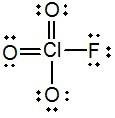
Step-by-Step Guidance
Count the number of valence electrons for chlorine in ClO3F.
Identify the number of nonbonding electrons (lone pairs) and bonding electrons around chlorine.
Apply the formal charge formula to chlorine using the values from the Lewis structure.
Determine the oxidation number by assigning electrons in each bond to the more electronegative atom.
Try solving on your own before revealing the answer!
