 Back
BackCHEM 1000: Chemical Structure – Course Syllabus and Study Guide
Study Guide - Smart Notes
 Tailored notes based on your materials, expanded with key definitions, examples, and context.
CHEM 1000: Chemical Structure – Course Syllabus and Study Guide
Course Overview
This course provides an introduction to chemistry with a focus on the physical and electronic structure of matter. Key topics include the behavior of gases, thermochemistry, atomic structure, the periodic table, chemical bonding, and the structure of liquids and solids. The course is designed for students beginning their studies in general chemistry and emphasizes both theoretical understanding and practical laboratory skills.
Course Structure and Logistics
Lectures: Three hours per week, covering fundamental concepts and problem-solving strategies.
Tutorials: One hour per week, focusing on example problems and clarifying lecture material.
Laboratories: Five in-person lab sessions throughout the term, emphasizing experimental techniques and data analysis.
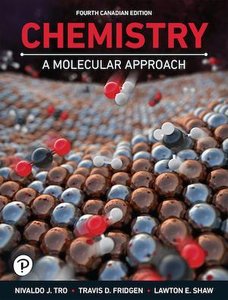
Textbook: Chemistry: A Molecular Approach (4th Canadian Edition) by Tro, Fridgen, and Shaw.
Key Topics and Chapter Alignment
The course content aligns closely with standard general chemistry topics, as outlined below:
Ch. 1-4: Prerequisite knowledge (units, significant figures, oxidation states, solutions, molarity)
Ch. 5: Gases (pressure, gas laws, mixtures, real gases)
Ch. 6: Thermochemistry (energy, enthalpy, calorimetry, Hess's Law)
Ch. 7: Atomic Structure (light, spectroscopy, quantum mechanics, electron configuration)
Ch. 8: Periodic Properties (trends, atomic/ionic radii, ionization energy, electron affinity)
Ch. 9/10: Chemical Bonding (Lewis structures, bonding models, VSEPR, hybridization)
Ch. 11: Solids, Liquids, and Intermolecular Forces (IMFs, phase changes, phase diagrams)
Laboratory Component
The laboratory portion is essential for developing practical skills in experimental chemistry. Students will:
Perform five laboratory experiments, each with a pre-lab quiz and a lab report.
Learn to use laboratory equipment safely, including lab coats and goggles.
Apply concepts such as gas laws, calorimetry, and phase changes in hands-on settings.
Analyze and interpret experimental data, including graphical representations.

Evaluation Scheme
Component | Percentage | Details |
|---|---|---|
Test 1 | 20% | February 25, 2026 (90 min) |
Test 2 | 20% | March 25, 2026 (90 min) |
Online Weekly Quizzes | 10% | Best 8 of 10 quizzes |
Laboratory | 20% | 5 lab experiments (4% each) |
Final Exam | 30% | Cumulative, 3 hours |
Key Learning Outcomes
Solve quantitative and qualitative problems related to gases, thermochemistry, stoichiometry, and atomic spectroscopy.
Explain periodic trends such as atomic size, ionization energy, and electron affinity.
Draw Lewis structures and represent formal charges and resonance forms.
Predict molecular shapes using VSEPR and valence bond theory.
Compare and contrast intermolecular forces and predict their effects on physical properties.
Develop laboratory skills, including data collection, analysis, and graphical representation.
Course Policies and Academic Integrity
Email Etiquette: Use your official university email and include your name and student number in all correspondence.
Missed Tests/Labs: No makeup tests; missed test weight shifts to the final exam. Missing three or more labs results in course failure.
Academic Honesty: All work must be individual. Plagiarism and unauthorized collaboration are strictly prohibited.
Accessibility: Students requiring accommodations should register with Student Accessibility Services early in the term.
Course Resources and Support
Course website: York eClass for announcements, materials, and quizzes.
Instructor and administrative contacts provided for academic and administrative support.
Practice problems and solutions manual available for all textbook editions used in the course.
Visual Summary of Course Components
 Collaborative learning and support
 Conceptual understanding and problem-solving
- Laboratory skills and experimental techniques
Additional Info
For detailed learning outcomes and chapter-specific objectives, refer to the document posted on eClass.
All policies regarding academic integrity, accessibility, and student conduct are in accordance with York University regulations.
