 Back
BackChem 101 Spring 2026 Mock Final Exam – Step-by-Step Study Guidance
Study Guide - Smart Notes
 Tailored notes based on your materials, expanded with key definitions, examples, and context.
Q1. How many protons, neutrons, and electrons are in a neutral atom of Mo7+4298?
Background
Topic: Atomic Structure and Ions
This question tests your understanding of how to determine the number of protons, neutrons, and electrons in an atom and its ions, using atomic number, mass number, and charge.
Key Terms and Formulas:
Atomic number (): Number of protons in the nucleus.
Mass number (): Total number of protons and neutrons ().
Charge: For ions, electrons = protons minus the charge (for cations, subtract; for anions, add).
Step-by-Step Guidance
Identify the atomic number () and mass number () from the notation: means , .
Calculate the number of protons: The atomic number () is the number of protons.
Calculate the number of neutrons: .
Calculate the number of electrons: For a ion, subtract 7 from the number of protons.
Try solving on your own before revealing the answer!
Final Answer: 42 protons, 56 neutrons, 35 electrons
Protons: 42 (atomic number), Neutrons: 98 - 42 = 56, Electrons: 42 - 7 = 35.
For a ion, the atom has lost 7 electrons compared to the neutral atom.
Q2. Which ionic compound would not be soluble in water?
Background
Topic: Solubility Rules for Ionic Compounds
This question tests your ability to apply solubility rules to predict whether a compound will dissolve in water.
Key Terms and Formulas:
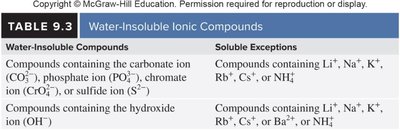
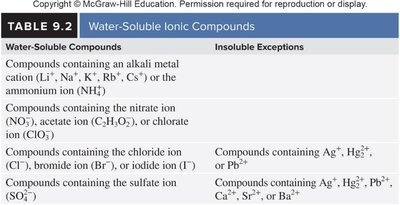
Solubility rules: Guidelines for predicting solubility of ionic compounds in water.
Common ions: Carbonate (), chromate (), sulfate (), chloride (), etc.
Step-by-Step Guidance
Review the solubility rules for carbonate, chromate, and other ions in the compounds listed.
Check for any exceptions (such as alkali metal ions or ammonium) that would make the compound soluble.
Compare each compound to the rules and identify which one does not have a soluble exception.
Try solving on your own before revealing the answer!
Final Answer: MgCO3 is not soluble in water
Magnesium carbonate does not contain an alkali metal or ammonium ion, so it is insoluble according to the rules.
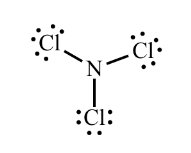
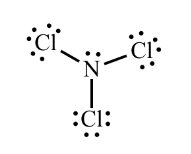
Q3. What is the correct Lewis structure for NCl3?
Background
Topic: Lewis Structures and Molecular Geometry
This question tests your ability to draw and interpret Lewis structures, including the placement of valence electrons and lone pairs.
Key Terms and Formulas:
Lewis structure: Diagram showing bonds and lone pairs for a molecule.
Valence electrons: Electrons in the outermost shell, important for bonding.
Step-by-Step Guidance
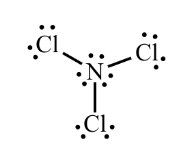
Count the total number of valence electrons for NCl3: N (5) + 3 × Cl (7) = 26 electrons.
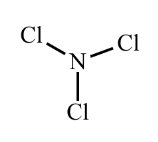
Draw the central atom (N) and connect three Cl atoms with single bonds.
Distribute the remaining electrons as lone pairs on Cl and N to satisfy the octet rule.
Check that each atom has a complete octet and that the total number of electrons matches your count.
Try solving on your own before revealing the answer!
Final Answer: The correct Lewis structure is image_6
N is the central atom with three Cl atoms bonded, and lone pairs are placed on both N and Cl atoms to complete their octets.
