 Back
BackChem 1210 Midterm 4 Study Guide: Periodic Properties, Bonding, and Molecular Geometry
Study Guide - Smart Notes
 Tailored notes based on your materials, expanded with key definitions, examples, and context.
Q1. Write the shorthand Nobel gas electron configuration for a neutral tin atom (Sn).
Background
Topic: Electron Configuration
This question tests your understanding of how to write the shorthand (noble gas) electron configuration for an element, which is a foundational skill for predicting chemical behavior.
Key Terms and Formulas:
Shorthand (noble gas) configuration: Uses the previous noble gas to abbreviate the electron configuration.
Valence electrons: Electrons in the outermost shell, important for chemical reactivity.
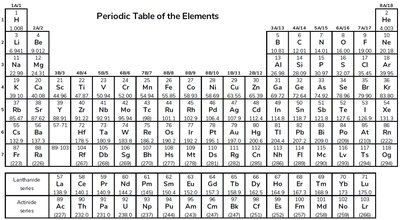
Step-by-Step Guidance
Locate tin (Sn) on the periodic table and identify its atomic number.
Find the nearest noble gas before tin (Sn) and use it to abbreviate the electron configuration.
Write out the remaining electron configuration after the noble gas.
Count the total electrons to ensure the configuration matches tin's atomic number.
Try solving on your own before revealing the answer!
Final Answer:
The shorthand electron configuration for tin (Sn) is .
We use krypton (Kr) as the noble gas core, then add the electrons in the 4d, 5s, and 5p subshells to reach tin.
Q1a. Use the electron configuration for tin to explain why tin (II) oxide (SnO) exists.
Background
Topic: Oxidation States and Electron Configuration
This question tests your ability to relate electron configuration to the formation of specific compounds and oxidation states.
Key Terms:
Oxidation state: The charge an atom would have if all bonds were ionic.
Sn(II): Tin with a +2 charge.
Step-by-Step Guidance
Review the electron configuration of tin (Sn).
Identify which electrons are lost when tin forms a +2 ion.
Explain how the removal of these electrons leads to the formation of SnO.
Try solving on your own before revealing the answer!
Final Answer:
SnO exists because tin can lose its two 5p electrons, resulting in a +2 oxidation state. This matches the electron configuration for Sn(II), allowing it to bond with oxygen in SnO.
Q1b. Use the electron configuration for tin to explain why tin (IV) oxide (SnO2) exists.
Background
Topic: Oxidation States and Electron Configuration
This question tests your understanding of how electron configuration allows tin to achieve a +4 oxidation state.
Key Terms:
Sn(IV): Tin with a +4 charge.
Step-by-Step Guidance
Review the electron configuration for tin (Sn).
Determine which electrons are lost when tin forms a +4 ion.
Explain how the removal of these electrons allows tin to form SnO2.
Try solving on your own before revealing the answer!
Final Answer:
SnO2 exists because tin can lose both its 5s and 5p electrons, resulting in a +4 oxidation state. This allows tin to bond with two oxygen atoms in SnO2.
Q2. Calculate the effective nuclear charge the following electrons experience on the corresponding atoms (Zeff = Z - S)
Background
Topic: Effective Nuclear Charge (Zeff)
This question tests your ability to calculate the effective nuclear charge experienced by electrons in different shells, which affects atomic properties.
Key Terms and Formulas:
Effective nuclear charge (): The net positive charge experienced by an electron.
Z: Atomic number
S: Shielding constant
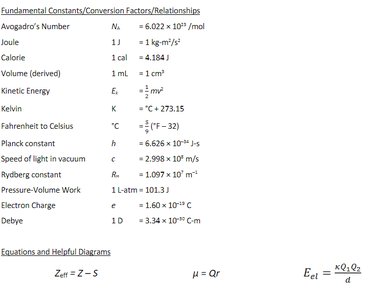
Step-by-Step Guidance
Write out the full electron configuration for the atom in question (e.g., Mg or Cl).
Identify the electron of interest (e.g., 1s, 2s, valence electron).
Determine the atomic number (Z) for the atom.
Calculate the shielding constant (S) for the electron of interest.
Set up the formula for the electron.
Try solving on your own before revealing the answer!
Final Answer:
For each electron, is calculated by subtracting the shielding constant from the atomic number. For example, for a 1s electron in Mg, , and S is the number of electrons shielding the 1s electron.
Q3. What is the Zeff of a valence electron on the following atoms: Aluminum, Silicon, Antimony, Iodine, Potassium, Cesium?
Background
Topic: Effective Nuclear Charge and Periodic Trends
This question tests your understanding of how Zeff changes across the periodic table and how it affects chemical properties.
Key Terms:
Valence electron: The outermost electron involved in bonding.
Shielding: The effect of inner electrons reducing the nuclear charge felt by valence electrons.
Step-by-Step Guidance
Identify the atomic number (Z) for each element.
Determine the number of core electrons (S) for each element.
Set up the formula for the valence electron.
Try solving on your own before revealing the answer!
Final Answer:
For each atom, is calculated using the atomic number and the number of core electrons. For example, Aluminum (Z=13, S=10), so .
Q4. Compare the following elements: Sulfur and Chlorine. Which n=3 electron experiences a higher Zeff? Which n=3 electron is more attracted to the nucleus? Which n=3 electron is closer to the nucleus?
Background
Topic: Periodic Trends and Effective Nuclear Charge
This question tests your understanding of how Zeff affects electron attraction and distance from the nucleus.
Key Terms:
n=3 electron: Electron in the third energy level.
Zeff: Effective nuclear charge.
Step-by-Step Guidance
Identify the atomic numbers for sulfur and chlorine.
Determine the number of core electrons for each element.
Calculate Zeff for the n=3 electron in each element.
Compare the Zeff values to determine which electron is more attracted and closer to the nucleus.
Try solving on your own before revealing the answer!
Final Answer:
Chlorine's n=3 electron experiences a higher Zeff, is more attracted to the nucleus, and is closer to the nucleus than sulfur's n=3 electron.
Q4b. Nitrogen and Phosphorous: Which n=1 electron experiences a higher Zeff? Which n=1 electron is more attracted to the nucleus? Which n=1 electron is closer to the nucleus?
Background
Topic: Effective Nuclear Charge and Periodic Trends
This question tests your understanding of Zeff for core electrons and how it changes with atomic number.
Key Terms:
n=1 electron: Electron in the first energy level.
Zeff: Effective nuclear charge.
Step-by-Step Guidance
Identify the atomic numbers for nitrogen and phosphorus.
Determine the number of electrons shielding the n=1 electron.
Calculate Zeff for the n=1 electron in each element.
Compare the Zeff values to determine which electron is more attracted and closer to the nucleus.
Try solving on your own before revealing the answer!
Final Answer:
Nitrogen's n=1 electron experiences a higher Zeff, is more attracted to the nucleus, and is closer to the nucleus than phosphorus's n=1 electron.
Q5. Using the periodic table, arrange each set of atoms in order of increasing radius: (a) Ba, Ca, Na; (b) Al, Be, Si
Background
Topic: Atomic Radius and Periodic Trends
This question tests your understanding of how atomic radius changes across periods and down groups.
Key Terms:
Atomic radius: The distance from the nucleus to the outermost electron.
Periodic trends: Patterns in properties across the periodic table.
Step-by-Step Guidance
Locate each element on the periodic table.
Recall that atomic radius increases down a group and decreases across a period.
Arrange the elements in each set from smallest to largest radius based on their positions.
Try solving on your own before revealing the answer!
Final Answer:
(a) Na < Ca < Ba; (b) Be < Al < Si. Atomic radius increases down a group and decreases across a period.
Q6. Explain the following variations in atomic or ionic radii: (a) I– > I > I+; (b) Fe > Fe2+ > Fe3+
Background
Topic: Ionic Radius and Charge
This question tests your understanding of how gaining or losing electrons affects atomic and ionic radii.
Key Terms:
Ionic radius: The radius of an ion.
Charge: Positive ions (cations) are smaller, negative ions (anions) are larger.
Step-by-Step Guidance
Consider how adding electrons (forming anions) increases electron-electron repulsion and radius.
Consider how removing electrons (forming cations) decreases radius.
Apply these principles to the given ions and atoms.
Try solving on your own before revealing the answer!
Final Answer:
(a) I– is largest because it has gained an electron, increasing repulsion; I is neutral; I+ is smallest because it has lost an electron. (b) Fe > Fe2+ > Fe3+ for similar reasons.
Q7. Arrange each of the following sets of atoms and ions in order of increasing size: (a) Se2–, Te2–, Se; (b) Co3+, Fe2+, Fe3+; (c) Ca, Ti4+, Sc3+; (d) Be2+, Na+, Ne
Background
Topic: Ionic and Atomic Radius
This question tests your ability to compare sizes of atoms and ions based on their charge and position in the periodic table.
Key Terms:
Isoelectronic series: Ions with the same number of electrons but different nuclear charges.
Atomic and ionic radius: Influenced by charge and nuclear attraction.
Step-by-Step Guidance
Identify the charge and electron configuration for each atom/ion.
Compare nuclear charge for isoelectronic ions.
Arrange the ions/atoms based on their expected size.
Try solving on your own before revealing the answer!
Final Answer:
(a) Se < Se2– < Te2–; (b) Co3+ < Fe3+ < Fe2+; (c) Ti4+ < Sc3+ < Ca; (d) Be2+ < Ne < Na+.
Q8. What is the trend in first ionization energies as one proceeds down the group 1A elements? Explain how this trend relates to the variation in atomic radii.
Background
Topic: Ionization Energy and Periodic Trends
This question tests your understanding of how ionization energy changes down a group and its relationship to atomic radius.
Key Terms:
Ionization energy: Energy required to remove an electron.
Atomic radius: Increases down a group.
Step-by-Step Guidance
Recall that ionization energy decreases down a group.
Explain that atomic radius increases down a group, making it easier to remove an electron.
Relate the trend in ionization energy to the trend in atomic radius.
Try solving on your own before revealing the answer!
Final Answer:
First ionization energy decreases down group 1A as atomic radius increases, making electrons easier to remove.
Q9. What is the trend in first ionization energies as one moves across the fourth period from K to Kr? How does this trend compare to atomic radii?
Background
Topic: Ionization Energy and Periodic Trends
This question tests your understanding of how ionization energy changes across a period and its relationship to atomic radius.
Key Terms:
Ionization energy: Increases across a period.
Atomic radius: Decreases across a period.
Step-by-Step Guidance
Recall that ionization energy increases across a period.
Explain that atomic radius decreases across a period, making electrons harder to remove.
Relate the trend in ionization energy to the trend in atomic radius.
Try solving on your own before revealing the answer!
Final Answer:
First ionization energy increases from K to Kr as atomic radius decreases, making electrons harder to remove.
Q10. The ionic radii of the ions S2–, Cl–, and K+ are 184, 181, 138 pm respectively. Explain why these ions have different sizes even though they contain the same number of electrons.
Background
Topic: Isoelectronic Ions and Ionic Radius
This question tests your understanding of how nuclear charge affects the size of isoelectronic ions.
Key Terms:
Isoelectronic ions: Ions with the same number of electrons.
Nuclear charge: Number of protons in the nucleus.
Step-by-Step Guidance
Identify the number of protons in each ion.
Explain how a higher nuclear charge pulls electrons closer, reducing ionic radius.
Compare the radii based on nuclear charge.
Try solving on your own before revealing the answer!
Final Answer:
S2–, Cl–, and K+ have the same number of electrons, but different nuclear charges. The ion with the highest nuclear charge (K+) has the smallest radius, while the ion with the lowest nuclear charge (S2–) has the largest radius.
Q11. The following represents the successive ionization energy for a period 3 element. What is the identity of the element? Write the 6 chemical equations that represent the successive ionization energies of the element above.
Background
Topic: Successive Ionization Energies
This question tests your ability to interpret ionization energy data to identify an element and write chemical equations for each ionization step.
Key Terms:
Successive ionization energy: Energy required to remove each electron in sequence.
Period 3 elements: Elements in the third row of the periodic table.
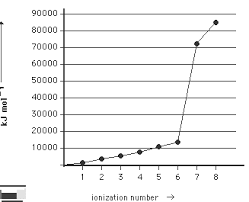
Step-by-Step Guidance
Analyze the ionization energy graph for the element.
Identify the element based on the number of electrons and the jump in ionization energy.
Write the chemical equations for each ionization step, removing one electron at a time.
Try solving on your own before revealing the answer!
Final Answer:
The element is magnesium (Mg). The six equations are:
Mg → Mg+ + e–
Mg+ → Mg2+ + e–
Mg2+ → Mg3+ + e–
Mg3+ → Mg4+ + e–
Mg4+ → Mg5+ + e–
Mg5+ → Mg6+ + e–
Q12. The electron affinity for a neutral sulfur atom is -200 kJ/mol. (a) Write the chemical equation that describes the electron affinity for Sulfur. (b) Why is electron affinity a negative (exothermic) value?
Background
Topic: Electron Affinity
This question tests your understanding of electron affinity and why it is typically negative (exothermic).
Key Terms:
Electron affinity: Energy change when an atom gains an electron.
Exothermic: Releases energy.
Step-by-Step Guidance
Write the chemical equation for sulfur gaining an electron.
Explain why the process releases energy (negative value).
Try solving on your own before revealing the answer!
Final Answer:
(a) S(g) + e– → S–(g); (b) Electron affinity is negative because energy is released when an electron is added to sulfur.
Q13. Predict which of the pair will possess the more negative electron affinity and state the reason: (c) Na vs K; (d) S vs Cl; (e) O vs O–; (f) Li vs Li+
Background
Topic: Electron Affinity and Periodic Trends
This question tests your understanding of how electron affinity varies between elements and ions.
Key Terms:
Electron affinity: More negative means greater tendency to accept an electron.
Periodic trends: Electron affinity increases across a period and decreases down a group.
Step-by-Step Guidance
Compare the position of each element/ion on the periodic table.
Recall that electron affinity is more negative for elements closer to the right and top of the table (except noble gases).
Apply these trends to each pair.
Try solving on your own before revealing the answer!
Final Answer:
(c) Na; (d) Cl; (e) O; (f) Li. Elements with higher electron affinity are more negative due to greater nuclear attraction for added electrons.
Q14. Which energy change step (1-5) corresponds to the electron affinity of a gaseous F atom in the Born-Haber cycle for KF?
Background
Topic: Born-Haber Cycle and Electron Affinity
This question tests your ability to identify steps in the Born-Haber cycle related to electron affinity.
Key Terms:
Born-Haber cycle: A thermochemical cycle for ionic compound formation.
Electron affinity: Energy change when an atom gains an electron.
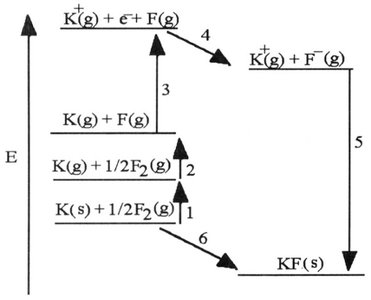
Step-by-Step Guidance
Examine the Born-Haber cycle diagram and identify the step where F(g) gains an electron.
Match this step to the labeled steps (1-5).
Try solving on your own before revealing the answer!
Final Answer:
Step 4 corresponds to the electron affinity of a gaseous F atom in the Born-Haber cycle for KF.
Q15. Given the values for steps 1–6 in the Born-Haber cycle, calculate the lattice energy of KF (s) (magnitude of step 5).
Background
Topic: Lattice Energy and Born-Haber Cycle
This question tests your ability to use thermochemical data to calculate lattice energy.
Key Terms and Formulas:
Lattice energy: Energy required to separate ions in a solid.
Born-Haber cycle: Relates various energy changes to lattice energy.
Step-by-Step Guidance
Write the equation relating the steps in the Born-Haber cycle to lattice energy.
Plug in the given values for each step.
Set up the calculation for lattice energy (step 5).
Try solving on your own before revealing the answer!
Final Answer:
Lattice energy of KF(s) is 562.6 kJ (magnitude of step 5), calculated using the Born-Haber cycle values.
Q16. Write the equation for Coulombic Attractions (potential energy) and describe two conditions under which lattice energy increases.
Background
Topic: Lattice Energy and Coulombic Attractions
This question tests your understanding of the relationship between lattice energy and ionic properties.
Key Terms and Formulas:
Coulombic Attractions:
Lattice energy: Increases with higher charge and smaller distance between ions.
Step-by-Step Guidance
Write the equation for Coulombic Attractions.
Identify how increasing charge or decreasing distance affects lattice energy.
Describe the two conditions for increased lattice energy.
Try solving on your own before revealing the answer!
Final Answer:
Lattice energy increases when the charge of the ions increases and when the distance between ions decreases.
Q17. For the following molecules, draw the Lewis Structure, predict the electron and molecular geometry (VSEPR Theory), predict whether the molecule is polar or non-polar, and predict the hybridization of the central atom: CH3Cl, HCN, CO32–
Background
Topic: Molecular Geometry and Bonding Theories
This question tests your ability to apply Lewis structures, VSEPR theory, polarity, and hybridization concepts.
Key Terms:
Lewis Structure: Shows bonding and lone pairs.
VSEPR Theory: Predicts geometry based on electron domains.
Hybridization: Describes mixing of atomic orbitals.
Step-by-Step Guidance
Draw the Lewis structure for each molecule.
Count electron domains to predict electron geometry.
Determine molecular geometry based on bonding and lone pairs.
Assess polarity based on shape and electronegativity.
Predict hybridization based on electron domains.
Try solving on your own before revealing the answer!
Final Answer:
CH3Cl: tetrahedral, polar, sp3; HCN: linear, polar, sp; CO32–: trigonal planar, non-polar, sp2.
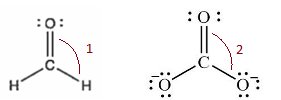
Q18. How many sigma and pi bonds are found in the Lewis structure of formaldehyde, H2CO? What is the hybridization of the central C atom? What orbitals are involved in the sigma and pi bonds? Which molecule can undergo resonance? Which molecule has the larger bond order, bond enthalpy, bond length, and bond angle?
Background
Topic: Bond Types, Hybridization, Resonance, and Bond Properties
This question tests your understanding of sigma and pi bonds, hybridization, resonance, and bond properties.
Key Terms:
Sigma bond: Single covalent bond.
Pi bond: Double/triple bond component.
Hybridization: Mixing of atomic orbitals.
Resonance: Delocalization of electrons.
Step-by-Step Guidance
Draw the Lewis structure for H2CO and CO32–.
Count the number of sigma and pi bonds in H2CO.
Determine the hybridization of the central C atom.
Identify the orbitals involved in sigma and pi bonds.
Compare bond order, bond enthalpy, bond length, and bond angle between the two molecules.
Try solving on your own before revealing the answer!
Final Answer:
H2CO has 3 sigma bonds and 1 pi bond; central C is sp2 hybridized. Sigma bonds involve sp2 and s orbitals; pi bonds involve unhybridized p orbitals. CO32– can undergo resonance. H2CO has larger bond order, bond enthalpy, and bond angle; CO32– has longer bond length.
