 Back
CHEM 1411 Exam IV Review – Thermochemistry, Bonding, and Molecular Structure
Study Guide - Smart Notes
 Tailored notes based on your materials, expanded with key definitions, examples, and context.
Q21. Estimate the enthalpy change (ΔH) for the gas-phase hydration of ethylene to ethanol using average bond dissociation energies.
Background
Topic: Thermochemistry & Bond Energies
This question tests your ability to estimate the enthalpy change for a chemical reaction by using average bond dissociation energies. You are asked to analyze the reaction:
Ethylene (C2H4) + Water (H2O) → Ethanol (C2H5OH)

Key Terms and Formulas:
Bond Dissociation Energy (D): The energy required to break a specific chemical bond in one mole of gaseous molecules.
ΔH (Enthalpy Change): The overall energy change for the reaction.
Key formula:
Step-by-Step Guidance
Write out the bonds present in the reactants (C2H4 and H2O) and the product (C2H5OH).
Identify which bonds are broken and which are formed during the reaction.
Use the provided average bond dissociation energies for each relevant bond (e.g., C=C, C–H, C–O, O–H, etc.).
Calculate the total energy required to break all bonds in the reactants.
Set up the calculation for the total energy released when new bonds are formed in the product.
Try solving on your own before revealing the answer!
Final Answer: ΔH ≈ -35 kJ
Using the bond dissociation energies provided, the enthalpy change for the reaction is approximately -35 kJ. This means the reaction is exothermic, releasing energy as ethanol is formed from ethylene and water.
We calculated ΔH by summing the energies for bonds broken and subtracting the energies for bonds formed, following the formula above.
Q51. Which of the following molecular structures should be nonlinear?
Background
Topic: Molecular Geometry & VSEPR Theory
This question tests your understanding of how electron pairs and molecular geometry determine whether a molecule is linear or nonlinear. You are given three different Lewis structures to analyze.

Key Terms and Concepts:
Linear Geometry: Atoms are arranged in a straight line, typically with no lone pairs on the central atom.
Nonlinear (Bent) Geometry: Atoms are not arranged in a straight line, often due to lone pairs on the central atom.
VSEPR Theory: Predicts molecular shapes based on repulsion between electron pairs.
Step-by-Step Guidance
Examine each structure for lone pairs on the central atom (A).
Recall that lone pairs cause repulsion, which can bend the molecule away from linearity.
Apply VSEPR theory to determine the geometry for each structure.
Identify which structures have a bent or nonlinear shape based on the presence of lone pairs.
Try solving on your own before revealing the answer!
Final Answer: II and III are nonlinear
Structures II and III have lone pairs on the central atom, causing the molecule to adopt a bent (nonlinear) geometry according to VSEPR theory.
Q57. Based on the molecular orbital (MO) diagram for B2, what is the bond order and magnetic property?
Background
Topic: Molecular Orbital Theory
This question tests your ability to interpret a molecular orbital diagram and determine bond order and whether the molecule is paramagnetic or diamagnetic.
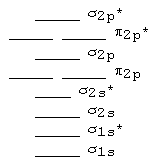
Key Terms and Formulas:
Bond Order:
Paramagnetic: Molecule has unpaired electrons.
Diamagnetic: Molecule has all electrons paired.
Step-by-Step Guidance
Count the total number of electrons in B2 (boron has 5 electrons, so B2 has 10).
Fill the molecular orbitals according to the diagram, starting from the lowest energy level.
Identify the number of bonding and antibonding electrons.
Calculate the bond order using the formula above.
Check for unpaired electrons to determine if B2 is paramagnetic or diamagnetic.
Try solving on your own before revealing the answer!
Final Answer: Bond order = 1, B2 is paramagnetic
B2 has a bond order of 1 and is paramagnetic because there are unpaired electrons in the molecular orbital diagram.
Q59. What is the geometry around the central atom in the molecular model of SO2?
Background
Topic: Molecular Geometry & VSEPR Theory
This question tests your ability to identify the molecular geometry of SO2 based on its model and the arrangement of atoms and lone pairs.

Key Terms and Concepts:
Bent Geometry: Occurs when the central atom has lone pairs, causing the molecule to bend.
VSEPR Theory: Used to predict the shape based on electron pair repulsion.
Step-by-Step Guidance
Count the number of charge clouds (bonding pairs and lone pairs) around the central atom (S).
Apply VSEPR theory to determine the geometry based on the number of charge clouds.
Identify if the molecule is linear or bent based on the arrangement.
Try solving on your own before revealing the answer!
Final Answer: Bent geometry
The SO2 molecule has a bent geometry due to the presence of lone pairs on the central sulfur atom, as predicted by VSEPR theory.
Q60. What is the geometry around the central atom in the molecular model of SCl4?
Background
Topic: Molecular Geometry & VSEPR Theory
This question tests your ability to identify the molecular geometry of SCl4 based on its model and the arrangement of atoms and lone pairs.

Key Terms and Concepts:
Seesaw Geometry: Occurs when there are five charge clouds (four bonds and one lone pair) around the central atom.
Trigonal Bipyramidal: The parent geometry for five charge clouds.
VSEPR Theory: Used to predict the shape based on electron pair repulsion.
Step-by-Step Guidance
Count the number of charge clouds (bonding pairs and lone pairs) around the central atom (S).
Apply VSEPR theory to determine the geometry based on the number of charge clouds.
Identify the specific geometry (seesaw, trigonal bipyramidal, etc.) based on the arrangement.
Try solving on your own before revealing the answer!
Final Answer: Seesaw geometry
The SCl4 molecule has a seesaw geometry due to the presence of one lone pair and four bonding pairs around the central sulfur atom, as predicted by VSEPR theory.
