 Back
BackChem121A Exam 1 Study Guide: Matter, Atoms, Molecules, and Chemical Reactions
Study Guide - Smart Notes
 Tailored notes based on your materials, expanded with key definitions, examples, and context.
Chapter 1: Matter, Energy, and Measurement
Physical States and Classification of Matter
The physical states of matter—solid, liquid, and gas—are fundamental concepts in chemistry. Each state has distinct properties and behaviors.
Solid: Definite shape and volume; particles are closely packed and vibrate in place.
Liquid: Definite volume but no definite shape; particles are less tightly packed and can move past each other.
Gas: No definite shape or volume; particles are far apart and move freely.
Classification: Matter can be classified as pure substances (elements or compounds) or mixtures (homogeneous or heterogeneous).
Chemical vs. Physical Changes: Chemical changes alter the composition of matter (e.g., burning), while physical changes do not (e.g., melting).
Intensive vs. Extensive Properties: Intensive properties (e.g., density) do not depend on the amount of substance; extensive properties (e.g., mass) do.
Examples: Water boiling (physical), iron rusting (chemical).
Measurement and SI Units
Measurement is essential in chemistry. The SI system provides standard units for scientific work.
SI Base Units: Length (meter), mass (kilogram), temperature (Kelvin), time (second), amount (mole).
Temperature Conversions: Use the following formulas:
Metric Prefixes: Prefixes modify the base unit by powers of ten (e.g., milli-, kilo-, micro-). Know the relationships from Mega (M) to pico (p).
Dimensional Analysis: Use conversion factors to change units, often involving multi-step calculations.
Precision, Accuracy, and Significant Figures
Accurate and precise measurements are critical for reliable results.
Precision: Consistency of repeated measurements.
Accuracy: Closeness to the true value.
Significant Figures: Rules determine which digits are significant. Calculations must be rounded appropriately based on these rules.
Scientific Notation: Express numbers as for clarity and ease of calculation.
Dimensional Analysis: Essential for converting units and solving quantitative problems.
Chapter 2: Atoms, Molecules, and Ions
Structure of the Atom
Atoms are composed of three subatomic particles: protons, neutrons, and electrons.
Proton: Positive charge, found in the nucleus.
Neutron: Neutral charge, found in the nucleus.
Electron: Negative charge, smallest mass, found outside the nucleus.
Isotopes: Atoms of the same element with different numbers of neutrons.
Average Atomic Mass: Calculated using:
Atomic Number: Number of protons; determines the element.
Atomic Mass: Sum of protons and neutrons.
Atomic Symbols: Notation includes atomic number and mass; ions are indicated with charge.
Periodic Table and Chemical Formulas
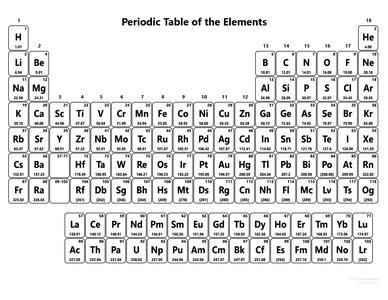
The periodic table organizes elements by atomic number and groups with similar properties.
Groups: Vertical columns; elements in a group share chemical properties.
Metals vs. Nonmetals: Metals are typically shiny, conductive, and malleable; nonmetals are varied in properties.
Empirical vs. Molecular Formulas: Empirical formula shows simplest ratio; molecular formula shows actual number of atoms.
Ions and Naming Compounds
Ions are atoms or molecules with a net charge due to loss or gain of electrons.
Cation: Positive charge; electrons lost.
Anion: Negative charge; electrons gained.
Predicting Ionic Formulas: Combine ions to achieve charge neutrality (swap-and-drop method).
Variable-Charge Ions: Transition metals can have multiple charges; indicated with Roman numerals in names.
Monoatomic and Polyatomic Ions: Learn common ions, their names, formulas, and charges.
Naming Rules:
Ionic Compounds: Name cation first, then anion; use Roman numerals for variable-charge cations.
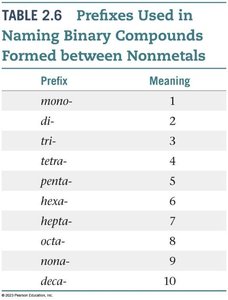
Molecular Compounds: Use prefixes to indicate number of atoms (see table below).
Prefix | Meaning |
|---|---|
mono- | 1 |
di- | 2 |
tri- | 3 |
tetra- | 4 |
penta- | 5 |
hexa- | 6 |
hepta- | 7 |
octa- | 8 |
nona- | 9 |
deca- | 10 |
Chapter 3: Chemical Reactions and Reaction Stoichiometry
Balancing Chemical Equations and Types of Reactions
Chemical reactions must obey the law of conservation of mass. Balancing equations ensures equal numbers of atoms on both sides.
Law of Conservation of Mass: Mass is neither created nor destroyed in a chemical reaction.
Balancing Equations: Adjust coefficients to balance atoms.
Types of Reactions:
Combination: Two or more substances form one product.
Decomposition: One substance breaks into two or more products.
Combustion: Substance reacts with oxygen, producing energy, CO2, and H2O.
Stoichiometry and Quantitative Calculations
Stoichiometry involves quantitative relationships in chemical reactions, using moles, masses, and conversion factors.
Formula Weight (FW): Sum of atomic masses in a formula; units are amu or g/mol.
Percent Composition:
Mole Concept: 1 mole = particles (Avogadro's number).
Molar Mass: Mass of 1 mole of substance; units are g/mol.
Conversions: Use molar mass and Avogadro's number to convert between grams, moles, and molecules.
Empirical Formula: Simplest ratio of elements; determined from mass, moles, or percent composition.
Stoichiometry Calculations: Molar Ratios, Limiting Reagents, and Yield
Stoichiometry calculations use balanced equations to determine quantities of reactants and products.
Molar Ratios: Coefficients in balanced equations indicate ratios of moles.
Limiting Reagent: The reactant that determines the maximum amount of product formed.
Theoretical Yield: Maximum possible product based on limiting reagent.
Percent Yield:
Example:
Given 10 g of A and 15 g of B, determine the limiting reagent, theoretical yield, and percent yield if 8 g of product is obtained.
Additional info: Practice and repetition are essential for mastering stoichiometry and quantitative calculations. Use dimensional analysis for all conversions and ensure correct use of significant figures in answers.
