Back
Chemical Bond Types and Lone Pairs: Lewis Structures
Study Guide - Smart Notes
 Tailored notes based on your materials, expanded with key definitions, examples, and context.
Chemical Bonding and Lewis Structures
Types of Chemical Bonds and Lone Pairs
Chemical bonds are the forces that hold atoms together in molecules. The most common types of bonds are single, double, and triple bonds, which differ in the number of shared electron pairs between atoms. Lewis structures are diagrams that show the bonding between atoms and the location of lone pairs of electrons.
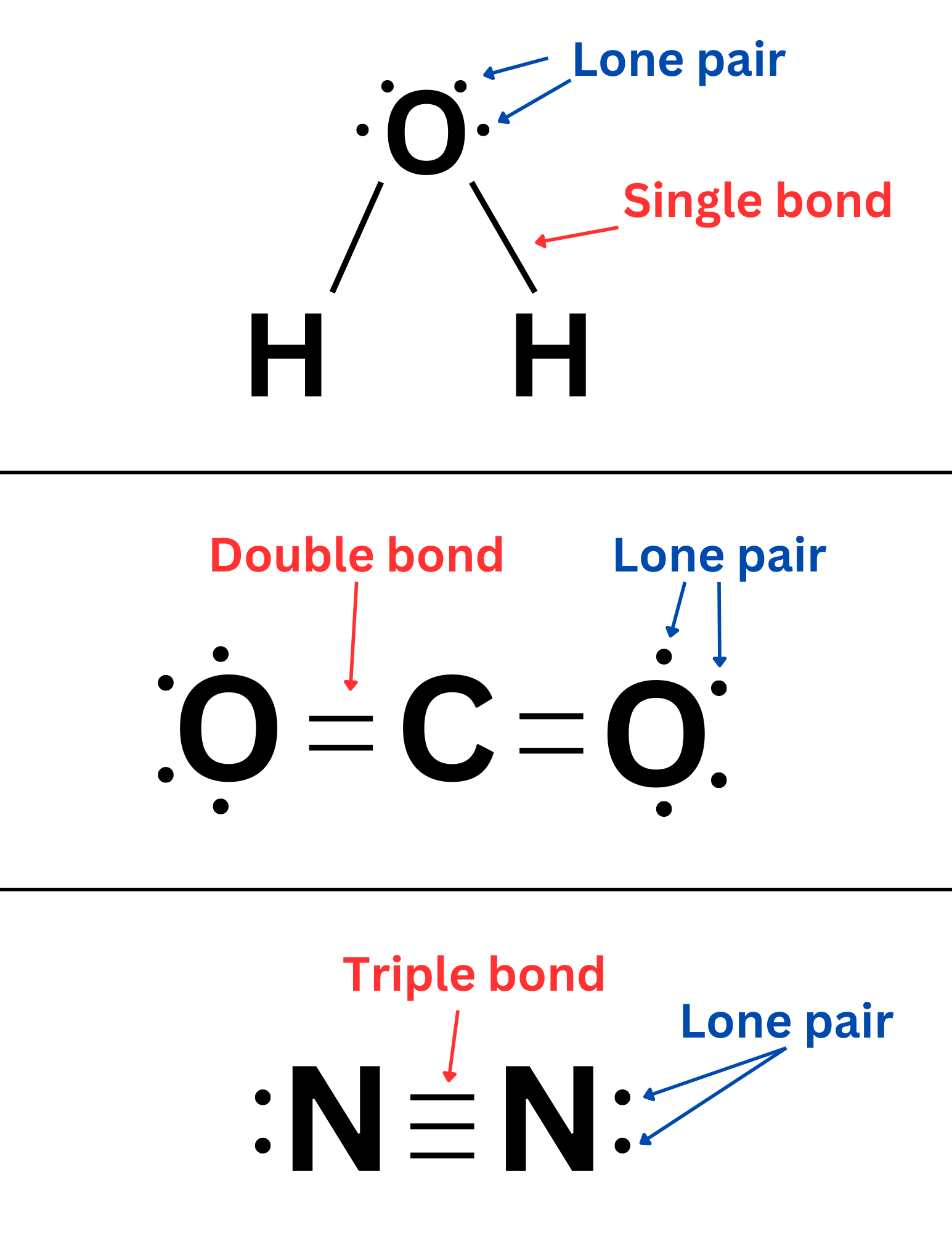
Single Bond: A single bond involves one pair of shared electrons between two atoms. It is represented by a single line between atoms in a Lewis structure.
Double Bond: A double bond consists of two pairs of shared electrons. It is depicted by two lines between atoms.
Triple Bond: A triple bond involves three pairs of shared electrons, shown as three lines between atoms.
Lone Pair: A lone pair is a pair of valence electrons that are not involved in bonding. These are shown as pairs of dots around the atom in Lewis structures.
Example: The water molecule (H2O) has two single bonds between oxygen and hydrogen, and two lone pairs on the oxygen atom. Carbon dioxide (CO2) has two double bonds between carbon and oxygen, and each oxygen atom has two lone pairs. Nitrogen gas (N2) has a triple bond between two nitrogen atoms, and each nitrogen atom has one lone pair.
Lewis Structure Notation:
Dots represent electrons.
Lines represent shared pairs (bonds).
Lone pairs are shown as pairs of dots on the atom.
Bond Order: The bond order is the number of shared electron pairs between two atoms. Higher bond order means stronger and shorter bonds.
General Formula:
Single bond:
Double bond:
Triple bond:
Applications: Understanding bond types and lone pairs is essential for predicting molecular shape, reactivity, and properties.