Back
Chemical Bonding and Molecular Geometry: Polarity, VSEPR, and Bond Energies
Study Guide - Smart Notes
 Tailored notes based on your materials, expanded with key definitions, examples, and context.
Chemical Bonding and Molecular Geometry
Molecular Shape and Biological Function
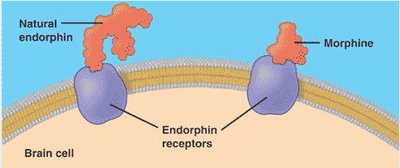
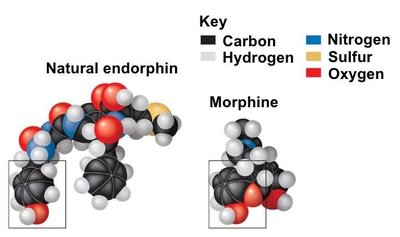
The three-dimensional shape of molecules is crucial for their function, especially in biological systems. Molecules interact with specific receptors in the body based on their shape, a concept known as the lock-and-key model. For example, morphine mimics the shape of natural endorphins, allowing it to bind to endorphin receptors in the brain and produce similar physiological effects.
Lock-and-Key Model: The biological activity of a molecule often depends on its ability to fit into a specific receptor site, much like a key fits into a lock.
Molecular Imposters: Some drugs, such as morphine, have shapes similar to natural molecules (endorphins) and can bind to the same receptors, affecting biological processes.
Electronegativity and Bond Polarity
Electronegativity Trends
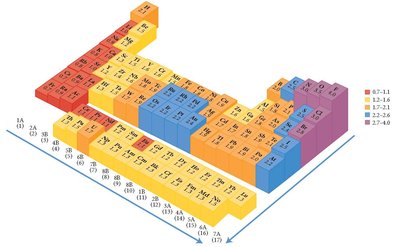
Electronegativity is the ability of an atom to attract electrons in a chemical bond. It varies across the periodic table:
Increases from left to right across a period.
Decreases from top to bottom within a group.
Fluorine is the most electronegative element; francium is the least.
Bond Polarity and Types of Bonds
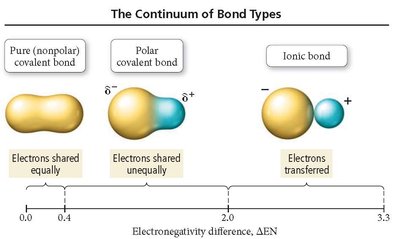
The difference in electronegativity (ΔEN) between two atoms determines the type of bond formed:
Nonpolar Covalent Bond: Electrons are shared equally (ΔEN ≈ 0).
Polar Covalent Bond: Electrons are shared unequally (0 < ΔEN < 2).
Ionic Bond: Electrons are transferred from one atom to another (ΔEN > 2).
Quantifying Bond Polarity: Dipole Moment
The dipole moment (μ) measures the separation of positive and negative charges in a molecule:
Calculated as where q is the charge and r is the distance between charges.
Measured in Debye (D):
The greater the charge separation, the larger the dipole moment.
Percent Ionic Character
The percent ionic character of a bond compares the measured dipole moment to the value expected for a completely ionic bond:
Calculated as
Bonds with >50% ionic character are considered ionic.
Dipole Moments of Common Molecules
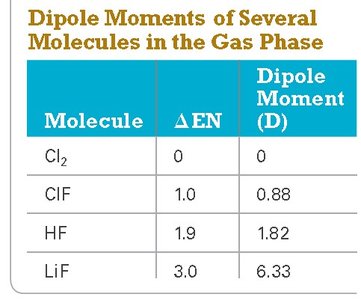
The table below shows the relationship between electronegativity difference and dipole moment for several molecules:
Molecule | ΔEN | Dipole Moment (D) |
|---|---|---|
Cl2 | 0 | 0 |
ClF | 1.0 | 0.88 |
HF | 1.9 | 1.82 |
LiF | 3.0 | 6.33 |
Lewis Structures, Resonance, and Formal Charge
Drawing Lewis Structures
Lewis structures represent the arrangement of valence electrons in molecules and polyatomic ions. The steps include:
Determine the skeletal structure (central atom is usually the least electronegative).
Sum the valence electrons from all atoms (add or subtract electrons for ions).
Connect atoms with single bonds, complete octets for terminal atoms, and place remaining electrons on the central atom.
If the central atom lacks an octet, form multiple bonds as needed.
Resonance Structures
Some molecules cannot be represented by a single Lewis structure. Resonance structures are two or more valid Lewis structures for the same molecule, differing only in the arrangement of electrons. The actual molecule is a resonance hybrid of these forms.
Formal Charge
Formal charge helps determine the most stable Lewis structure:
Calculated as:
The sum of all formal charges in a neutral molecule must be zero; for ions, it must equal the ion's charge.
Structures with the smallest (or zero) formal charges are preferred; negative charges should reside on the most electronegative atoms.
Exceptions to the Octet Rule
Odd-electron species: Molecules with an odd number of electrons (free radicals).
Incomplete octets: Some atoms (e.g., B, Be) may have fewer than eight electrons.
Expanded octets: Atoms in period 3 or higher can have more than eight electrons.
Bond Energies and Bond Lengths
Bond Energy
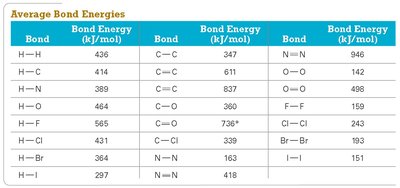
Bond energy is the energy required to break one mole of a bond in the gas phase. It is a measure of bond strength:
Higher bond energy = stronger bond.
Average bond energies are used for calculations involving different molecules.
Bond | Bond Energy (kJ/mol) |
|---|---|
H–H | 436 |
C–C | 347 |
C=C | 611 |
C≡C | 837 |
O=O | 498 |
N≡N | 946 |
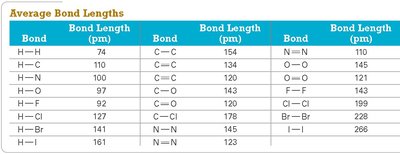
Bond Length
Bond length is the average distance between the nuclei of two bonded atoms. Generally, as bond order increases (single, double, triple), bond length decreases and bond energy increases.
Bond | Bond Length (pm) |
|---|---|
H–H | 74 |
C–C | 154 |
C=C | 134 |
C≡C | 120 |
N≡N | 110 |
Valence Shell Electron Pair Repulsion (VSEPR) Theory
Basic Principles
VSEPR theory predicts the geometry of molecules based on the repulsion between electron groups (lone pairs, single, double, and triple bonds) around a central atom. The arrangement that minimizes repulsion determines the molecular shape.
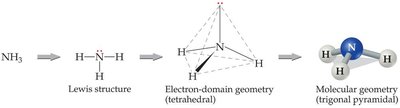
Electron-domain geometry: Arrangement of all electron domains (bonding and nonbonding) around the central atom.
Molecular geometry: Arrangement of only the atoms (ignoring lone pairs).
Common Electron-Domain Geometries
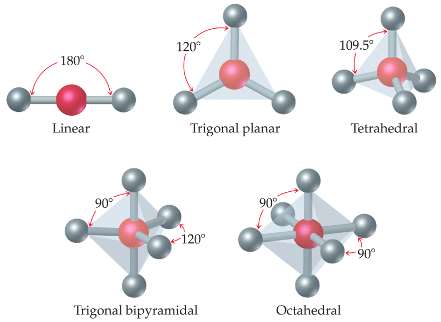
2 electron domains: Linear (180°)
3 electron domains: Trigonal planar (120°)
4 electron domains: Tetrahedral (109.5°)
5 electron domains: Trigonal bipyramidal (90°, 120°)
6 electron domains: Octahedral (90°)
Effect of Lone Pairs and Multiple Bonds
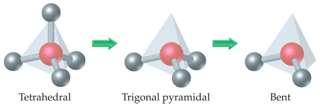
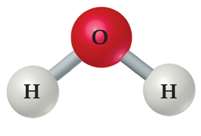
Lone pairs and multiple bonds exert greater repulsive forces than bonding pairs, leading to smaller bond angles. For example, in water (H2O), the bond angle is 104.5°, less than the ideal tetrahedral angle due to two lone pairs on oxygen.
Examples of Molecular Geometries
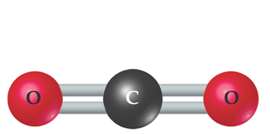
Linear: CO2
Bent: SO2, H2O
Trigonal planar: SO3
Tetrahedral: CH4
Trigonal pyramidal: NH3
Seesaw: SF4
T-shaped: ClF3
Octahedral: SF6
Molecular Shape and Polarity
Bond Dipoles and Molecular Dipole Moment
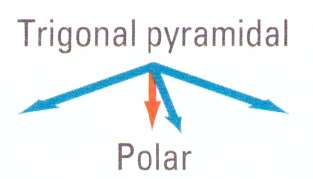
The overall polarity of a molecule depends on both the polarity of individual bonds and the molecular geometry. Bond dipoles are vector quantities; their sum (vector addition) gives the molecular dipole moment.
Nonpolar molecules: Symmetrical geometry causes bond dipoles to cancel (e.g., CO2).
Polar molecules: Asymmetrical geometry results in a net dipole moment (e.g., H2O, SO2).
Example: SO2 Polarity
Lewis structure: Bent geometry due to lone pair on sulfur.
Resonance: Two equivalent structures.
Polarity: The molecule is polar due to the bent shape and unequal sharing of electrons.
Vector Addition in Molecular Polarity
Vectors represent both magnitude and direction. The overall dipole moment is the vector sum of individual bond dipoles.