 Back
BackChemical Bonding and Molecular Geometry: Study Notes
Study Guide - Smart Notes
 Tailored notes based on your materials, expanded with key definitions, examples, and context.
Chemical Bonding and Molecular Geometry
Ionic vs. Covalent Bonding
Chemical bonds are classified as either ionic or covalent based on how electrons are distributed between atoms. Ionic bonds involve the transfer of electrons from one atom to another, typically between metals and nonmetals, resulting in the formation of ions. Covalent bonds involve the sharing of electrons between nonmetal atoms.
Ionic Compounds: Formed between metals and nonmetals (e.g., NaCl, CaF2).
Covalent Compounds: Formed between nonmetals (e.g., CO2).
Example: Sodium chloride (ionic), carbon dioxide (covalent), calcium fluoride (ionic).
Lewis Dot Symbols
Lewis dot symbols represent the valence electrons of an atom as dots around the elemental symbol. The group number in the periodic table indicates the number of valence electrons for main group elements.
To draw a Lewis dot symbol, place the correct number of dots (valence electrons) around the element's symbol.
Example: Sulfur (S) is in group 16, so it has 6 valence electrons.
Bond Polarity and Electronegativity
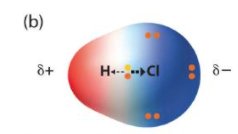
Bond polarity arises from differences in electronegativity—the ability of an atom to attract electrons in a bond. If electrons are shared equally, the bond is nonpolar; if not, the bond is polar. The greater the difference in electronegativity, the more polar the bond.
Electronegativity increases from left to right and bottom to top on the periodic table.
Example: In HCl, chlorine is more electronegative than hydrogen, resulting in a polar bond with partial charges (δ+ on H, δ− on Cl).
Lewis Structures and the Octet Rule
Lewis structures show how valence electrons are arranged among atoms in a molecule. The octet rule states that atoms tend to form bonds until they are surrounded by eight valence electrons (except for hydrogen, which follows the duet rule).
Sum the valence electrons from all atoms.
Choose the least electronegative atom as the central atom.
Connect atoms with single bonds (2 electrons per bond).
Complete the octet of outer atoms.
Place remaining electrons on the central atom.
If needed, form multiple bonds to complete the octet.
Octet Rule Exceptions
Odd number of valence electrons: Example: NO (nitrogen monoxide).
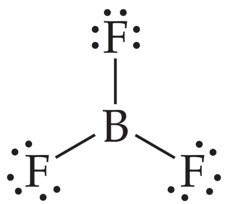
Less than an octet: Example: BF3 (boron trifluoride).
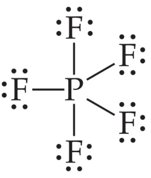
Expanded octet: Example: PF5 (phosphorus pentafluoride).
Formal Charge
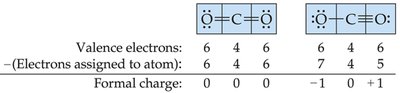
Formal charge helps determine the most stable Lewis structure. It is calculated as:
The dominant Lewis structure has formal charges closest to zero and places negative charges on the most electronegative atoms.
Example: For CO2, the structure with all formal charges zero is preferred.
Resonance Structures
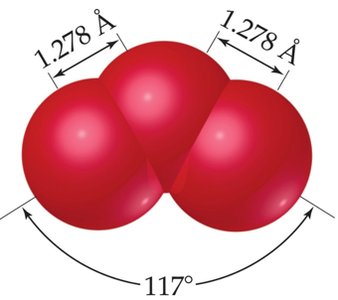
When a single Lewis structure cannot accurately represent a molecule, resonance structures are used. Resonance explains bond lengths and electron delocalization.
Electrons in double bonds can be delocalized, resulting in bond lengths that are intermediate between single and double bonds.
Example: Ozone (O3) has two resonance structures, leading to equal bond lengths and angles.
Bond Enthalpies and Bond Order
Bond enthalpy is the energy required to break a bond. As the number of bonds between two atoms increases (single, double, triple), the bond becomes shorter and stronger.
Single bond: longest and weakest
Double bond: intermediate length and strength
Triple bond: shortest and strongest
Example: N–N single, double, and triple bonds
Valence Shell Electron Pair Repulsion (VSEPR) Theory
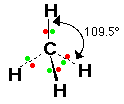
VSEPR theory is used to predict the geometry of molecules based on the repulsion between electron domains (regions of electron density) around a central atom.
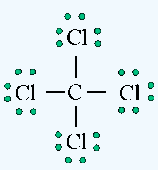
Draw the Lewis structure first.
Count the number of electron domains (bonding and lone pairs).
Assign the correct electron geometry based on the number of domains.
Molecular Geometry
Molecular geometry describes the arrangement of atoms (not electron pairs) in a molecule. Lone pairs affect the shape and bond angles.
Example: Ammonia (NH3) has a tetrahedral electron geometry but a trigonal pyramidal molecular geometry due to one lone pair on nitrogen.
Geometry of Larger Molecules
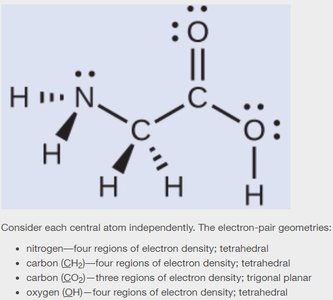
For larger molecules, determine the geometry around each central atom independently by counting electron domains and applying VSEPR theory.
Valence Bond Theory and Hybridization
Valence bond theory explains bonding as the overlap of atomic orbitals. Hybridization occurs when atomic orbitals mix to form new, equivalent hybrid orbitals, which determine molecular geometry.
sp3 hybridization: tetrahedral geometry (e.g., CH4)
sp2 hybridization: trigonal planar geometry (e.g., BF3)
sp hybridization: linear geometry (e.g., CO2)
Sigma (σ) and Pi (π) Bonds
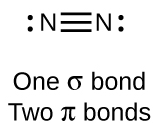
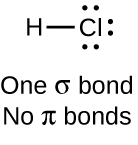
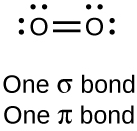
Single bonds are sigma (σ) bonds. Multiple bonds contain one sigma bond and one or more pi (π) bonds.
Double bond: 1 σ + 1 π
Triple bond: 1 σ + 2 π
Examples:
Summary Table: Bond Types and Geometries
Compound | Lewis Structure | Electron Geometry | Molecular Geometry | Bond Angle | Polar/Nonpolar | Hybridization |
|---|---|---|---|---|---|---|
BeH2 | Linear | Linear | Linear | 180° | Nonpolar | sp |
NF3 | Trigonal pyramidal | Tetrahedral | Trigonal pyramidal | ~107° | Polar | sp3 |
CF4 | Tetrahedral | Tetrahedral | Tetrahedral | 109.5° | Nonpolar | sp3 |
HCCl3 | Tetrahedral | Tetrahedral | Tetrahedral | 109.5° | Polar | sp3 |
HCN | Linear | Linear | Linear | 180° | Polar | sp |
PF5 | Trigonal bipyramidal | Trigonal bipyramidal | Trigonal bipyramidal | 90°, 120° | Nonpolar | sp3d |
Additional info: These notes cover the essential concepts of chemical bonding, Lewis structures, resonance, formal charge, VSEPR theory, hybridization, and bond types, providing a comprehensive overview for general chemistry students.
