 Back
BackChemical Bonding: Formal Charge, Resonance, Octet Rule Exceptions, and Ionic Bonding
Study Guide - Smart Notes
 Tailored notes based on your materials, expanded with key definitions, examples, and context.
Chemical Bonding: Formal Charge, Resonance, Octet Rule Exceptions, and Ionic Bonding
Formal Charge
The formal charge (FC) is a bookkeeping tool used to estimate the distribution of electrons in a molecule. It helps identify the most stable Lewis structure among several possibilities.
Formula:
The sum of the formal charges in a neutral molecule must be zero; for an ion, it must equal the ion's charge.
The most stable Lewis structure is typically the one with formal charges closest to zero and with negative charges on the most electronegative atoms.
Example: Thiocyanate Ion (SCN-)
Possible Lewis structures and their formal charges are shown below. The dominant structure is the one with the lowest formal charges and negative charge on the most electronegative atom (N).

Exceptions to the Octet Rule
While the octet rule is a useful guideline, there are important exceptions:
Odd number of electrons: Molecules or ions with an odd number of electrons cannot have all atoms obey the octet rule.
Fewer than eight electrons: Some elements (especially B and Be) can be stable with fewer than eight electrons.
More than eight electrons (expanded octet): Elements in period 3 or higher can have more than eight valence electrons due to available d-orbitals.
Odd Number of Electrons
These species are rare and often highly reactive. Example: Nitric oxide (NO).

Fewer Than Eight Electrons
Elements such as boron can form stable compounds with less than a full octet. For example, in BF3, boron has only six electrons. Attempting to give boron a full octet would result in unfavorable formal charges.
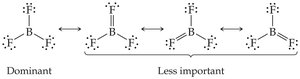
More Than Eight Electrons (Expanded Octet)
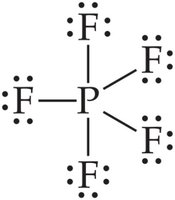
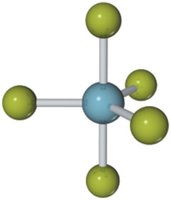
Atoms in period 3 or beyond (e.g., phosphorus, sulfur) can accommodate more than eight electrons. Example: PF5 has ten electrons around phosphorus.
Resonance Structures
Some molecules cannot be adequately represented by a single Lewis structure. Resonance structures are multiple valid Lewis structures for the same molecule. The actual structure is a resonance hybrid, or an average of all possible resonance forms.
Resonance stabilizes molecules by delocalizing electrons.
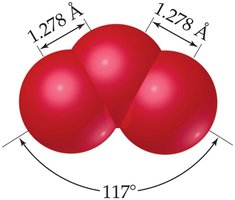
Example: Ozone (O3) has two equivalent resonance forms, and both O–O bonds are identical in length and strength.

Practice Question
How many equivalent resonance forms can be drawn for CO32- (with carbon as the central atom)?
Answer: 3
Ionic Bonding
Formation of Ionic Bonds
Ionic bonding occurs between metals and nonmetals (except group 8A). It involves the transfer of electrons from a metal (low ionization energy) to a nonmetal (high electron affinity), resulting in the formation of cations and anions. The process is highly exothermic.


Properties of Ionic Substances
Brittle
High melting points
Crystalline structure
Cleave along smooth lines
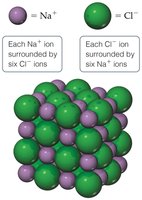
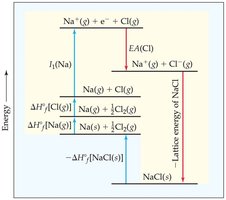
Energetics of Ionic Bonding: The Born–Haber Cycle
The Born–Haber cycle is a thermochemical cycle that analyzes the steps in the formation of an ionic compound from its elements. It includes ionization energy, electron affinity, and lattice energy.
Energy is required to convert elements to gaseous atoms (endothermic).
Energy is required to create cations (endothermic).
Energy is released when anions are formed (exothermic).
Formation of the solid lattice releases a large amount of energy (exothermic).
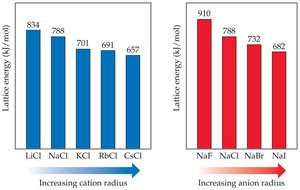
Lattice Energy
Lattice energy is the energy required to completely separate one mole of a solid ionic compound into its gaseous ions. It is a measure of the strength of the ionic bond.
Lattice energy increases with increasing ionic charge and decreasing ionic radius.
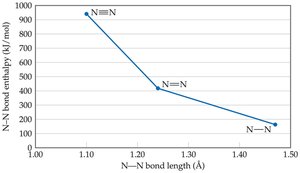
Bond Enthalpy and Bond Length
Bond enthalpy is the energy required to break a bond in a molecule (always positive, as bond breaking is endothermic). Bond length is the average distance between nuclei of two bonded atoms. Multiple bonds are stronger and shorter than single bonds.
As the number of bonds increases (single → double → triple), bond length decreases and bond enthalpy increases.
Example Question: In which of the molecules below is the carbon-carbon distance the shortest?
Answer: B) H–C≡C–H (triple bond, shortest bond length)
