 Back
BackChemical Bonding I: Electronegativity, Lewis Structures, Resonance, and Molecular Geometry
Study Guide - Smart Notes
 Tailored notes based on your materials, expanded with key definitions, examples, and context.
Chemical Bonding I
Electronegativity and Bond Polarity
Chemical bonds involve the sharing or transfer of electrons between atoms. However, not all covalent bonds share electrons equally. The concept of electronegativity helps explain the unequal sharing of electrons and the resulting bond polarity.
Electronegativity (EN): The ability of an atom to attract electrons to itself in a chemical bond.
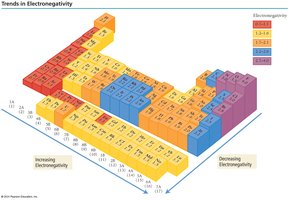
EN increases from left to right across a period and decreases from top to bottom in a group.
Fluorine is the most electronegative element; noble gases are not assigned EN values.
The difference in electronegativity between two atoms predicts the type of bond formed:
Electronegativity Difference (ΔEN) | Bond Type | Example |
|---|---|---|
Small (0–0.4) | Covalent | Cl2 |
Intermediate (0.4–2.0) | Polar covalent | HCl |
Large (2.0+) | Ionic | NaCl |
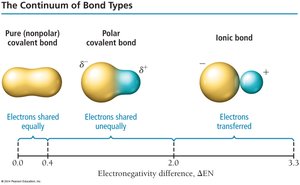
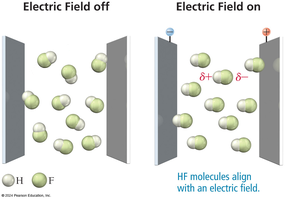
Bond Polarity: In a polar covalent bond, the more electronegative atom acquires a partial negative charge (δ–), and the less electronegative atom acquires a partial positive charge (δ+).
Dipole Moment: The direction of the dipole moment is from the less electronegative atom to the more electronegative atom.
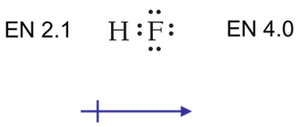
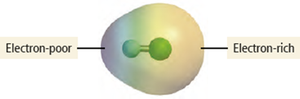
Example: In HF, F is more electronegative than H, so the bond is polar and the molecule aligns in an electric field.
Writing Lewis Structures
Lewis structures are diagrams that represent the arrangement of valence electrons in a molecule. They help visualize bonding and lone pairs.
Count the total number of valence electrons for the molecule or ion.
For cations, subtract electrons equal to the charge; for anions, add electrons equal to the charge.
Arrange atoms with the least electronegative atom (except H) in the center. Hydrogen is always terminal.
Connect atoms with single bonds (pairs of electrons).
Distribute remaining electrons as lone pairs to satisfy the octet rule (except for H and B).
If not enough electrons, form multiple bonds as needed.
Example: Drawing the Lewis structure for CO2:
Count valence electrons: C (4) + 2 × O (6) = 16 electrons.
Arrange C in the center, connect to O atoms with single bonds.
Distribute remaining electrons to complete octets; form double bonds if necessary.
Practice with molecules such as HBr, CH3F, H2S, NH3, NH4+, SiH4, N2, PH3, SH–, NO2–.
Resonance and Formal Charge
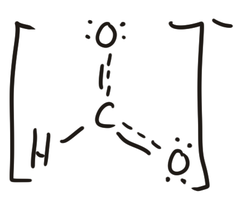
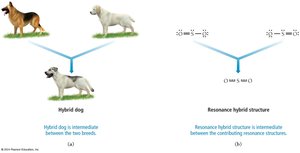
Some molecules cannot be represented by a single Lewis structure. These molecules exhibit resonance, where two or more valid Lewis structures exist, and the actual structure is a hybrid of these forms.
Resonance structures differ only in the placement of electrons, not atoms.
The resonance hybrid is an average of all possible resonance structures.
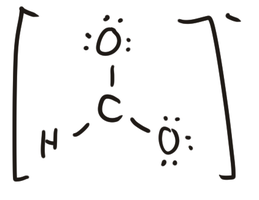
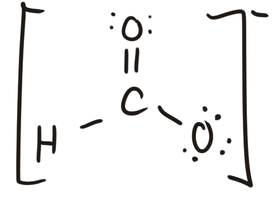
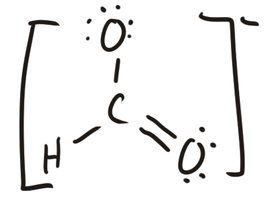
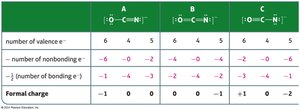
Formal Charge (FC): Used to determine the most stable Lewis structure.
Formal charge is calculated as:
The sum of formal charges should equal the overall charge of the molecule or ion.
Structures with the smallest formal charges (closest to zero) are preferred.
If a negative formal charge is present, it should be on the most electronegative atom.
Exceptions to the Octet Rule
While the octet rule is a useful guideline, there are important exceptions:
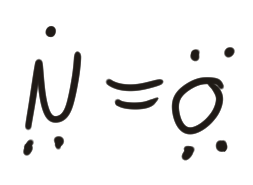
Odd-electron species (free radicals): Molecules with an odd number of electrons, such as NO.
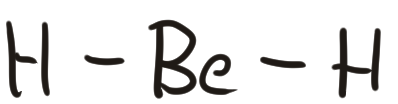
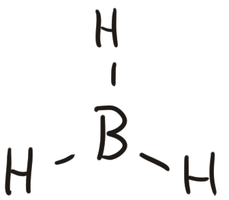
Incomplete octets: Atoms (usually from groups 2A and 3A, such as Be and B) can be stable with fewer than 8 electrons.
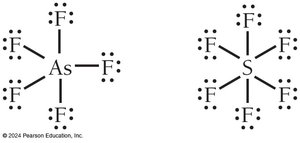
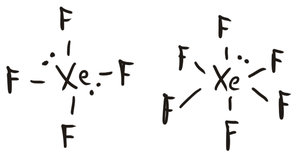
Expanded octets: Atoms in period 3 or higher (such as P, S, Xe) can have more than 8 electrons due to available d-orbitals.
Bond Energy and Bond Length
The strength and length of a bond depend on the bond order (single, double, triple):
Bond Length: The distance between the nuclei of two bonded atoms. Increases as bond order decreases.
Bond Energy: The energy required to break a bond. Increases as bond order increases.
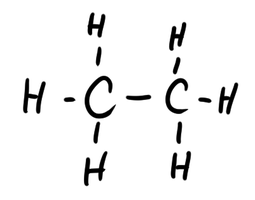
Bond | Bond Length (pm) | Bond Energy (kJ/mol) |
|---|---|---|
C≡C (triple) | 120 | 837 |
C=C (double) | 134 | 611 |
C–C (single) | 154 | 347 |
VSEPR Theory and Molecular Geometry
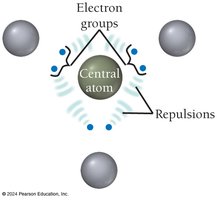
The Valence Shell Electron Pair Repulsion (VSEPR) theory predicts the shapes of molecules based on the repulsion between electron groups (bonding and lone pairs) around a central atom.
Electron groups arrange themselves as far apart as possible to minimize repulsion.
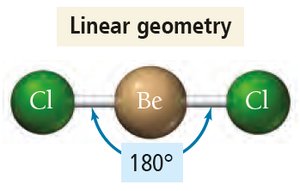
The number of electron groups determines the electron geometry:
Number of Electron Groups | Electron Geometry | Bond Angle |
|---|---|---|
2 | Linear | 180° |
3 | Trigonal Planar | 120° |
4 | Tetrahedral | 109.5° |
5 | Trigonal Bipyramidal | 90°, 120° |
6 | Octahedral | 90° |
VSEPR and Lone Pairs
Lone pairs occupy more space than bonding pairs, causing bond angles to decrease and affecting molecular shape. The molecular geometry considers only the positions of atoms, not lone pairs.
For example, water (H2O) has a bent shape due to two lone pairs on oxygen, even though its electron geometry is tetrahedral.
Molecular Shape and Polarity
The polarity of a molecule depends on both the polarity of its bonds and its molecular geometry. Even if a molecule contains polar bonds, the overall molecule may be nonpolar if the bond dipoles cancel out due to symmetry.
CO2: Linear geometry; bond dipoles cancel, so the molecule is nonpolar.
H2O: Bent geometry; bond dipoles do not cancel, so the molecule is polar.
To determine molecular polarity:
Draw the Lewis structure.
Determine the electron geometry and molecular shape.
Assess the bond polarities and their directions.
If the vector sum of bond dipoles is nonzero, the molecule is polar.
Example: Oil and water do not mix because polar molecules (like water) interact with other polar molecules, while nonpolar molecules (like oil) interact with nonpolar molecules.
