Back
Chemical Bonding I: The Lewis Model – General Chemistry Study Notes
Study Guide - Smart Notes
 Tailored notes based on your materials, expanded with key definitions, examples, and context.
Chapter 10: Chemical Bonding I – The Lewis Model
What Is Chemical Bonding?
Chemical bonding explains why atoms combine to form molecules and compounds. Atoms bond to achieve a more stable, lower-energy state, often resembling a 'full shell' or noble gas electron configuration. Understanding bonding helps predict molecular structure and properties.
Bond Formation: Atoms form bonds to maximize attractive forces and minimize repulsive forces.
Valence Electrons: The outermost electrons involved in bonding and chemical reactions.
Molecular Structure: The arrangement of atoms and distribution of electrons in a molecule.
Types of Intramolecular Chemical Bonds
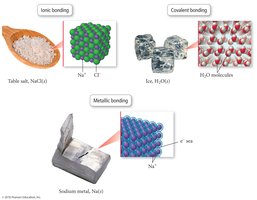
There are three primary types of chemical bonds, classified by the nature of the atoms involved and the mechanism of electron interaction.
Ionic Bonding: Complete transfer of one or more electrons from a metal (cation) to a nonmetal (anion).
Covalent Bonding: Sharing of valence electrons between nonmetals.
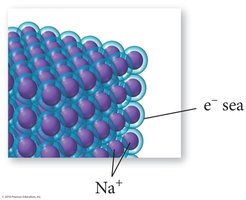
Metallic Bonding: Communal sharing of electrons among metal atoms, forming a 'sea of electrons.'
Bond Continuum: Most real bonds have characteristics between pure ionic and pure covalent types.
Why Do Atoms Bond?
Atoms bond to achieve a stable electron configuration, often a full valence shell. The strength and type of bond depend on factors such as electronegativity, atomic size, and the number of shared electrons.
Electronegativity and Bond Polarity
What Is Electronegativity?
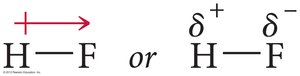
Electronegativity is a measure of an atom's ability to attract electrons in a chemical bond. Differences in electronegativity between atoms lead to bond polarity and the formation of dipole moments.
Symbol: δ (delta) indicates partial charges.
Dipole Moment (μ): A quantitative measure of bond polarity, given by (where q is the charge and r is the distance between charges).
Units: Debye (D).
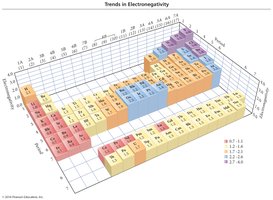
Electronegativity Trends
Electronegativity increases across a period (left to right) and decreases down a group (top to bottom) in the periodic table. Values range from about 0.7 to 4.0.
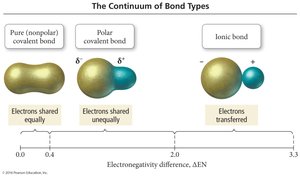
Bond Type and Electronegativity Difference
The difference in electronegativity (ΔEN) between two bonded atoms determines the bond type:
Electronegativity Difference (ΔEN) | Bond Type | Example |
|---|---|---|
0 – 0.4 | Pure (nonpolar) covalent | C2 |
0.4 – 2.0 | Polar covalent | HCl |
≥ 2.0 | Ionic | NaCl |

Properties of Ionic, Covalent, and Metallic Compounds
Properties of Ionic Compounds
Ionic compounds are formed by the electrostatic attraction between cations and anions. These compounds exhibit characteristic physical properties:
High melting and boiling points (usually > 300°C)
Hard, brittle crystalline solids at room temperature
Non-conductive as solids, but conductive as liquids (strong electrolytes)
Many are soluble in water

Properties of Molecular (Covalent) Compounds
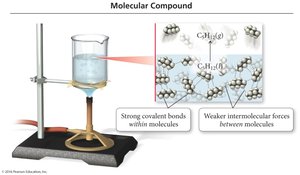
Molecular compounds consist of discrete molecules formed by covalent bonds between nonmetals. Their properties include:
Low melting and boiling points (generally < 300°C)
Variable hardness and brittleness
Can exist as solids, liquids, or gases at room temperature
Do not conduct electricity in any state
Properties of Metals and Metallic Bonding
Metallic bonding involves a lattice of metal cations surrounded by a sea of delocalized electrons. This structure gives rise to the following properties:
High melting and boiling points (except Hg)
Malleability and ductility
Good electrical and thermal conductivity (decreases with increasing temperature)
Shiny, reflective surfaces
The Lewis Model and Lewis Dot Structures
Valence Electrons and Lewis Dot Structures
Lewis dot structures represent the distribution of valence electrons in atoms, ions, and molecules. Valence electrons are shown as dots around the element symbol, with pairs representing shared (bonding) or unshared (lone) electrons.
Core electrons: Inner, filled shells
Valence electrons: Outermost shell, involved in bonding
Lewis Theory of Bonding
According to Lewis theory, atoms bond to achieve a noble gas configuration (octet rule). This can occur by:
Transfer of electrons (ionic bonding)
Sharing of electrons (covalent bonding)
Octet Rule and Its Exceptions
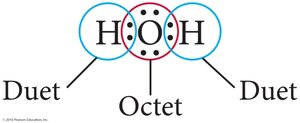
The octet rule states that atoms tend to have eight electrons in their valence shell. Exceptions include:
Duet rule: H, Li, Be, and B may have fewer than eight electrons (e.g., H achieves a duet).
Expanded octets: Elements in period 3 or below can have more than eight valence electrons.
Drawing Lewis Structures: Guidelines
Count the total number of valence electrons for all atoms.
Determine the central atom (never hydrogen; usually the least electronegative).
Arrange atoms and distribute electrons to satisfy the octet (or duet) rule.
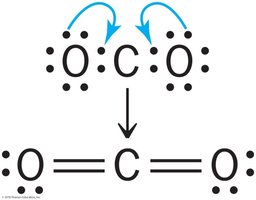
Use single, double, or triple bonds as needed to complete octets.
Multiple Bonds and Resonance
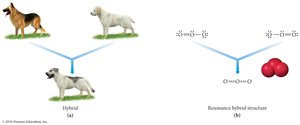
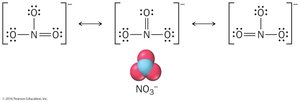
Some molecules require double or triple bonds to satisfy the octet rule. Resonance structures occur when more than one valid Lewis structure can be drawn for a molecule; the true structure is a hybrid of these forms.

Formal Charge
Formal charge helps determine the most stable Lewis structure. It is calculated as:
Version 1:
Version 2:
The most stable structure has formal charges closest to zero, with negative charges on the most electronegative atoms.
Bond Energies and Bond Lengths
Bond Energies
Bond energy is the energy required to break one mole of a bond in a compound. Stronger bonds have higher bond energies and are shorter in length. Multiple bonds (double, triple) are stronger and shorter than single bonds.
Example:
Bond Length
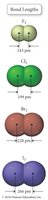
Bond length is the distance between the nuclei of two bonded atoms. It depends on atomic size, bond order, and electronegativity.
Single bonds are longer than double bonds, which are longer than triple bonds.
Bond length decreases as bond strength increases.
Estimating Enthalpy Change (ΔH) from Bond Energies
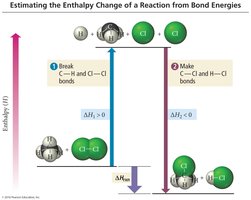
The enthalpy change of a reaction can be estimated by comparing the energy required to break bonds in reactants and the energy released when new bonds form in products:
Breaking bonds: energy absorbed (positive)
Forming bonds: energy released (negative)
Lattice Energy in Ionic Compounds
Lattice Energy
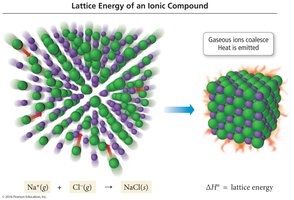
Lattice energy is the energy released when gaseous ions form an ionic solid. It is a measure of the stability of the ionic lattice and is always exothermic.
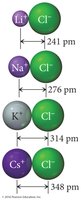
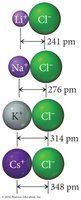
Depends on the charges of the ions (directly proportional) and the distance between them (inversely proportional).
Larger ions have lower lattice energies due to increased distance between charges.