 Back
Chemical Bonding II: Valence Bond Theory, Hybridization, and Molecular Orbital Theory
Study Guide - Smart Notes
 Tailored notes based on your materials, expanded with key definitions, examples, and context.
Ch 6 – Chemical Bonding II
Valence Bond Theory
Valence bond theory explains how atoms form chemical bonds by overlapping their atomic orbitals. This theory is foundational for understanding molecular shapes and the localization of electrons in bonds.
Electrons are localized in their respective atomic orbitals (s, p, d, etc.).
Chemical bonds form when two half-filled orbitals overlap, or when a filled orbital overlaps with an empty orbital.
Geometry of overlapping orbitals determines the molecular shape.
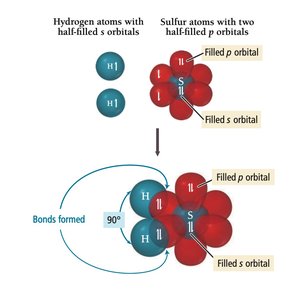
Example: In H2S, hydrogen atoms with half-filled s orbitals overlap with sulfur's half-filled p orbitals, forming bonds at approximately 90° angles.
Hybridization
Hybridization is the process by which atomic orbitals mix to form new, equivalent hybrid orbitals, optimizing molecular geometry and bond formation.
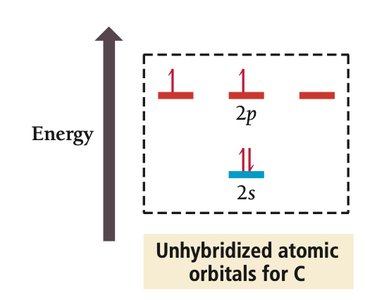
sp3 hybridization: Mixing one s and three p orbitals forms four equivalent sp3 hybrid orbitals, as seen in methane (CH4).
Geometry: Hybridized orbitals arrange themselves to minimize repulsion, resulting in tetrahedral, trigonal planar, or linear shapes depending on the hybridization type.
Example: In CH4, carbon's orbitals hybridize to form four sp3 orbitals, each forming a sigma bond with hydrogen.
Bond Types: Sigma (σ) and Pi (π) Bonds
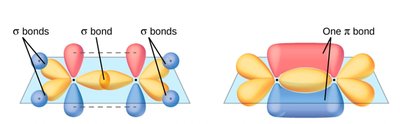
Bonds between atoms can be classified as sigma (σ) or pi (π) bonds, depending on the type of orbital overlap.
σ bonds: Formed by direct overlap of orbitals along the axis connecting two nuclei; these are single bonds and allow free rotation.
π bonds: Formed by side-to-side overlap of p orbitals above and below the bonding axis; these restrict rotation and are present in double and triple bonds.
Example: A double bond consists of one σ and one π bond.
Practice and Applications of Hybridization
Hybridization can be determined for various atoms in molecules by analyzing their bonding and lone pairs.
sp3 hybridization: Found in atoms with four electron domains (e.g., NH3, H2O).
sp2 hybridization: Found in atoms with three electron domains (e.g., BF3, C2H4).
sp hybridization: Found in atoms with two electron domains (e.g., BeH2, C2H2).
Example: In ethylene (C2H4), each carbon is sp2 hybridized.
Molecular Orbital Theory
Atomic and Molecular Orbitals
Molecular orbital theory describes how atomic orbitals combine to form molecular orbitals, which are spread over the entire molecule and can be bonding or antibonding.
Atomic orbitals: Regions of space where electrons are most likely to be found, defined by quantum mechanics.
Molecular orbitals: Formed by linear combinations of atomic orbitals; the number of molecular orbitals equals the number of atomic orbitals combined.
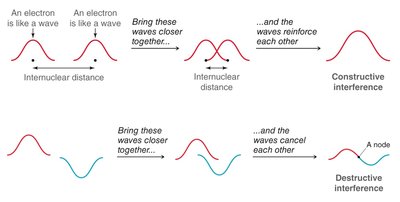
Bonding orbitals: Result from constructive interference of atomic orbitals, lowering energy and stabilizing the molecule.
Antibonding orbitals: Result from destructive interference, raising energy and destabilizing the molecule.
Energy Correlation Diagrams
Correlation diagrams visually represent the energy levels of atomic and molecular orbitals, helping to predict bond order and stability.
Bond order: Indicates the stability of a bond and is calculated as:
Example: For H2, bond order is 1; for He2, bond order is 0, indicating no stable bond.
Second-Row Diatomic Molecules
For diatomic molecules formed from second-row elements (B2, C2, N2, O2, F2), the energy and overlap of atomic orbitals determine the molecular orbital configuration and bond order.
Key points: Only atomic orbitals with similar energies and significant overlap contribute to bonding.
Example: N2 has a bond order of 3, O2 has a bond order of 2 and is paramagnetic due to unpaired electrons in antibonding orbitals.
Paramagnetism and Bonding
Paramagnetic vs. Diamagnetic Materials
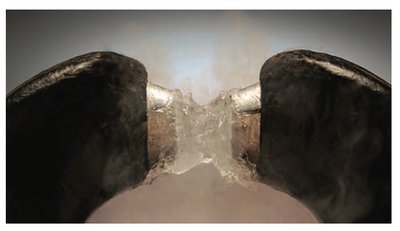
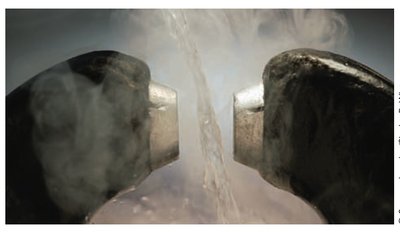
Paramagnetic materials contain unpaired electrons and interact with magnetic fields, while diamagnetic materials have all electrons paired and do not interact with magnetic fields.
Example: O2 is paramagnetic due to unpaired electrons in its molecular orbital configuration.
Summary Table: Hybridization Types and Molecular Geometry
Hybridization | Electron Domains | Geometry | Example |
|---|---|---|---|
sp | 2 | Linear | BeH2, C2H2 |
sp2 | 3 | Trigonal planar | BF3, C2H4 |
sp3 | 4 | Tetrahedral | CH4, NH3, H2O |
Practice Problems
Determine the hybridization of the oxygen atom in CH3OH.
Calculate the bond order for H2, H2-, H2+, and He2 using molecular orbital theory.
Draw correlation diagrams for C2 and F2 and determine their bond order and molecular orbital electron configuration.
