 Back
BackChemical Bonding: Ionic and Covalent Bonds, Lewis Structures, VSEPR, Resonance, and Hybridization
Study Guide - Smart Notes
 Tailored notes based on your materials, expanded with key definitions, examples, and context.
Chemical Bonding
Introduction to Chemical Bonds
Chemical bonds are the attractive forces that hold atoms together in compounds. The main types of chemical bonds are ionic bonds and covalent bonds. The nature of the bond depends on the difference in electronegativity between the atoms involved.
Ionic bonds: Formed by the transfer of electrons from a metal to a non-metal, resulting in the formation of cations and anions.
Covalent bonds: Formed by the sharing of electrons between two non-metals.
Polar covalent bonds: Electrons are shared unequally due to a moderate difference in electronegativity.
Non-polar covalent bonds: Electrons are shared equally due to similar electronegativities.
Ionic Bonding
Formation and Properties of Ionic Compounds
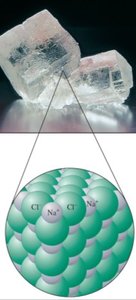
Ionic bonds are formed when one atom donates electrons to another, resulting in the formation of oppositely charged ions that are held together by electrostatic forces. Ionic compounds typically form crystalline solids with high melting and boiling points.
Criteria for ionic bond: Electronegativity difference (ΔEN) ≥ 2.
Example: Sodium chloride (NaCl) forms when Na donates an electron to Cl, creating Na+ and Cl- ions.
Properties: High melting/boiling points, solid at room temperature, conduct electricity when molten or dissolved in water.
Size Changes in Ion Formation
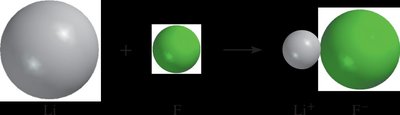
When atoms form ions, their sizes change. Cations are smaller than their parent atoms, while anions are larger.
Ionic Character and Electronegativity Difference
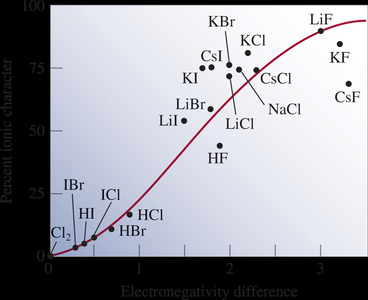
The percent ionic character of a bond increases with the difference in electronegativity between the two atoms.
Comparison of Ionic and Covalent Compounds
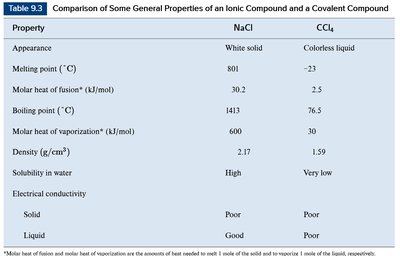
Ionic and covalent compounds have distinct physical properties due to the nature of their bonding.
Property | NaCl (Ionic) | CCl4 (Covalent) |
|---|---|---|
Appearance | White solid | Colorless liquid |
Melting point (°C) | 801 | -23 |
Boiling point (°C) | 1413 | 76.5 |
Solubility in water | High | Very low |
Electrical conductivity (liquid) | Good | Poor |
Covalent Bonding
Formation of Covalent Bonds
Covalent bonds are formed when two atoms share one or more pairs of electrons. The shared electrons allow each atom to attain a stable electron configuration.
Single bond: One pair of shared electrons.
Double bond: Two pairs of shared electrons.
Triple bond: Three pairs of shared electrons.
Polar and Non-Polar Covalent Bonds
The polarity of a covalent bond depends on the difference in electronegativity between the bonded atoms.
Polar covalent bond: 0.4 ≤ ΔEN < 2 (unequal sharing, partial charges develop).
Non-polar covalent bond: ΔEN ≤ 0.3 (equal sharing, no partial charges).
Lewis Structures
Drawing Lewis Structures
Lewis structures are two-dimensional representations of molecules showing how valence electrons are arranged among atoms. Shared pairs are shown as lines (bonds), and lone pairs as dots.
Only valence electrons are shown.
Octet rule: Atoms (except H) tend to be surrounded by eight electrons.
Hydrogen follows the duet rule (2 electrons).
Exceptions to the Octet Rule
Incomplete octet: Be (4 electrons), B (6 electrons).
Expanded octet: Elements in period 3 or beyond can have more than 8 electrons (e.g., SF6).
Odd-electron molecules: Molecules with an odd number of electrons (e.g., NO).

VSEPR Theory and Molecular Geometry
Valence Shell Electron Pair Repulsion (VSEPR) Model
The VSEPR model predicts the three-dimensional shape of molecules based on the repulsion between electron pairs around a central atom. Electron pairs (bonding and lone pairs) arrange themselves to minimize repulsion.
Repulsion number (R.N.): Number of sigma bonds + number of lone pairs.
Bond angles: Determined by the arrangement of electron pairs.
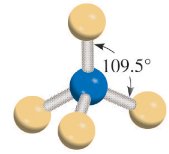
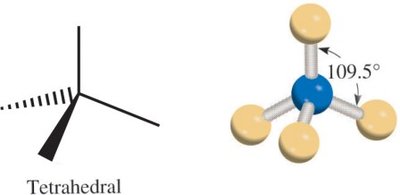
Common Molecular Geometries
Linear: 180° bond angle (e.g., BeCl2).
Trigonal planar: 120° bond angle (e.g., BF3).
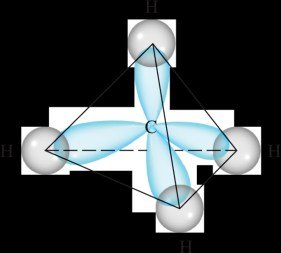
Tetrahedral: 109.5° bond angle (e.g., CH4).
Trigonal bipyramidal: 90° and 120° bond angles (e.g., PCl5).
Octahedral: 90° bond angles (e.g., SF6).
Effect of Lone Pairs on Geometry
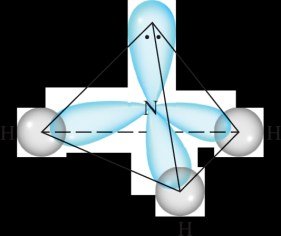
Lone pairs occupy more space than bonding pairs, causing bond angles to decrease from the ideal values. For example, in water (H2O), the bond angle is about 105° due to two lone pairs on oxygen.
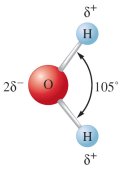
Resonance Structures
Resonance and Delocalization
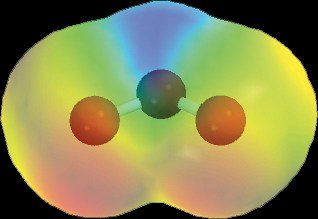
Some molecules cannot be represented by a single Lewis structure. Resonance structures are used to depict delocalized electrons within molecules where two or more valid Lewis structures exist. The actual structure is a resonance hybrid of all possible forms.
Isomerism
Structural and Stereoisomers
Isomers are compounds with the same molecular formula but different structures. Stereoisomers have the same connectivity but different spatial arrangements.
Geometric isomers: Differ in the arrangement around a double bond or ring (cis/trans).
Optical isomers: Non-superimposable mirror images (chiral molecules).

Valence Bond Theory and Hybridization
Valence Bond Theory
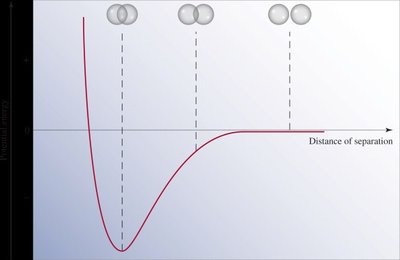
Valence bond theory explains covalent bond formation as the overlap of atomic orbitals. The strength of the bond depends on the extent of orbital overlap.
Sigma (σ) and Pi (π) Bonds
Sigma (σ) bonds: Formed by end-to-end overlap of orbitals; allow free rotation.
Pi (π) bonds: Formed by side-to-side overlap of p orbitals; restrict rotation.
Hybridization of Atomic Orbitals
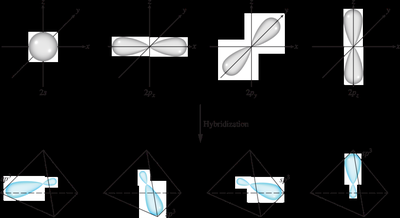
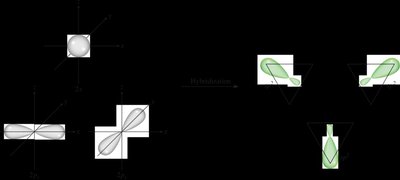
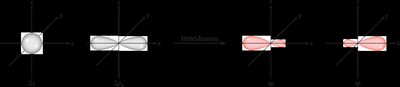
Hybridization is the mixing of atomic orbitals to form new, equivalent hybrid orbitals that explain observed molecular geometries.
Repulsion Number | Hybrid Orbitals | Geometry | Bond Angle |
|---|---|---|---|
2 | sp | Linear | 180° |
3 | sp2 | Trigonal planar | 120° |
4 | sp3 | Tetrahedral | 109.5° |
5 | sp3d | Trigonal bipyramidal | 90°, 120° |
6 | sp3d2 | Octahedral | 90° |
Summary
Chemical bonding involves the transfer or sharing of electrons to achieve stable electron configurations.
Ionic bonds form between metals and non-metals; covalent bonds form between non-metals.
Lewis structures, resonance, and VSEPR theory are essential tools for predicting molecular structure and properties.
Hybridization explains the observed shapes of molecules by combining atomic orbitals into new hybrid orbitals.
