 Back
Chemical Bonding: Ionic, Covalent, and Lewis Structures
Study Guide - Smart Notes
 Tailored notes based on your materials, expanded with key definitions, examples, and context.
Chemical Bonding: Types and Principles
Types of Chemical Bonds
Chemical bonds are the forces that hold atoms together in compounds. The three primary types of chemical bonds are ionic, covalent, and metallic bonds. The nature of the bond depends on the elements involved and their electronic structures.
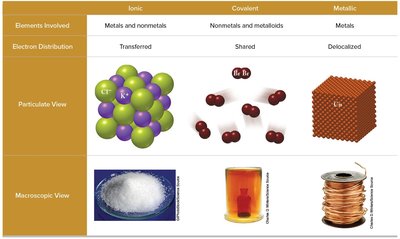
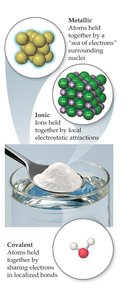
Ionic Bonds: Formed between metals and nonmetals, involving the transfer of electrons from one atom to another, resulting in the formation of cations and anions.
Covalent Bonds: Occur between nonmetals and metalloids, where atoms share pairs of electrons to achieve stable electron configurations.
Metallic Bonds: Found in metals, where electrons are delocalized and move freely among a lattice of metal atoms.
Bond Characteristics and Physical Properties
The characteristics of chemical bonds determine the physical and chemical properties of substances. Ionic compounds tend to be crystalline solids with high melting points, covalent compounds can be gases, liquids, or solids with lower melting points, and metallic substances are typically malleable and conductive.
Lewis Symbols and the Octet Rule
Lewis Symbols
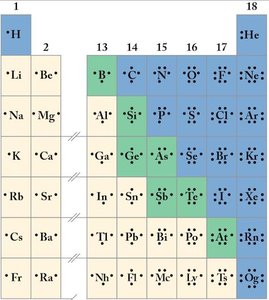
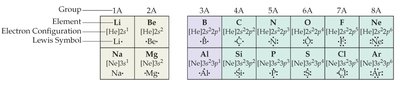
Lewis symbols are a simple way to represent the valence electrons of an atom. Each dot represents a valence electron, and the element's symbol is surrounded by these dots.
Valence electrons are those in the outermost shell.
Dots are placed on four sides of the element symbol, with up to two electrons per side.
All sides are equivalent; dots are spread out as much as possible.


The Octet Rule
The octet rule states that atoms tend to gain, lose, or share electrons until they are surrounded by eight valence electrons, achieving the stable configuration of noble gases (except helium, which has two).
An octet consists of full s and p subshells.
The rule applies mainly to main-group elements.
Ionic Bonding
Formation of Ionic Bonds
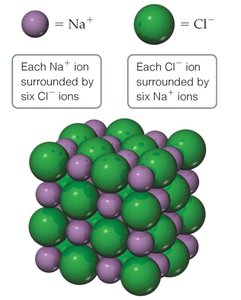
Ionic bonds form when one atom (usually a metal) transfers electrons to another atom (usually a nonmetal), resulting in oppositely charged ions held together by electrostatic attraction.
Electron transfer is favored when one atom has low ionization energy and the other has high electron affinity.
Example: Sodium (Na) transfers an electron to chlorine (Cl) to form Na+ and Cl-.

Lattice Energy
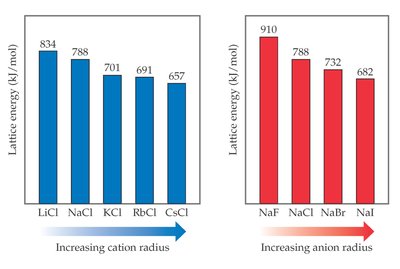
Lattice energy is the energy released when one mole of an ionic compound forms from its ions in the gas phase. It increases with higher ion charges and decreases with larger ionic radii.
Lattice energy trends parallel those in ionic radius.
Covalent Bonding and Lewis Structures
Formation of Covalent Bonds
Covalent bonds are formed when two atoms share one or more pairs of electrons. This sharing allows each atom to achieve a stable electron configuration.
Example: Two hydrogen atoms share electrons to form H2.
Example: Two chlorine atoms share electrons to form Cl2.

Steps for Drawing Lewis Structures
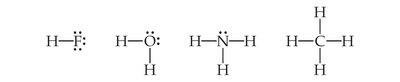
Lewis structures visually represent the arrangement of atoms and electrons in a molecule. The five-step process is:
Determine the total number of valence electrons.
Arrange symbols to show how atoms are bonded and connect them with single bonds.
Complete the octet of atoms (except hydrogen) bonded to the central atom by adding lone pairs.
Compare the number of valence electrons in the structure with the total determined in step 1.
Complete the octet on the central atom.
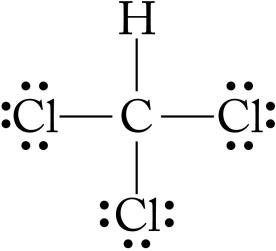
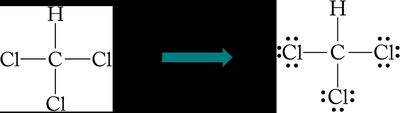
Example: Lewis Structure of Chloroform (CHCl3)
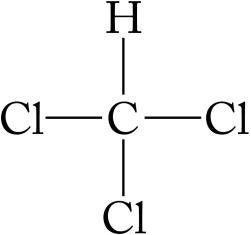
Chloroform contains one carbon atom, one hydrogen atom, and three chlorine atoms. Carbon is the central atom, and each Cl and H forms a bond with C. Each Cl atom has three lone pairs to complete its octet.
Total valence electrons: 26
Structure: C bonded to H and three Cl atoms, with lone pairs on Cl
Multiple Bonds: Double and Triple Bonds
Double Bonds
A double bond involves the sharing of two pairs of electrons between two atoms. For example, in carbon dioxide (CO2), each oxygen forms a double bond with carbon.
Double bonds are represented by two lines in Lewis structures.

Triple Bonds
A triple bond involves the sharing of three pairs of electrons. In nitrogen gas (N2), two nitrogen atoms share three pairs of electrons to achieve an octet.
Triple bonds are represented by three lines in Lewis structures.

Example: Lewis Structure of Acetylene (C2H2)
Acetylene contains two carbon atoms and two hydrogen atoms. The two carbons are connected by a triple bond, and each carbon is bonded to one hydrogen.
Total valence electrons: 10
Structure: H–C≡C–H
Summary Table: Bond Types
Bond Type | Elements Involved | Electron Distribution | Particulate View | Macroscopic View |
|---|---|---|---|---|
Ionic | Metals and nonmetals | Transferred | Na+ and Cl- ions in a lattice | Crystalline solid (e.g., salt) |
Covalent | Nonmetals and metalloids | Shared | Molecules (e.g., H2, Cl2) | Liquids, gases, pliable solids |
Metallic | Metals | Delocalized | Metal atoms in a lattice | Conductive, malleable solids |
Additional info: The notes also reference formal charge, hypervalent systems, and resonance structures, which are important for advanced Lewis structure analysis but are not fully covered in the provided content.
