 Back
BackChemical Bonding: Ionic, Covalent, and Metallic Bonds
Study Guide - Smart Notes
 Tailored notes based on your materials, expanded with key definitions, examples, and context.
Chemical Bonding: Types and Models
Overview of Chemical Bonding
Chemical bonding describes the forces that hold atoms together in compounds. The three primary types of chemical bonds are ionic, covalent, and metallic bonds. Each type of bond is associated with distinct properties and models that explain the behavior of substances at the atomic level.
Ionic bonding: Involves the transfer of electrons from a metal to a nonmetal, resulting in the formation of cations and anions held together by electrostatic attraction.
Covalent bonding: Involves the sharing of electrons between nonmetal atoms, resulting in the formation of molecules.
Metallic bonding: Involves the pooling of valence electrons among metal atoms, creating a 'sea' of delocalized electrons.
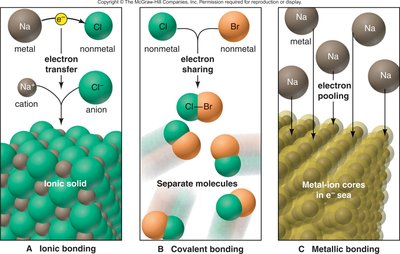
Ionic, Covalent, and Metallic Bonding
Ionic Bonding
Ionic bonds form when electrons are transferred from one atom (typically a metal) to another (typically a nonmetal), resulting in the formation of oppositely charged ions. These ions are held together by strong electrostatic forces in a crystal lattice structure.
Formation: Metal atoms lose electrons to become cations; nonmetal atoms gain electrons to become anions.
Properties: High melting points, hard and brittle, conduct electricity when molten or dissolved in water, but not as solids.
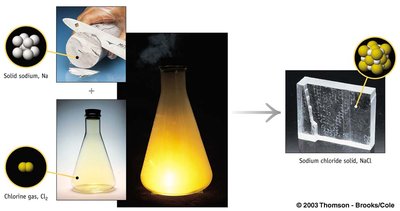
Example: Sodium chloride (NaCl) forms from the reaction of sodium metal and chlorine gas.
Covalent Bonding
Covalent bonds form when two nonmetal atoms share one or more pairs of electrons. The shared electrons allow each atom to achieve a stable electron configuration, often following the octet rule (except for hydrogen, which follows the duet rule).
Formation: Atoms share electrons to achieve noble gas configurations.
Properties: Exist as discrete molecules, lower melting and boiling points compared to ionic compounds, poor conductors of electricity.
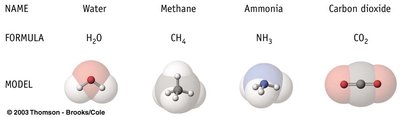
Examples: Water (H2O), methane (CH4), ammonia (NH3), carbon dioxide (CO2).
Metallic Bonding
Metallic bonds occur in metals, where atoms collectively share their valence electrons in a 'sea' of electrons that move freely throughout the structure. This model explains many characteristic properties of metals.
Formation: Valence electrons are delocalized and shared among all atoms in the metal.
Properties: Malleable, ductile, good conductors of heat and electricity, variable melting points.
The Octet Rule and Exceptions
Octet Rule
The octet rule states that atoms tend to gain, lose, or share electrons to achieve a full valence shell of eight electrons, similar to the noble gases. Hydrogen is an exception, following the duet rule (two electrons in its valence shell).
Ionic bonding: Metals lose electrons, nonmetals gain electrons to achieve octets.
Covalent bonding: Atoms share electrons to complete their octets.
Exceptions: Some molecules have fewer or more than eight electrons around an atom (expanded octets, odd-electron species).
Bond Formation and Potential Energy
Potential Energy in Bond Formation
When two atoms approach each other, their potential energy changes due to attractive and repulsive forces. A stable bond forms at the distance where the energy is minimized (bond length), and the energy released is called the bond energy.
Bond length: The distance between the nuclei of two bonded atoms at minimum potential energy.
Bond energy: The energy required to break a bond; always positive (endothermic process).

Bond Order, Bond Length, and Bond Energy
Bond Order
Bond order refers to the number of shared electron pairs between two atoms. A single bond has a bond order of 1, a double bond has a bond order of 2, and a triple bond has a bond order of 3.
Bond length: Decreases as bond order increases (triple < double < single).
Bond energy: Increases as bond order increases (triple > double > single).
Bond | Bond Order | Bond Length (pm) | Bond Energy (kJ/mol) |
|---|---|---|---|
C–C | 1 | 154 | 347 |
C=C | 2 | 134 | 611 |
C≡C | 3 | 120 | 837 |
N–N | 1 | 145 | 160 |
N=N | 2 | 123 | 418 |
N≡N | 3 | 110 | 945 |
Electronegativity and Bond Polarity
Electronegativity
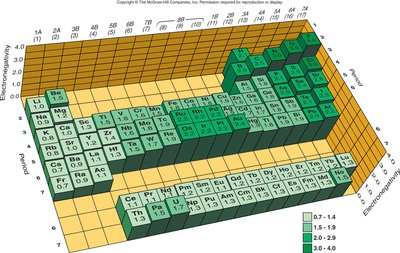
Electronegativity (EN) is a measure of an atom's ability to attract shared electrons in a chemical bond. The difference in electronegativity between two atoms determines the bond's polarity.
Nonpolar covalent bond: Electrons are shared equally (ΔEN ≈ 0).
Polar covalent bond: Electrons are shared unequally (0 < ΔEN < 1.7).
Ionic bond: Electrons are transferred (ΔEN > 1.7).
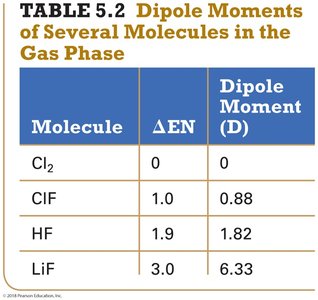
Bond Polarity and Dipole Moment
A polar bond has a dipole moment due to unequal sharing of electrons, resulting in partial positive (δ+) and partial negative (δ–) charges on the bonded atoms. The dipole moment (μ) is calculated as:
q: Magnitude of the charge
r: Distance between charges
Lattice Energy and Properties of Ionic Compounds
Lattice Energy
Lattice energy is the energy released when gaseous ions combine to form an ionic solid. It is a measure of the strength of the forces holding the ions together in the lattice. Lattice energy increases with higher ionic charges and smaller ionic radii.
Q1, Q2: Charges of the ions
r: Distance between ion centers (ionic radius)
Properties of Ionic Compounds
High melting and boiling points
Hard but brittle
Conduct electricity when molten or dissolved in water
Form crystalline solids with a regular lattice structure
Properties of Covalent and Metallic Compounds
Covalent Compounds
Exist as discrete molecules
Low to moderate melting and boiling points
Poor conductors of electricity
Physical properties depend on intermolecular forces
Metallic Compounds
Malleable and ductile
Good conductors of heat and electricity
Variable melting points
Non-directional bonding due to delocalized electrons
Summary Table: Comparison of Bond Types
Bond Type | Formation | Properties | Examples |
|---|---|---|---|
Ionic | Electron transfer (metal to nonmetal) | High melting point, brittle, conducts electricity when molten/aqueous | NaCl, CaF2 |
Covalent | Electron sharing (nonmetal to nonmetal) | Low melting point, poor conductor, discrete molecules | H2O, CO2 |
Metallic | Electron pooling (metal atoms) | Malleable, ductile, good conductor | Fe, Cu, Al |
Practice Problems and Applications
Classify the following as ionic, covalent, or metallic: CO2, FeCl3, PCl3, NaI.
Predict the formula and name for compounds formed by Mg and F, Al and O.
Arrange the following bonds in order of increasing polarity: N–F, Be–F, O–F.
Explain why compounds such as NaO (Na2+O2–) or BaCl (Ba2+Cl2–) do not form.
