 Back
Chemical Bonding: Types, Properties, and Molecular Structures
Study Guide - Smart Notes
 Tailored notes based on your materials, expanded with key definitions, examples, and context.
Chemical Bonding
Introduction to Chemical Bonding
Chemical bonding is a fundamental concept in chemistry that explains how atoms combine to form molecules and compounds. The nature of these bonds determines the properties and behaviors of substances.


Types of Chemical Bonds
Ionic and Covalent Bonds
There are two primary types of chemical bonds: ionic bonds and covalent bonds. Each type arises from different interactions between atoms and results in distinct physical and chemical properties.

Ionic Bonds: Formed by the transfer of electrons from a metal to a nonmetal, resulting in oppositely charged ions held together by electrostatic attraction.
Covalent Bonds: Formed by the sharing of electrons between two nonmetals, resulting in a molecule with shared electron pairs.
General Properties of Ionic and Covalent Substances
Comparison of Physical Properties
Ionic and covalent substances exhibit different physical properties due to the nature of their bonding. These differences are summarized in the following table:


Ionic | Covalent |
|---|---|
Crystalline solids | Gases, liquids, or solids |
Hard and brittle solids | Brittle and weak solids, or soft and waxy solids |
Very high melting point | Low melting point |
Very high boiling point | Low boiling point |
Good electrical conductor when molten or in solution | Poor conductor of electricity and heat |
Often soluble in water but not in carbon tetrachloride | Often soluble in carbon tetrachloride but not in water |
Lewis Symbols
Representation of Valence Electrons
Lewis symbols are used to represent the valence electrons of atoms, which are the electrons involved in chemical bonding. This notation helps visualize electron transfer or sharing during bond formation.

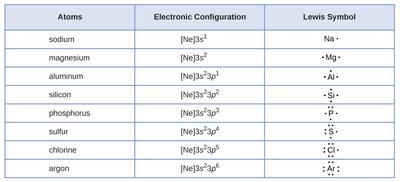
Atoms | Electronic Configuration | Lewis Symbol |
|---|---|---|
sodium | [Ne]3s1 | Na• |
magnesium | [Ne]3s2 | •Mg• |
aluminum | [Ne]3s23p1 | •Al• |
silicon | [Ne]3s23p2 | ••Si•• |
phosphorus | [Ne]3s23p3 | •••P••• |
sulfur | [Ne]3s23p4 | ••••S•••• |
chlorine | [Ne]3s23p5 | •••••Cl••••• |
argon | [Ne]3s23p6 | ••••••Ar•••••• |
Ionic Bonds
Formation and Characteristics
Ionic bonds are formed when a metal atom transfers one or more electrons to a nonmetal atom, resulting in the formation of cations and anions. The electrostatic attraction between these oppositely charged ions creates a strong bond.

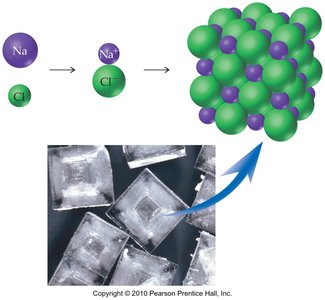
Electrostatic Attraction: The force holding ions together in an ionic compound.
Octet Rule: Atoms tend to gain, lose, or share electrons to achieve a stable configuration with eight valence electrons.
Example: Formation of NaCl from sodium and chlorine.
Covalent Bonds
Formation and Characteristics
Covalent bonds are formed when two nonmetal atoms share one or more pairs of electrons. This sharing allows each atom to achieve a stable electron configuration.


Electron Sharing: Each shared electron pair interacts with both nuclei.
Bond Strength: Covalent bonds are generally weaker than ionic bonds.
Example: Formation of H2O, NH3, and other molecules.
Single, Double, and Triple Covalent Bonds
Bond Types and Examples
Covalent bonds can involve the sharing of one, two, or three pairs of electrons, resulting in single, double, or triple bonds, respectively. The number of shared pairs affects bond strength and length.



Single Bond: One pair of electrons shared (e.g., H2, F2).
Double Bond: Two pairs of electrons shared (e.g., O2).
Triple Bond: Three pairs of electrons shared (e.g., N2).
Exceptions to the Octet Rule
Expanded and Deficient Octets
Some molecules do not follow the octet rule. These exceptions include molecules with fewer than eight electrons (e.g., BeCl2), and those with more than eight electrons (e.g., SF6).

Deficient Octet: Atoms like Be and B may have fewer than eight electrons.
Expanded Octet: Atoms in period 3 or higher can have more than eight electrons.
Lewis Structures
Drawing Lewis Structures
Lewis structures are diagrams that show the bonding between atoms and the arrangement of valence electrons. They are essential for predicting molecular geometry and reactivity.

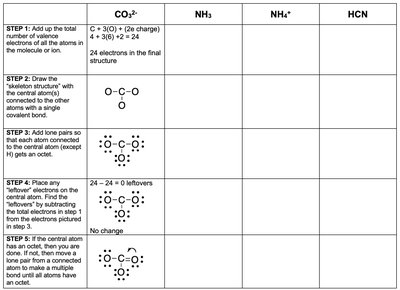
Step | CO32- | NH3 | NH4+ | HCN |
|---|---|---|---|---|
1. Add up valence electrons | C + 3O + (2e charge) = 24 | |||
2. Draw skeleton structure | O–C–O–O | |||
3. Add lone pairs | Each O gets lone pairs | |||
4. Place leftovers | 24 – 24 = 0 leftovers | |||
5. Form multiple bonds if needed | Form double bonds to satisfy octet |
Resonance Structures
Delocalization of Electrons
Resonance structures represent molecules where electrons are delocalized across multiple atoms, resulting in several valid Lewis structures. The actual molecule is a hybrid of these structures, which increases stability.

Resonance Hybrid: Composite of all resonance structures.
Delocalized Electrons: Electrons are spread over several atoms, not localized to a single bond.
Example: Nitrate ion (NO3-) has three resonance structures.
Shapes of Molecules
Valence-Shell Electron-Pair Repulsion (VSEPR) Theory
The shape of a molecule is determined by the arrangement of electron pairs around the central atom. VSEPR theory states that electron pairs repel each other and adopt positions that maximize their separation.

Electron Domains: Includes bonding pairs and lone pairs.
Parent Structures: Linear, trigonal planar, tetrahedral, etc.
Bond Angles: Determined by the number of electron domains.
Classification of Bonding
Polar and Nonpolar Covalent Bonds
Covalent bonds can be classified as polar or nonpolar based on the difference in electronegativity between the bonded atoms. This affects the distribution of electron density and molecular polarity.
Nonpolar Covalent Bond: Electrons are shared equally; no charge separation.
Polar Covalent Bond: Electrons are shared unequally; partial charges develop.
Electronegativity: The ability of an atom to attract bonding electrons. Greater differences lead to more polar bonds.
Polarity of Molecules
Determining Molecular Polarity
The polarity of a molecule depends on both the polarity of its bonds and its shape. Symmetrical molecules with polar bonds may be nonpolar if the bond dipoles cancel out.
Nonpolar Molecule: All bonds are nonpolar or polar bonds cancel out.
Polar Molecule: Polar bonds do not cancel out, resulting in a net dipole moment.
Example: Water (H2O) is polar; carbon dioxide (CO2) is nonpolar.
Practice and Applications
Bond Identification and Molecular Polarity
Students should practice identifying bond types and predicting molecular polarity based on structure and electronegativity differences.
Example: Label bonds in LiF, HF, NF3, F2 as ionic, polar covalent, or nonpolar covalent.
Application: Predict whether molecules like NH3, NBr3, H2Te, BH3 are polar or nonpolar.
Summary
Chemical bonding is central to understanding the structure and properties of substances. Mastery of ionic and covalent bonds, Lewis structures, resonance, and molecular shapes is essential for success in general chemistry.
