 Back
BackChemical Bonds, Ionic Compounds, and Aqueous Reactions: Study Notes for General Chemistry
Study Guide - Smart Notes
 Tailored notes based on your materials, expanded with key definitions, examples, and context.
Chemical Bonds and the Octet Rule
Introduction to Chemical Bonds
Chemical bonds are the attractive forces that hold atoms together in compounds. The formation of chemical bonds allows atoms to achieve more stable electron configurations, often by attaining a full valence shell, as described by the octet rule.
Octet Rule: Atoms tend to form compounds in ways that give them eight electrons in their valence shell (except for hydrogen and helium, which seek two).
Noble Gases: Group 8A elements are stable due to their full valence shells and rarely form compounds.
Valence Electrons: The electrons in the outermost shell, crucial for chemical bonding.
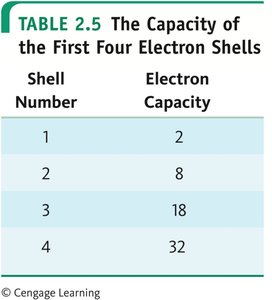
Electron Shells and Electron Configuration
Electrons are arranged in shells around the nucleus, each with a specific capacity. The arrangement of electrons determines an element's chemical properties and reactivity.
Electron Shells: Energy levels where electrons reside; each shell has a maximum capacity.
Filling Order: Electrons fill the lowest available energy levels first.
Valence Shell: The outermost occupied shell, which determines bonding behavior.
Shell Number | Electron Capacity |
|---|---|
1 | 2 |
2 | 8 |
3 | 18 |
4 | 32 |
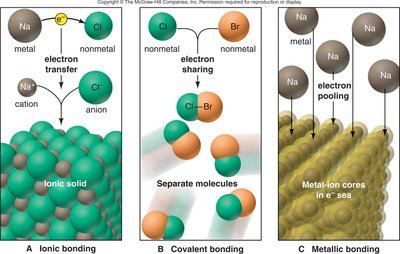
Types of Chemical Bonding
Ionic, Covalent, and Metallic Bonds
Atoms can achieve stable electron configurations by transferring, sharing, or pooling electrons, resulting in three primary types of chemical bonds:
Ionic Bonding: Involves the transfer of electrons from a metal to a nonmetal, forming cations and anions that are held together by electrostatic attraction.
Covalent Bonding: Involves the sharing of electron pairs between nonmetals.
Metallic Bonding: Involves the pooling of electrons among a lattice of metal atoms, creating a 'sea' of delocalized electrons.
Electronegativity
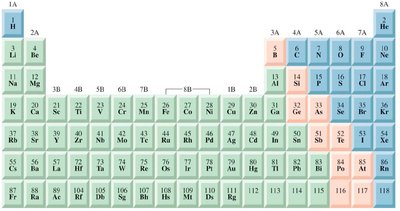
Electronegativity is a measure of an atom's ability to attract electrons in a chemical bond. It increases across a period and decreases down a group in the periodic table. Fluorine is the most electronegative element.
High Electronegativity: Atoms like F, O, and N strongly attract electrons.
Low Electronegativity: Metals have lower electronegativity and tend to lose electrons.
Ions and Ionic Compounds
Formation of Ions
Ions are charged species formed when atoms gain or lose electrons to achieve a stable electron configuration.
Cations: Positively charged ions formed by the loss of electrons (typically metals).
Anions: Negatively charged ions formed by the gain of electrons (typically nonmetals).
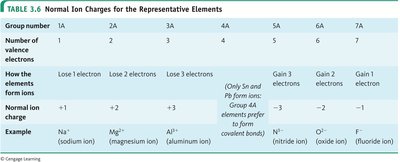
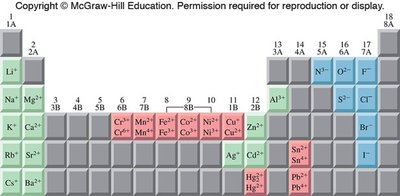
Predicting Charges: The charge of an ion can often be predicted from its group number in the periodic table.
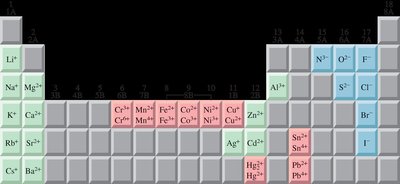
Group Number | Valence Electrons | Ion Charge | Example |
|---|---|---|---|
1A | 1 | +1 | Na+ |
2A | 2 | +2 | Mg2+ |
3A | 3 | +3 | Al3+ |
5A | 5 | -3 | N3- |
6A | 6 | -2 | O2- |
7A | 7 | -1 | F- |
Forming Ionic Compounds
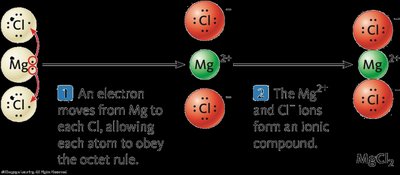
Ionic compounds are formed by the combination of cations and anions in ratios that yield a net charge of zero. These compounds are often called salts.
Charge Balance: The total positive and negative charges must balance.
Example:
Example:
Transition Metals and Variable Charges
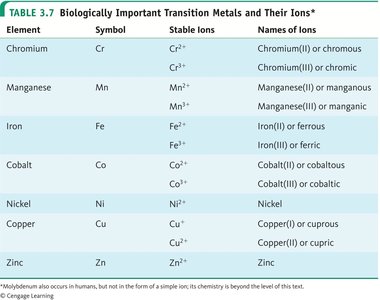
Transition metals can form more than one type of cation, so their ionic charge must be specified using Roman numerals in compound names.
Example: Fe2+ is iron(II), Fe3+ is iron(III).
Table of Common Transition Metal Ions:
Element | Symbol | Stable Ions | Names of Ions |
|---|---|---|---|
Iron | Fe | Fe2+, Fe3+ | Iron(II), Iron(III) |
Copper | Cu | Cu+, Cu2+ | Copper(I), Copper(II) |
Zinc | Zn | Zn2+ | Zinc |
Naming Ionic Compounds
Rules for Naming
The name of an ionic compound consists of the cation name followed by the anion name. For transition metals, the charge is indicated in parentheses using Roman numerals.
Monatomic Ions: Anions end in -ide (e.g., chloride, oxide).
Polyatomic Ions: Names are specific (e.g., sulfate, nitrate, ammonium).
Example: MgF2 is magnesium fluoride; Fe2O3 is iron(III) oxide.
Common Polyatomic Ions
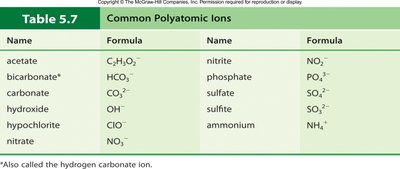
Polyatomic ions are groups of atoms covalently bonded together with an overall charge. They are treated as single units in compounds.
Name | Formula |
|---|---|
Ammonium | NH4+ |
Nitrate | NO3- |
Sulfate | SO42- |
Carbonate | CO32- |
Hydroxide | OH- |
Chemical Quantities and Aqueous Reactions
Mass-Mole-Number Relationships
Stoichiometry involves the quantitative relationships between the amounts of reactants and products in a chemical reaction. The mole is the standard unit for amount of substance.
Molar Mass (g/mol): The mass of one mole of a substance.
Avogadro's Number: entities per mole.
Conversions: Mass ↔ Moles ↔ Number of particles.
Aqueous Solutions and Solubility
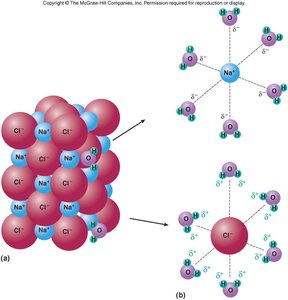
When ionic compounds dissolve in water, they dissociate into their component ions. The solubility of ionic compounds depends on the ions present.
Solvation: The process by which solvent molecules surround and interact with solute ions or molecules.
Dissociation: The separation of an ionic compound into its ions in solution.
Solubility Rules: Predict which ionic compounds are soluble in water.
Negative Ions | Positive Ions | Solubility |
|---|---|---|
All | Na+, K+, NH4+ | Soluble |
Nitrates (NO3-) | All | Soluble |
Chlorides (Cl-), Iodides (I-) | Ag+, Pb2+, Hg22+ | Low solubility |
Sulfates (SO42-) | Ca2+, Sr2+, Ba2+, Pb2+ | Low solubility |
Carbonates (CO32-) | Group 1, NH4+ | Soluble |
Hydroxides (OH-) | Group 1, Ba2+, NH4+ | Soluble |
Sulfides (S2-) | Group 1, NH4+, Mg2+, Ca2+, Ba2+ | Soluble |
Precipitation Reactions
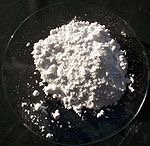
When two soluble ionic compounds are mixed, an insoluble compound (precipitate) may form if the product is not soluble in water. The reaction can be represented by molecular, total ionic, and net ionic equations.
Example:
Net Ionic Equation:
Recognizing Ionic and Molecular Compounds
Ionic compounds are generally formed from metals and nonmetals, while molecular compounds are formed from nonmetals only. The type of bonding and the properties of the compound depend on the elements involved.
Ionic Compounds: High melting points, conduct electricity when molten or dissolved.
Molecular Compounds: Lower melting points, do not conduct electricity in solution.
