 Back
BackChemical Equilibrium and Acid-Base Chemistry: Exam 3 Study Guide
Study Guide - Smart Notes
 Tailored notes based on your materials, expanded with key definitions, examples, and context.
Chapter 15: Chemical Equilibrium
Hemoglobin and Equilibrium
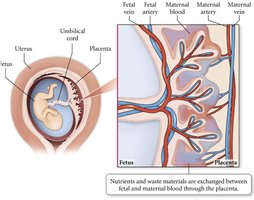
Hemoglobin (Hb) is a protein in red blood cells that binds oxygen (O2) and facilitates its transport throughout the body. The binding and release of O2 by hemoglobin is governed by chemical equilibrium, allowing efficient oxygen exchange between mother and fetus.
Dynamic Equilibrium: The reaction Hb + O2 ↔ HbO2 is reversible and reaches equilibrium where the rates of forward and reverse reactions are equal.
Fetal Hemoglobin: Fetal hemoglobin (HbF) has a higher equilibrium constant than adult hemoglobin, enabling more effective O2 uptake by the fetus.
Oxygen Exchange: In the placenta, O2 is transferred from maternal to fetal blood due to differences in equilibrium constants.
Arrow Conventions in Chemical Reactions
Chemists use arrows to indicate the extent of reactions:
Single Arrow (→): Indicates complete conversion of reactants to products.
Double Arrow (↔): Indicates a reversible reaction that reaches equilibrium with both reactants and products present.
Reaction Dynamics and Dynamic Equilibrium
Reactions begin with reactants converting to products (forward reaction). As products accumulate, the reverse reaction (products converting back to reactants) becomes significant. Dynamic equilibrium is achieved when both reactions proceed at equal rates, resulting in constant concentrations of all species.
Example: H2(g) + I2(g) ↔ 2HI(g)
Equilibrium: At equilibrium, concentrations remain constant but are not necessarily equal.
Equilibrium Constant (K)
The equilibrium constant (K) quantifies the ratio of product to reactant concentrations at equilibrium, as described by the Law of Mass Action.
General Expression: For a reaction aA + bB ↔ cC + dD:
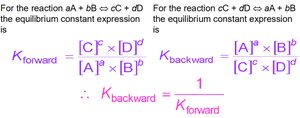
Interpretation: K >>> 1 favors products; K <<< 1 favors reactants.
Relationships Between K and Chemical Equations
Manipulating chemical equations affects the equilibrium constant:
Reverse Reaction: K is inverted.
Multiplying Coefficients: K is raised to the power of the factor.
Adding Equations: K values are multiplied.
Equilibrium Constants for Gaseous Reactions
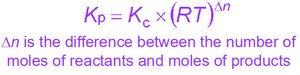
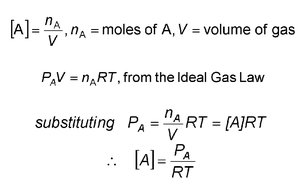
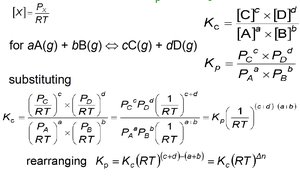
For reactions involving gases, equilibrium constants can be expressed in terms of concentrations (Kc) or partial pressures (Kp):
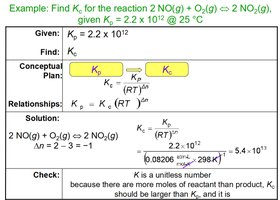
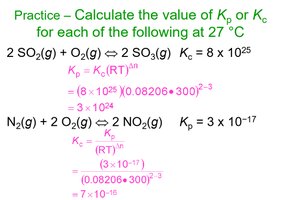
Relationship: where Δn is the change in moles of gas.
Heterogeneous Equilibria
In reactions involving solids and liquids, their concentrations are not included in the equilibrium constant expression because they remain constant.
Example: For aA(s) + bB(aq) ↔ cC(l) + dD(aq):
Calculating Equilibrium Constants and Concentrations
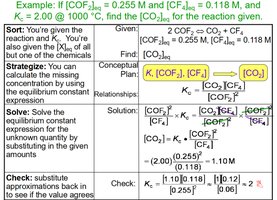
Equilibrium constants can be determined from measured concentrations at equilibrium. Stoichiometry and ICE tables are used to calculate unknown concentrations.
Example: If initial and equilibrium concentrations are known, use the equilibrium constant expression to solve for unknowns.
The Reaction Quotient (Q)
The reaction quotient (Q) is calculated using the same expression as K but with current concentrations. Comparing Q to K predicts the direction the reaction will proceed:
Q > K: Reaction proceeds in reverse.
Q < K: Reaction proceeds forward.
Q = K: System is at equilibrium.
Le Chatelier’s Principle
Le Chatelier’s Principle states that if a system at equilibrium is disturbed, it will shift to minimize the disturbance and restore equilibrium.
Adding Reactants: Shifts equilibrium toward products.
Removing Reactants: Shifts equilibrium toward reactants.
Changing Volume: For gases, decreasing volume shifts equilibrium toward the side with fewer gas molecules.
Changing Temperature: For exothermic reactions, increasing temperature shifts equilibrium toward reactants; for endothermic reactions, toward products.
Chapter 16: Acids and Bases
General Properties of Acids and Bases
Acids and bases are fundamental chemical species with distinct properties:
Acids: Sour taste, dissolve metals, neutralize bases, turn blue litmus red.
Bases: Bitter taste, slippery feel, neutralize acids, turn red litmus blue.
Definitions of Acids and Bases
Three main definitions describe acids and bases:
Arrhenius: Acids produce H+ (or H3O+) in water; bases produce OH-.
Bronsted-Lowry: Acids donate H+; bases accept H+.
Lewis: Acids accept electron pairs; bases donate electron pairs.
Strengths of Acids and Bases
Acids and bases are classified as strong or weak based on their degree of ionization in water:
Strong Acids/Bases: Nearly complete ionization; strong electrolytes.
Weak Acids/Bases: Partial ionization; weak electrolytes; equilibrium is established.
Acid Ionization Constant (Ka) and Base Ionization Constant (Kb)
The strength of an acid or base is measured by its equilibrium constant:
Acid:
Base:
Autoionization of Water and Ion Product (Kw)
Water can act as both an acid and a base, leading to autoionization:
at 25°C
Neutral solutions:
Measuring Acidity: pH and pOH
pH and pOH are logarithmic measures of acidity and basicity:
pH < 7: acidic; pH > 7: basic; pH = 7: neutral
Polyprotic Acids
Polyprotic acids can donate more than one proton, ionizing in steps with separate Ka values for each step. Typically, the first ionization is strongest.
Acid-Base Properties of Salts
Salt solutions can be acidic, basic, or neutral depending on the nature of their cation and anion:
Cation | Anion: Conjugate base of strong acid | Anion: Conjugate base of weak acid |
|---|---|---|
Conjugate acid of weak base | Acidic | Depends on relative strength |
Small, highly-charged metal ion | Acidic | Depends on relative strength |
Counterion of strong base | Neutral | Basic |
Lewis Acid-Base Theory
Lewis acids are electron pair acceptors, and Lewis bases are electron pair donors. This theory expands acid-base reactions beyond those involving H+ transfer.
Example: Water acts as a Lewis base, donating a pair of electrons to CO2 (Lewis acid) to form carbonic acid.
Summary Table: Polyprotic Acids and Their Ionization Constants
Summary Table: pH of Salt Solutions
Summary Table: Lewis Acid-Base Reactions
Additional info: These notes cover the essential concepts of chemical equilibrium and acid-base chemistry, including equilibrium constants, Le Chatelier’s Principle, acid/base strength, pH calculations, and the classification of salt solutions. Tables and diagrams are included to reinforce key ideas and provide visual context for complex concepts.
