 Back
BackChemical Equilibrium and Le Châtelier’s Principle: Effects of Concentration, Volume, and Temperature
Study Guide - Smart Notes
 Tailored notes based on your materials, expanded with key definitions, examples, and context.
Chemical Equilibrium
Disturbing and Restoring Equilibrium
Chemical equilibrium occurs when the concentrations of reactants and products in a reversible reaction remain constant over time. However, if the system is disturbed by changes in conditions, the concentrations will shift until equilibrium is restored. The equilibrium constant (K) remains unchanged unless the temperature is altered.
Equilibrium Constant (K): A value that expresses the ratio of product to reactant concentrations at equilibrium for a given reaction.
Restoration of Equilibrium: After disturbance, the system adjusts concentrations to reestablish equilibrium, maintaining the same K (unless temperature changes).
Le Châtelier’s Principle
Definition and Applications
Le Châtelier’s Principle states that if a system at equilibrium is disturbed, the equilibrium will shift in a direction that minimizes the disturbance. Disturbances include changes in concentration, volume/pressure, and temperature.
Predicting Shifts: The principle helps predict how equilibrium will respond to changes in conditions.
Types of Disturbances:
Changing concentration of reactants or products
Changing volume or pressure (for gases)
Changing temperature
Effects of Concentration Changes
Adding or Removing Reactants and Products
Changing the concentration of reactants or products affects the rates of the forward and reverse reactions, causing the equilibrium to shift until a new balance is achieved.
Adding a Reactant:
Increases the rate of the forward reaction.
Equilibrium shifts to the right (toward products).
More products, less non-added reactants, and less of the added reactant at new equilibrium.
K remains unchanged.
Removing a Reactant:
Decreases the rate of the forward reaction.
Equilibrium shifts to the left (toward reactants).
More reactants, less products at new equilibrium.
K remains unchanged.
Adding or Removing Products:
Adding product shifts equilibrium to the left.
Removing product shifts equilibrium to the right.
Solids and Liquids: Adding/removing solids or liquids does not affect equilibrium because their concentrations are not included in the equilibrium expression.
Example: NO2 and N2O4 Equilibrium
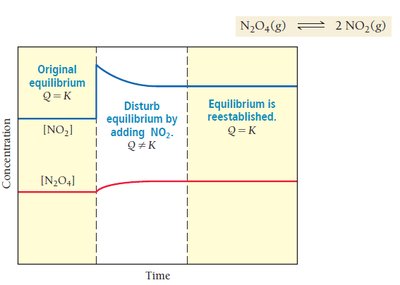
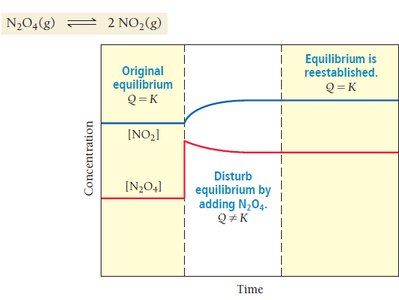
Consider the equilibrium:
Adding NO2 increases its concentration, causing N2O4 to form until equilibrium is restored.
Adding N2O4 increases its concentration, causing NO2 to form until equilibrium is restored.
Effects of Volume and Pressure Changes
Volume Changes in Gaseous Systems
Changing the volume of a container affects the equilibrium of reactions involving gases. According to Le Châtelier’s Principle:
Decreasing Volume (Increasing Pressure):
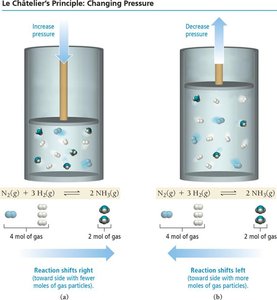
Equilibrium shifts toward the side with fewer moles of gas to reduce pressure.
K remains unchanged.
Increasing Volume (Decreasing Pressure):
Equilibrium shifts toward the side with more moles of gas.
K remains unchanged.
Equal Moles of Gas: If both sides have equal moles of gas, volume changes have no effect.
Adding Inert Gas: At constant volume, adding an inert gas does not affect equilibrium.
Aqueous Systems: Volume changes do not affect equilibrium in aqueous reactions.
Example: Ammonia Synthesis
For the reaction:
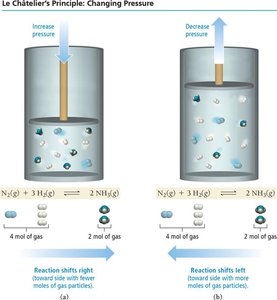
Decreasing volume shifts equilibrium toward NH3 (fewer gas molecules).
Increasing volume shifts equilibrium toward N2 and H2 (more gas molecules).
Effects of Temperature Changes
Exothermic and Endothermic Reactions
Temperature changes affect equilibrium differently for exothermic and endothermic reactions. Heat can be treated as a reactant or product:
Exothermic Reaction: Heat is a product. Increasing temperature shifts equilibrium to the left (toward reactants), decreasing K.
Endothermic Reaction: Heat is a reactant. Increasing temperature shifts equilibrium to the right (toward products), increasing K.
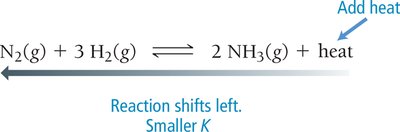
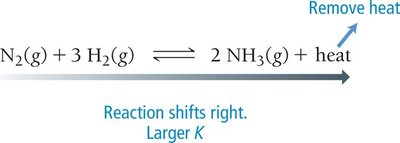
Example: Ammonia Synthesis (Exothermic)
For the reaction:
Adding heat shifts equilibrium left, decreasing K.
Removing heat shifts equilibrium right, increasing K.
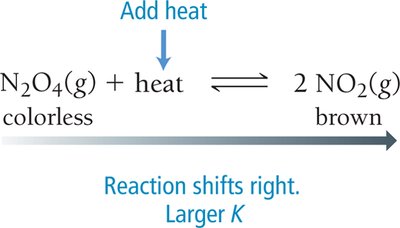
Example: N2O4 and NO2 (Endothermic)
For the reaction:
Adding heat shifts equilibrium right, increasing K.
Conceptual Connection: Predicting Equilibrium Shifts
Example Problem
Consider the exothermic reaction:
Adding NOCl: Shifts equilibrium left (toward reactants).
Increasing Volume: Shifts equilibrium toward the side with more gas molecules.
Increasing Temperature: Shifts equilibrium left (for exothermic reactions).
None of the above: If none of the changes favor the right shift, equilibrium does not shift right.
Summary Table: Effects on Equilibrium
Disturbance | Equilibrium Shift | K Changes? |
|---|---|---|
Add Reactant | Right (toward products) | No |
Remove Reactant | Left (toward reactants) | No |
Add Product | Left (toward reactants) | No |
Remove Product | Right (toward products) | No |
Decrease Volume (gases) | Toward fewer moles of gas | No |
Increase Volume (gases) | Toward more moles of gas | No |
Add Heat (exothermic) | Left (toward reactants) | Yes, decreases |
Add Heat (endothermic) | Right (toward products) | Yes, increases |
Additional info: The notes above expand on the original slides and images, providing definitions, examples, and a summary table for clarity and completeness.
