 Back
BackL24 Chemical Equilibrium and Le Chatelier’s Principle: Study Notes
Study Guide - Smart Notes
 Tailored notes based on your materials, expanded with key definitions, examples, and context.
Chemical Equilibrium
Dynamic Equilibrium in Chemical Reactions
Chemical equilibrium occurs when the rates of the forward and reverse reactions in a reversible process are equal, resulting in constant concentrations of reactants and products over time. This state is dynamic, meaning that both reactions continue to occur, but there is no net change in the composition of the system.
Reversible reactions can proceed in both directions simultaneously.
At equilibrium, the concentration of reactants and products remains constant, though not necessarily equal.
The system evolves toward equilibrium regardless of the starting composition.
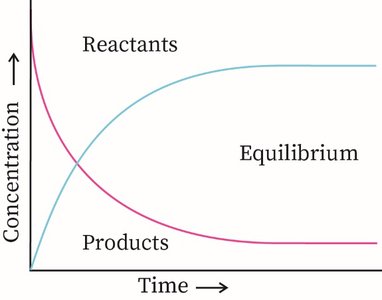
Additional info: The graph above illustrates how, over time, the concentration of reactants decreases while the concentration of products increases until both reach a plateau, indicating equilibrium.
Law of Mass Action and Equilibrium Constants
The Law of Mass Action provides the mathematical expression for the equilibrium constant (K) for a chemical reaction. For a general reaction:
The equilibrium constant in terms of concentration is:
For gas-phase reactions, the equilibrium constant can also be expressed in terms of partial pressures:
Pure solids and liquids are omitted from equilibrium expressions.
K > 1: Products are favored at equilibrium; K < 1: Reactants are favored.
Relationship Between and
For reactions involving gases, and are related by the equation:
is the change in moles of gas: (moles of gaseous products) – (moles of gaseous reactants).
When , .
Coupled Equilibria
Combining Equilibrium Reactions
Multiple equilibrium reactions can be combined to derive the equilibrium constant for a new reaction. The rules are:
If a reaction is reversed, use .
If a reaction is multiplied by a coefficient, raise to that power.
Multiply the values of the combined reactions to get the overall $K$.
Example: If two reactions are combined to yield a new reaction, the overall equilibrium constant is the product of the individual constants, adjusted for any reversals or multiplications.
Equilibrium Calculations
Using Equilibrium Concentrations
Given equilibrium concentrations, the equilibrium constant can be calculated using the Law of Mass Action. Conversely, if and some concentrations are known, unknown concentrations can be determined.
Always distinguish between initial and equilibrium concentrations.
Set up an ICE (Initial, Change, Equilibrium) table for systematic calculations.
Example: For , if M, M, M, M at equilibrium:
The Reaction Quotient ()
Predicting the Direction of Reaction
The reaction quotient () is calculated using the same expression as , but with current (not necessarily equilibrium) concentrations or pressures. Comparing $Q$ to $K$ predicts the direction the reaction will shift:
: Reaction shifts right (toward products).
: Reaction shifts left (toward reactants).
: System is at equilibrium.
Example: For , at 298 K. If M, M, M:
Since , the reaction will shift to the right.
Le Chatelier’s Principle
Response to Disturbances
Le Chatelier’s Principle states that if a system at equilibrium is disturbed, it will shift in the direction that counteracts the disturbance and re-establishes equilibrium. Disturbances include changes in concentration, pressure, volume, temperature, or the addition of inert substances or catalysts.
Change in concentration: Adding reactants or removing products shifts equilibrium toward products; the reverse shifts toward reactants.
Change in pressure/volume (gases): Decreasing volume (increasing pressure) shifts equilibrium toward the side with fewer moles of gas; increasing volume shifts toward more moles of gas.
Change in temperature: For exothermic reactions (), increasing temperature shifts equilibrium toward reactants; for endothermic reactions (), toward products.
Addition of inert substances: No effect on equilibrium position.
Addition of a catalyst: No effect on equilibrium position; only increases the rate at which equilibrium is achieved.

Additional info: The table above summarizes how different changes (e.g., decreasing pressure, temperature, adding inert gas, etc.) affect the direction of equilibrium shift for a sample reaction.
