 Back
BackChemical Equilibrium and Reaction Kinetics Study Guide
Study Guide - Smart Notes
 Tailored notes based on your materials, expanded with key definitions, examples, and context.
Q1. Write the expression for Kc for the following reactions:
Background
Topic: Chemical Equilibrium – Equilibrium Constant Expressions
This question tests your ability to write equilibrium constant expressions () for chemical reactions, distinguishing between reactants and products and recognizing which species are included in the expression.
Key Terms and Formulas:
= equilibrium constant in terms of concentration (mol/L)
Only aqueous and gaseous species are included in expressions; solids and pure liquids are omitted.
General formula:
Step-by-Step Guidance
For each reaction, identify which species are aqueous (aq), gaseous (g), or solid (s).
Write the equilibrium expression using only (aq) and (g) species, raising each to the power of its coefficient.
For part (a):
For part (b):
Try solving on your own before revealing the answer!
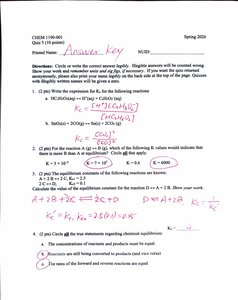
Q2. For the reaction A (g) \rightleftharpoons B (g), which of the following K values would indicate that there is more B than A at equilibrium?
Background
Topic: Interpreting Equilibrium Constants
This question tests your understanding of what the magnitude of the equilibrium constant () tells you about the relative concentrations of products and reactants at equilibrium.
Key Terms and Formulas:
for
If , products are favored (more B than A); if , reactants are favored (more A than B).
Step-by-Step Guidance
Write the equilibrium expression for the reaction: .
Compare the given values to 1 to determine which values indicate more B than A.
Circle all values greater than 1.
Try solving on your own before revealing the answer!
Q3. The equilibrium constants of the following reactions are known: A + 2 B \rightleftharpoons 2 C, ; 2 C \rightleftharpoons D, . Calculate the value of the equilibrium constant for the reaction D \rightleftharpoons A + 2 B.
Background
Topic: Manipulating Equilibrium Constants
This question tests your ability to combine and reverse chemical equations and their equilibrium constants to find the equilibrium constant for a new reaction.
Key Terms and Formulas:
When reversing a reaction, take the reciprocal of .
When adding reactions, multiply their values.
Step-by-Step Guidance
Write out the two given reactions and their values.
Reverse both reactions as needed to match the target reaction (D \rightleftharpoons A + 2 B).
Calculate the new by taking reciprocals and multiplying as appropriate.
Try solving on your own before revealing the answer!
Q4. Circle the true statements regarding chemical equilibrium:
Background
Topic: Chemical Equilibrium – Conceptual Understanding
This question tests your understanding of the characteristics of chemical equilibrium, including concentration, reaction rates, and dynamic nature.
Key Terms:
At equilibrium, the rates of the forward and reverse reactions are equal.
Concentrations of reactants and products are constant, but not necessarily equal.
Equilibrium is dynamic: reactants and products continue to interconvert.
Step-by-Step Guidance
Read each statement carefully and compare it to the definition of equilibrium.
Identify which statements are true based on your knowledge of equilibrium.
Circle the correct statements.
Try solving on your own before revealing the answer!
Q5. Which of the following statements about the reaction quotient, Q, is or are true? Circle all that apply.
Background
Topic: Reaction Quotient () vs. Equilibrium Constant ()
This question tests your understanding of the reaction quotient (), how it compares to the equilibrium constant (), and what their relative values indicate about the direction of a reaction.
Key Terms and Formulas:
is calculated the same way as , but with current concentrations.
If , the reaction will shift toward products to reach equilibrium.
If , the reaction will shift toward reactants.
Step-by-Step Guidance
Review the definition and calculation of .
Compare to and determine what happens when or .
Evaluate each statement and circle those that are true.
Try solving on your own before revealing the answer!
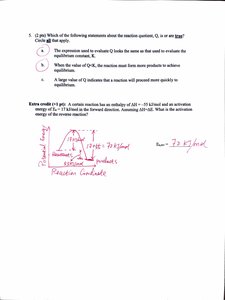
Extra Credit: A certain reaction has an enthalpy of kJ/mol and an activation energy of kJ/mol in the forward direction. Assuming (where is the reverse activation energy), what is the activation energy of the reverse reaction?
Background
Topic: Reaction Kinetics – Activation Energy and Enthalpy
This question tests your understanding of the relationship between activation energy, enthalpy change, and the energy profile of a reaction.
Key Terms and Formulas:
= change in enthalpy (difference between products and reactants)
= activation energy for the forward reaction
= activation energy for the reverse reaction
Relationship:
Step-by-Step Guidance
Write the relationship:
Plug in the given values for and .
Rearrange the equation to solve for (reverse activation energy).
Try solving on your own before revealing the answer!
