 Back
BackL23 Chemical Equilibrium and Reaction Mechanisms: Study Notes
Study Guide - Smart Notes
 Tailored notes based on your materials, expanded with key definitions, examples, and context.
Chemical Equilibrium and Reaction Mechanisms
Reaction Mechanisms
A reaction mechanism is a proposed sequence of elementary steps that describes how a chemical reaction occurs at the molecular level. Each step involves specific reactants and products, and the sum of all steps gives the overall reaction.
Elementary Steps: Simple reactions that occur in a single event or collision.
Intermediates: Species produced in one step and consumed in another; they do not appear in the overall reaction.
Catalysts: Substances that are consumed in an early step and regenerated in a later step; they speed up the reaction without being permanently changed.
Rate Law: Each elementary step has its own rate law, determined by the stoichiometry of the reactants in that step.
Example: In a two-step mechanism, a catalyst might be used in the first step and reformed in the second, while an intermediate is formed in the first step and consumed in the second.
Rate-Limiting Step and Energy Diagrams
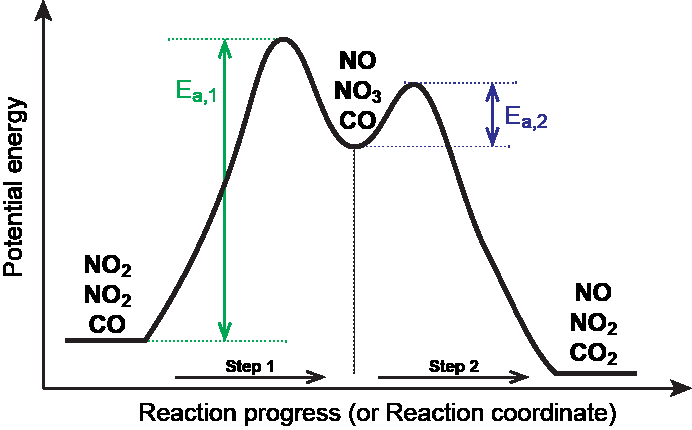
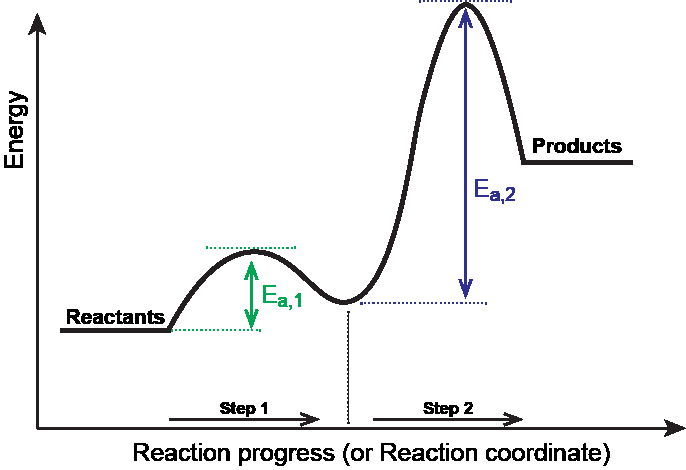
The rate-limiting step (or rate-determining step) is the slowest step in a multi-step reaction, characterized by the highest activation energy barrier. The overall reaction rate is governed by this step.
Activation Energy (Ea): The minimum energy required for a reaction to proceed.
Energy Profile: Multi-step reactions have multiple energy barriers, each corresponding to an elementary step.
Example: The energy diagram below shows two steps, each with its own activation energy. The step with the higher peak is the rate-limiting step.
Catalysis
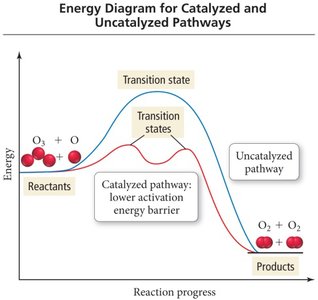
Catalysts increase the rate of a reaction by lowering the activation energy barrier. They are not consumed in the overall reaction and can be classified as:
Homogeneous Catalysts: Present in the same phase as the reactants (e.g., both in solution).
Heterogeneous Catalysts: Present in a different phase (e.g., solid catalyst with gaseous reactants).
Example: The energy diagram below compares catalyzed and uncatalyzed pathways, showing that the catalyzed pathway has a lower activation energy.
Chemical Equilibrium
Dynamic Equilibrium
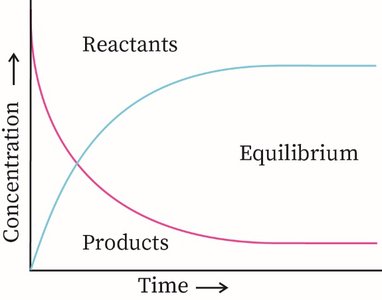
Many chemical reactions are reversible, meaning they can proceed in both forward and reverse directions. At equilibrium, the rates of the forward and reverse reactions are equal, and the concentrations of reactants and products remain constant over time. This is called dynamic equilibrium because reactions continue to occur at the molecular level, but there is no net change in macroscopic quantities.
Equilibrium Condition: Rate of forward reaction = Rate of reverse reaction
Notation: Equilibrium is indicated by a double arrow (⇌) in chemical equations.
Example: The graph below shows how reactant and product concentrations change over time, eventually reaching equilibrium.
The Law of Mass Action and Equilibrium Constants
The Law of Mass Action defines the equilibrium condition for a reaction. For a general reaction:
The equilibrium constant in terms of concentration (Kc) is:
Kc: Used for reactions in solution.
Kp: Used for reactions involving gases, based on partial pressures:
Both Kc and Kp are formally unitless, as concentrations and pressures are divided by standard values (1 M or 1 atm).
Heterogeneous Equilibria
For reactions involving solids or pure liquids, these phases are omitted from the equilibrium constant expression. Only concentrations or partial pressures of gases and solutes are included.
Example: For , only appears in the K expression.
Interpreting the Equilibrium Constant
The value of K indicates the relative amounts of products and reactants at equilibrium:
K > 1: Equilibrium favors products.
K < 1: Equilibrium favors reactants.
K >> 1: Almost all reactants are converted to products.
K << 1: Almost all products revert to reactants.
Note: K describes the equilibrium condition, not the speed of the reaction (kinetics).
Thermodynamics vs. Kinetics
While all chemical systems move toward equilibrium, the rate at which they do so depends on kinetics. The equilibrium position is determined by thermodynamics, but slow reactions may remain far from equilibrium for extended periods.
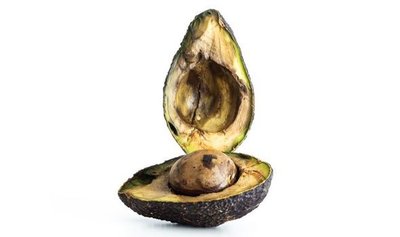
Example: An avocado exposed to air will eventually turn brown (reach equilibrium), but the process is slow, allowing it to remain green for hours.
Equilibrium Constants in Practice
For the reaction , if at 1073 K:
Interpretation: K < 1, so equilibrium favors reactants (higher partial pressure of H2S).
Expression:
Writing Equilibrium Constant Expressions
When writing K expressions, use Kc for solution-phase reactions and Kp for gas-phase reactions. Omit solids and pure liquids.
Example: For ,
Example: For ,
Summary Table: Types of Equilibrium Constants
Type | Expression | When Used |
|---|---|---|
Kc | Solution-phase reactions | |
Kp | Gas-phase reactions |
*Additional info: The notes include both kinetic and thermodynamic perspectives, emphasizing the distinction between reaction rate and equilibrium position. The avocado example illustrates slow kinetics, while the bridge analogy (not included as image due to lack of direct chemical relevance) is used to conceptualize dynamic equilibrium.*
