 Back
BackChemical Equilibrium and the Equilibrium Constant (Chapter 16, Part 1)
Study Guide - Smart Notes
 Tailored notes based on your materials, expanded with key definitions, examples, and context.
Chemical Equilibrium and the Equilibrium Constant
Introduction to Chemical Equilibrium
Chemical equilibrium is a fundamental concept in general chemistry, describing the state in which the rates of the forward and reverse reactions are equal, resulting in no net change in the concentrations of reactants and products. This chapter introduces the principles of dynamic equilibrium, the equilibrium constant, and their applications in chemical systems.
The Haber-Bosch Process and the Importance of Ammonia
Historical Context and Industrial Significance
The Haber-Bosch process revolutionized the production of ammonia (NH3), which is essential for fertilizers and explosives. In the late 1800s, ammonia was scarce, and wars were fought over natural sources such as guano deposits. The development of this process by Fritz Haber and Carl Bosch enabled the synthesis of ammonia from nitrogen and hydrogen gases using catalysts and high pressure, making large-scale production possible.
Ammonia is vital for agriculture and munitions.
Nickel catalysts lower the activation energy for both the decomposition and synthesis of ammonia, facilitating equilibrium.
Haber also contributed to chemical warfare by weaponizing chlorine gas during World War I.



Dynamic Equilibrium
Definition and Characteristics
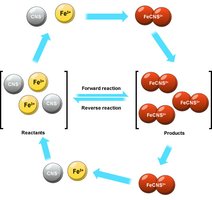
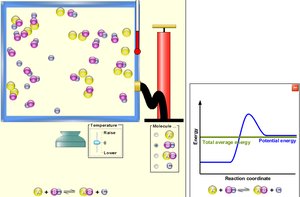
At dynamic equilibrium, the forward and reverse reactions occur at the same rate, so the concentrations of reactants and products remain constant over time. This does not mean the reactions have stopped, but rather that they are proceeding at equal rates in both directions.
Dynamic equilibrium is a hallmark of reversible reactions.
No net change in concentration of reactants or products at equilibrium.
The Equilibrium Constant (K)
Law of Mass Action and Expression of K
The equilibrium constant (K) quantifies the ratio of product concentrations to reactant concentrations at equilibrium, each raised to the power of their stoichiometric coefficients. For a general reaction:
aA + bB ↔ cC + dD
The equilibrium constant expression is:
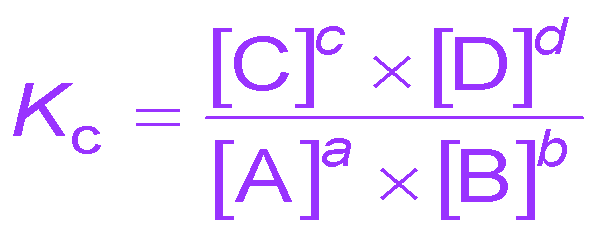
K is unitless and always written as products over reactants.
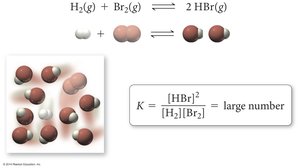
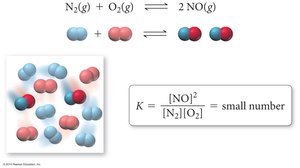
The magnitude of K indicates the relative amounts of products and reactants at equilibrium.
Interpreting the Value of K
If K >> 1: Products are favored at equilibrium (more products than reactants).
If K << 1: Reactants are favored at equilibrium (more reactants than products).
Manipulating Equilibrium Constants
Reversing and Scaling Reactions
The value of the equilibrium constant changes if the chemical equation is reversed or multiplied by a factor:
If a reaction is reversed, the new K is the reciprocal of the original K.
If the coefficients in a reaction are multiplied by n, the new K is the original K raised to the power n.
Example:
2 NO(g) ↔ N2O2(g):
NO(g) ↔ ½ N2O2(g):
Relationship:
Equilibrium in Multi-Step Reactions
Elementary Steps and Overall Reaction
Complex reactions may proceed through multiple elementary steps. The overall equilibrium constant is the product of the equilibrium constants for each step.
Example:
Step 1: NO2 + F2 → NO2F + F (slow)
Step 2: NO2 + F → NO2F (fast)
Overall: 2 NO2 + F2 → 2 NO2F
Equilibrium Constants for Reactions Involving Gases
Kc vs. Kp
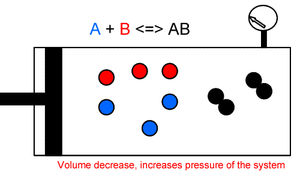
For gaseous reactions, the equilibrium constant can be expressed in terms of concentrations (Kc) or partial pressures (Kp):
R = gas constant (0.0821 L·atm/mol·K)
T = temperature in Kelvin
Δn = (moles of gaseous products) - (moles of gaseous reactants)
Heterogeneous Equilibria
Role of Solids and Liquids
In heterogeneous equilibria, only species in the gas or aqueous phase are included in the equilibrium constant expression. Pure solids and liquids do not appear in the expression because their concentrations are constant.
Example:
Fe2O3(s) + 3 H2(g) ↔ 2 Fe(s) + 3 H2O(l)
Kp expression: (only H2 is included)
Applications and Problem Solving
Calculating Equilibrium Constants
To calculate the equilibrium constant, substitute the equilibrium concentrations or partial pressures into the appropriate expression.
Example:
P4O10(s) ↔ P4(s) + 5 O2(g)
Given: [P4O10] = 2.000 mol, [P4] = 3.000 mol, [O2] = 4.000 M
Only O2 is included in K:
Comparing Kc and Kp
Kc and Kp are equal only when Δn = 0 (no change in the number of moles of gas between reactants and products).
Summary Table: Key Properties of Equilibrium Constants
Property | Description |
|---|---|
Expression | |
Unit | Unitless (derived from concentration or pressure ratios) |
Magnitude | K >> 1: products favored; K << 1: reactants favored |
Effect of Reversing | Kreverse = 1/K |
Effect of Multiplying Equation | Knew = Kn |
Heterogeneous Equilibria | Exclude solids and liquids from K |
Kp vs. Kc |
Visualizing Equilibrium
Conclusion
Understanding chemical equilibrium and the equilibrium constant is essential for predicting the outcome of chemical reactions, manipulating reaction conditions, and solving quantitative problems in chemistry. Mastery of these concepts provides a foundation for further study in chemical kinetics, thermodynamics, and advanced reaction mechanisms.
