 Back
BackChemical Equilibrium: Calculating Equilibrium Concentrations
Study Guide - Smart Notes
 Tailored notes based on your materials, expanded with key definitions, examples, and context.
Chemical Equilibrium
Definition and Dynamic Nature of Equilibrium
Chemical equilibrium occurs in a reversible reaction when the rates of the forward and reverse reactions become equal, resulting in no observable changes in the concentrations of reactants and products over time. At this point, the system is said to be at equilibrium, and the composition of the mixture remains constant unless disturbed by external factors.
Dynamic equilibrium: Both the forward and reverse reactions continue to occur, but at equal rates, so there is no net change in concentrations.
Equilibrium expression: The ratio of the concentrations of products to reactants, each raised to the power of their stoichiometric coefficients, is constant at a given temperature.
Reaction Quotient (Qc) and Equilibrium Constant (Kc)
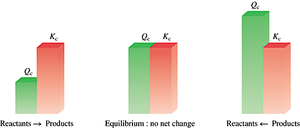
Comparing Qc and Kc
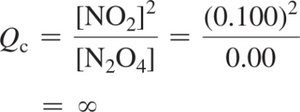
The reaction quotient (Qc) is calculated using the initial concentrations of reactants and products, while the equilibrium constant (Kc) uses equilibrium concentrations. Comparing Qc to Kc allows us to predict the direction in which a reaction will proceed to reach equilibrium.
If Qc < Kc: The reaction proceeds from left to right (reactants to products) to reach equilibrium.
If Qc = Kc: The system is at equilibrium; no net change occurs.
If Qc > Kc: The reaction proceeds from right to left (products to reactants) to reach equilibrium.
Calculating Equilibrium Concentrations
General Procedure
To determine equilibrium concentrations, follow these steps:
Express all equilibrium concentrations in terms of the initial concentrations and a variable (x) representing the change.
Write the equilibrium constant expression in terms of these variables.
Solve for x using the known value of Kc.
Calculate the equilibrium concentrations by substituting x back into the expressions.
This method is often summarized in an ICE table (Initial, Change, Equilibrium).
Worked Example: COF2 and CF4
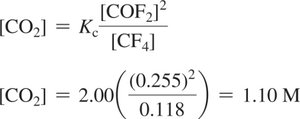
Given the equilibrium concentrations of COF2 and CF4, the equilibrium concentration of CO2 can be calculated using the equilibrium constant expression:
Substituting the values:
ICE Table Method
The ICE table is a systematic way to organize data for equilibrium calculations:
[N2O4] | [NO2] | |
|---|---|---|
Initial | 0.00 | 0.100 |
Change | +x | -2x |
Equilibrium | x | 0.100 - 2x |
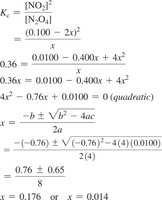
Solving for x Using the Quadratic Formula
When the equilibrium expression leads to a quadratic equation, use the quadratic formula:
Solving for x:
Example: Decomposition of H2S
For the reaction with at 800°C, and initial [H2S] = 0.0250 M, the ICE table is:
[H2S] | [H2] | [S2] | |
|---|---|---|---|
Initial | 0.0250 | 0.00 | 0.00 |
Change | -2x | +2x | +x |
Equilibrium | 0.0250 - 2x | 2x | x |
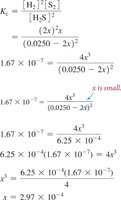
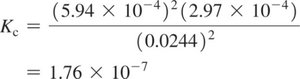
Solving for x and substituting back gives the equilibrium concentrations:
[H2S] = 0.0244 M
[H2] = 5.94 × 10⁻⁴ M
[S2] = 2.97 × 10⁻⁴ M
Summary Table: Predicting Reaction Direction Using Qc and Kc
Condition | Reaction Direction |
|---|---|
Qc < Kc | Proceeds forward (reactants → products) |
Qc = Kc | At equilibrium (no net change) |
Qc > Kc | Proceeds reverse (products → reactants) |
Key Concepts and Formulas
Equilibrium constant (Kc):
Reaction quotient (Qc): Same form as Kc, but uses initial concentrations.
ICE table: Organizes Initial, Change, and Equilibrium concentrations for systematic problem solving.
Quadratic formula: Used when equilibrium calculations yield a quadratic equation in x.
Practice Problems
Given initial concentrations and Kc, set up an ICE table and solve for equilibrium concentrations.
Calculate Qc and compare to Kc to predict the direction of the reaction.
Apply the quadratic formula when necessary to solve for x.
Additional info: The ICE table method is a universal approach for equilibrium calculations in general chemistry. When Kc is very small or very large, approximations may be used to simplify calculations, but always check the validity of the approximation (e.g., x is small compared to initial concentrations).
