 Back
BackLesson 7.1: Chemical Equilibrium: Dynamic Equilibrium and ICE Table Calculations (12 Chem)
Study Guide - Smart Notes
 Tailored notes based on your materials, expanded with key definitions, examples, and context.
Chemical Equilibrium
Introduction to Chemical Equilibrium
Chemical equilibrium occurs when the concentrations of reactants and products in a closed system remain constant over time. Unlike reactions that go to completion, many reactions reach a point where both forward and reverse reactions occur at equal rates, resulting in a dynamic equilibrium.
Chemical equilibrium: The state in which all reactants and products have constant concentrations in a closed system.
Dynamic equilibrium: A balance between forward and reverse processes occurring simultaneously at equal rates.
Closed system: A system where energy can transfer, but matter cannot enter or leave.
Equilibrium position: The relative concentrations of reactants and products at equilibrium.
Visual Evidence of Equilibrium
Some chemical reactions provide visual evidence of equilibrium. For example, the reaction between nitrogen dioxide gas (NO2(g)) and dinitrogen tetroxide gas (N2O4(g)) in a sealed chamber shows a change in color as equilibrium is approached. The brown color of NO2 decreases as it is converted to colorless N2O4, but never disappears completely, indicating equilibrium.
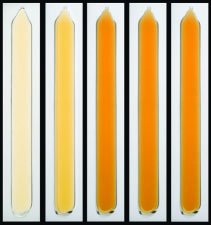
Dynamic Equilibrium Explained
Dynamic equilibrium is illustrated by the analogy of people moving between seats and concession stands at a sporting event. Although individuals move back and forth, the total number in each area remains constant. Similarly, in a chemical system, molecules continuously react in both directions, but the overall concentrations remain unchanged.
At equilibrium, the rates of the forward and reverse reactions are equal.
Reversible reactions are indicated by a double arrow (m) in chemical equations.
Reversible Reactions and Equilibrium Position
Reversible reactions can reach equilibrium from either the forward or reverse direction. The equilibrium position is the same regardless of the starting point, as demonstrated by experiments with N2O4(g) and NO2(g).
Experiment | Initial [N2O4] | Initial [NO2] | Final [N2O4] | Final [NO2] |
|---|---|---|---|---|
1 | 0.750 mol/L | 0 | 0.721 mol/L | 0.0580 mol/L |
2 | 0 | 1.50 mol/L | 0.721 mol/L | 0.0580 mol/L |
Additional info: The equilibrium concentrations are identical regardless of whether the system started with only reactant or only product, reflecting the stoichiometry of the reaction.
Stoichiometry and Chemical Equilibria
Stoichiometry allows prediction of concentration changes as a system approaches equilibrium. The coefficients in a balanced equation indicate the molar ratios of reactants and products. For example, in the synthesis of ammonia:
Balanced equation:
For every 1 mol of N2 consumed, 3 mol of H2 are consumed and 2 mol of NH3 are produced.
ICE Tables for Equilibrium Calculations
ICE tables are used to calculate equilibrium concentrations. ICE stands for Initial, Change, and Equilibrium:
I: Initial concentrations
C: Change in concentrations (based on stoichiometry)
E: Equilibrium concentrations
Example: For the reaction with initial concentrations of 2.00 mol/L for both reactants and an equilibrium concentration of 0.48 mol/L for F2:
H2(g) | F2(g) | HF(g) | |
|---|---|---|---|
I | 2.00 | 2.00 | 0 |
C | -x | -x | +2x |
E | 2.00-x | 2.00-x | 2x |
Solving for x:
Equilibrium concentrations:
[H2(g)] = 0.48 mol/L
[HF(g)] = 3.04 mol/L
Sample Problem: Decomposition of Ammonia
For the reaction with 4.0 mol NH3 in a 2.0 L container:
Initial [NH3] = 2.0 mol/L
At equilibrium, [NH3] = 1.0 mol/L
2NH3(g) | N2(g) | 3H2(g) | |
|---|---|---|---|
I | 2.0 | 0 | 0 |
C | -2x | +x | +3x |
E | 2.0-2x | x | 3x |
Solving for x:
Equilibrium concentrations:
[N2(g)] = 0.5 mol/L
[H2(g)] = 1.5 mol/L
Practice Problems
Use ICE tables to solve for equilibrium concentrations in various reactions, such as decomposition of dinitrogen tetroxide, nitrosyl chloride, and ethene with bromine.
Apply stoichiometry and equilibrium concepts to real-world and laboratory scenarios.
Summary of Key Concepts
Some reactions reach chemical equilibrium rather than completion.
Dynamic equilibrium involves equal rates of forward and reverse reactions.
Equilibrium position is independent of the starting direction.
ICE tables are essential for calculating equilibrium concentrations.
